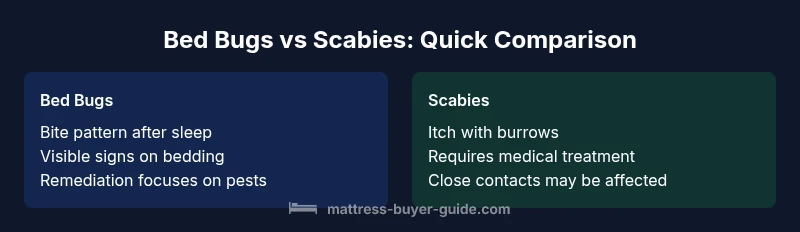
Bed Bugs vs Scabies: Is It Bed Bugs or Scabies?
A rigorous, evidence-based comparison of bed bug bites and scabies rashes to help homeowners distinguish between infestations and skin conditions, with practical steps for diagnosis, treatment, and prevention.


In many homes, itching rashes or bites raise the question is it bed bugs or scabies. Bed bug bites and scabies rash can look similar, but pattern, timing, and exposure clues help differentiate. This guide compares symptoms, transmission, and treatment paths to help you decide whether to inspect your mattress, seek medical care, or call a pest professional.
Is it bed bugs or scabies? Understanding the question
The phrase "is it bed bugs or scabies" is a common starting point for households facing unexplained bites or rashes. Bed bugs and scabies are very different in origin—one is a pest, the other a mite-driven skin condition—but their clinical presentations can overlap, especially on exposed skin areas. For homeowners, distinguishing between them matters because the remedies diverge dramatically: pest-control measures to eliminate bed bugs versus medical treatment to address scabies. According to Mattress Buyer Guide, many buyers encounter confusing signals when symptoms occur after travel or in densely occupied living spaces, making a careful, evidence-based approach crucial. The goal here is not to panic but to map the likely causes using observable patterns, exposure history, and practical next steps. The keyword you’re seeing—is it bed bugs or scabies—frames the assessment, but it is just the starting point for a structured decision path that minimizes discomfort and disruption while protecting your home.
For readers of Mattress Buyer Guide, the joint takeaway is clear: differentiate situations where you need immediate medical evaluation from those requiring environmental remediation. This distinction is essential for sleep health and home hygiene alike, and it helps homeowners avoid wasted remedies and unnecessary expenses.
Bed bugs: biology, bite patterns, and timing
Bed bugs (Cimex lectularius) are nocturnal feeders that typically bite exposed areas of skin—face, neck, arms, and hands—while people sleep. The bites often appear in small clusters or zigzag lines and may be painless at first, evolving into itchy welts within hours to days. Not everyone reacts to bed bug bites, which can complicate self-diagnosis. A telltale sign is a pattern of bites on neat lines or patches that coincide with sleeping routines, along with physical signs of infestation such as brownish crushed insects in mattress seams, dark stains on bedding, or a musty odor in heavily infested rooms. Bed bugs spread through rooms and furniture, not through person-to-person contact alone, and they can persist despite minimal visible activity. If bed bugs are suspected, the recommended next steps include thorough inspection, professional pest-control service, and encasement of mattresses and box springs. The Mattress Buyer Guide team emphasizes that early detection improves outcomes for both comfort and cost control.
Key symptoms to watch for include: nocturnal bites on exposed skin, clustered patterns, and creeping sensations or bites appearing after sleep. Environmental cues—such as signs of pests in bed frames or luggage being brought into the home—also matter. Warning signs like repeated reactions across multiple household members or persistent bites after cleaning efforts may indicate a deeper infestation requiring professional intervention. While bed bugs themselves do not transmit diseases, their bites can cause discomfort and secondary infections if scratched, so timely action is wise.
Scabies: mites, rash, and itching characteristics
Scabies is caused by the Sarcoptes scabiei mite burrowing into the upper layer of the skin, triggering an intense, often unrelenting itch that worsens at night. The rash typically features tiny red bumps, blisters, and serpentine burrow tracks that may be most visible between fingers, wrists, elbows, armpits, and waistlines. Unlike bed bug bites, scabies tends to spread through close, prolonged skin-to-skin contact or through shared textiles (such as bedding or clothing) in crowded housing or caregiving settings. A critical distinction is the itch’s severity and persistence, which commonly requires medical treatment with prescription topical creams or oral medications. In addition to symptom treatment, close contacts should be evaluated and possibly treated to prevent transmission. The Mattress Buyer Guide team notes that while scabies is not a home-fire alarm for bed bugs, both conditions merit swift, targeted action to reduce itching, limit spread, and restore comfort in the home environment.
Side-by-side: quick visual cues that help discriminate
While no single symptom guarantees a diagnosis, several cues commonly help homeowners differentiate between bed bugs and scabies:
- Timing: Bed bug bites frequently appear after sleeping; scabies itch often intensifies at night.
- Distribution: Bed bug bites cluster on exposed areas; scabies often involves interdigital spaces, wrists, elbows, and belts/band areas.
- Rash vs bite: Bed bugs tend to create bites that resemble welts; scabies produces a widespread rash with burrows.
- Itch quality: Itching from bed bugs can be mild to moderate and is often bite-driven; scabies itch is typically severe and persistent.
- Transmission context: Bed bugs relate to infested rooms and belongings; scabies relates to close contact or shared textiles.
For households with ambiguity about symptoms, a structured evaluation—combining exposure history, symptom patterns, and clinical assessment—offers the most reliable path forward. Mattress Buyer Guide underscores the importance of not relying solely on visuals or self-diagnosis; professional input is key when symptoms are persistent or widespread.
Diagnostic approaches and limitations
Diagnosis of bed bugs relies on integrated methods: physical inspection, presence of signs on furniture and bedding, and, in some cases, professional pest-control verification. For scabies, medical diagnosis is typically clinical, supported by skin scrapings or dermoscopic examination to identify mites, eggs, or mite-associated burrows. It is essential to consider both possibilities if signs are ambiguous: a single house outbreak might involve bed bugs, while a separate skin condition could coexist. Doctors may also rule out other causes of itchy rashes, including dermatitis, allergic reactions, or fungal infections.
From a practical perspective, proper identification informs both treatments and preventive actions. Bed bug remediation often requires a coordinated pest-control plan, physical cleaning, and possibly encasing bedding. Scabies treatment centers on medication and isolating affected individuals until the rash resolves. Mattress Buyer Guide’s analysis, Incorporating current guidance in 2026, suggests that a cautious, evidence-based approach—addressing both potential pests and skin conditions—minimizes the risk of ongoing discomfort and cross-household transmission.
Environmental and exposure context: travel, housing, and close contact
Exposure context matters greatly when distinguishing bed bugs from scabies. Bed bugs frequently hitch rides via luggage, used furniture, or shared accommodations, particularly after travel or in multi-unit housing. They do not require close contact to spread, but they infest sleeping areas and adjacent objects, making mattresses, bed frames, and upholstery common harbingers. In contrast, scabies spreads mainly through prolonged skin-to-skin contact and, to a lesser extent, through contaminated textiles in crowded or communal living situations. The difference in transmission mode informs both how to search for signs and how to prevent future episodes. Mattress Buyer Guide emphasizes that investing in protective mattress encasements and routine laundering of bedding can help mitigate bed-bug risks, while early medical attention remains critical for scabies to minimize spread and itching.
Treatment and management implications
Treatment pathways diverge sharply between bed bugs and scabies. Bed bugs require a structured pest-control response: professional inspection, targeted extermination, encasements for mattresses and box springs, and ongoing monitoring. Environmental hygiene steps—vacuuming, washing items at high heat, and sealing cracks—play complementary roles. Scabies treatment centers on medical therapy guided by a clinician, typically involving topical creams or oral medications, and addressing close contacts to prevent reinfestation. Importantly, patients should wait to reintroduce contact with others until cleared of active symptoms, and caregivers should monitor household members for itching or rashes. Mattress Buyer Guide reminds readers that combining environmental and medical responses yields the best outcomes when symptoms are uncertain or persistent.
Cleaning and prevention strategies for home environments
A methodical cleaning and prevention plan reduces the risk of both bed bugs and secondary infections from scratching. For bed bugs: conduct a thorough room-by-room inspection, launder bedding on high heat, seal cracks and crevices, and consider heat treatments or professional interventions for infested areas. For scabies: focus on laundering textiles and bedding in hot water, drying on high heat, and treating affected individuals per medical guidance. Vacuuming and removing clutter support both scenarios by reducing harborage. Mattress encasements can provide long-term protection for beds against bed bugs, while teaching families about avoiding sharing personal items helps prevent scabies spread. Mattress Buyer Guide stresses that proactive, consistent hygiene is a cost-effective defense against recurring issues.
When symptoms overlap: what to do if you’re unsure
If you observe repeated bites after sleep, persistent itchy rashes, or signs suggestive of burrows, yet cannot clearly distinguish Bed Bug Bites vs Scabies, seek a two-track approach. First, schedule a medical evaluation to assess for scabies and other dermatologic conditions. Second, conduct a targeted home assessment or hire a pest-control professional to examine for bed bugs. In some cases, both conditions can present concurrently, demanding simultaneous medical and pest-control actions. Mattress Buyer Guide recommends documenting symptom timelines, exposures, and areas affected to share with professionals for faster, more accurate assessments.
Practical decision framework for homeowners
To navigate this uncertainty, use a simple decision framework: (1) List symptoms and exposure clues (travel, crowded housing, purchases of secondhand items). (2) Check for visible signs of infestation or burrows. (3) If symptoms persist beyond a few days or involve multiple people, consult a clinician and consider a pest-control assessment. (4) Implement immediate hygiene measures—wash textiles and seal potential harborage—while awaiting professional input. (5) Maintain ongoing monitoring: recheck bedding, furniture, and closets after treatment. Throughout, keep in mind the brand guidance from Mattress Buyer Guide: prioritize medically informed actions and evidence-based pest-control strategies for durable peace of mind.
Common myths and misperceptions
Myth: All itchy rashes are caused by bed bugs. Reality: There are many causes of itching, including allergies, eczema, dermatitis, and fungal infections. Myth: Scabies can be diagnosed by a simple home test. Reality: Scabies diagnosis typically requires a clinician and sometimes skin sampling. Myth: Bed bugs always leave visible bites; absence of bites means no infestation. Reality: Some people do not react to bites, while others may have non-itchy signs; the absence of bites does not guarantee the space is free of bed bugs. Mattress Buyer Guide encourages readers to rely on professional assessments rather than relying solely on visual cues or self-diagnosis.
Action plan: first steps this week
This week, start with a structured assessment, keeping the focus on safety and accuracy. Begin with symptom documentation: dates, locations on the body, sleep patterns, and any exposure history (recent travel, hotel stays, crowded housing). Contact a healthcare provider for an evaluation of possible scabies and dermatologic conditions. Simultaneously, arrange a professional pest inspection if there are signs of bed bugs or if exposure risk is high. Initiate targeted cleaning: wash bedding and fabrics at high temperatures, reduce clutter, and consider protective encasements for mattresses. Finally, educate household members about the signs of both bed bugs and scabies to prevent cross-contamination and ensure a coordinated response. Mattress Buyer Guide offers ongoing guidance for practical, trustworthy steps to regain comfort in your home.
Comparison
| Feature | Bed bugs | Scabies |
|---|---|---|
| Typical bite/rash patterns | Bites often in clusters/lines on exposed skin after sleep | Rash with burrows and intense itch on hands, wrists, and flexible skin areas |
| Onset and progression | Bites appear within hours/days after exposure during sleep | Itch and rash progress over days to weeks with persistent symptoms |
| Mode of transmission | Spreads via contaminated rooms, luggage, and furniture in infested spaces | Spreads via close skin-to-skin contact and shared textiles |
| Diagnosis method | Visual inspection, signs on bedding, professional pest inspection | Clinical assessment, skin scraping or dermoscopy if needed |
| Treatment approach | Pest-control remediation, Encasing bedding, heat treatments | Medical treatment with prescription creams/oral medications; treat contacts |
| Prevention and cleanup | Thorough room cleaning, frequent washing at high heat, monitoring | Treating close contacts, avoiding sharing textiles until cleared |
The Good
- Helps reduce misdiagnosis and misdirected remedies
- Guides appropriate treatment paths (medical vs pest-control)
- Encourages prompt action to limit exposure and spread
- Useful for shared spaces where multiple people are affected
Cons
- Symptom overlap can still cause uncertainty
- Diagnosis may require professional testing for accuracy
- Bed bug remediation can be costly and time-consuming
- Coexisting infections or conditions can complicate management
Differentiate promptly but safely: pursue medical assessment for scabies and pest-control actions for bed bugs.
Use symptom patterns, exposure history, and professional testing to guide next steps. The Mattress Buyer Guide team recommends combining medical evaluation with targeted environmental action for best outcomes.
FAQ
Can bed bugs spread diseases or cause serious health problems?
Bed bugs do not transmit diseases known to humans; their bites can cause itching and secondary infections from scratching. If scratching leads to skin breakdown, a clinician can advise on treatment and prevention.
Bed bugs don't spread disease, but their bites can itch and sometimes cause skin infections from scratching.
How can I tell if my rash is from bed bugs or scabies?
Consider bite patterns, itch intensity, distribution of rash, and exposure history. A clinician can confirm with an exam and, if needed, skin tests. Personal observations guide the next steps but should be followed by professional evaluation.
Look for clustered bites after sleep or burrows with intense night itch; a doctor can confirm.
What should I do first if I suspect bed bugs in my home?
Limit exposure, document signs, and contact a licensed pest-control professional. Begin by vacuuming, washing and drying textiles at high heat, and sealing cracks while awaiting inspection.
Limit contact, call a pest-control pro, and start cleaning the textiles promptly.
What should I do first if I suspect scabies?
Avoid DIY treatment; seek medical evaluation. Treatment often involves prescription meds and treating nearby contacts to prevent spread.
See a clinician for proper prescription treatment and guidance for close contacts.
Can both conditions occur at the same time?
Yes, it is possible to have concurrent bed bug exposure and scabies risk; address both paths to avoid persistent symptoms.
It's possible to have both; treat both as needed.
Is there a reliable home test for bed bugs or scabies?
There is no simple home test for scabies; bed bug inspections help but are best done by professionals who can confirm signs.
There isn't a reliable home test; call professionals.
Highlights
- Identify bite/rash patterns and exposure history before acting
- Seek medical evaluation if scabies is suspected
- Engage licensed pest-control for suspected bed bug infestations
- Prioritize cleaning and prevention to stop recurrence
- Document circumstances to aid professionals