Box Mattress vs Traditional: A Practical Buying Guide
Compare box mattresses with traditional innerspring to decide which surface fits your sleep style, budget, and durability goals. Learn about construction, cooling, motion transfer, and long-term value.


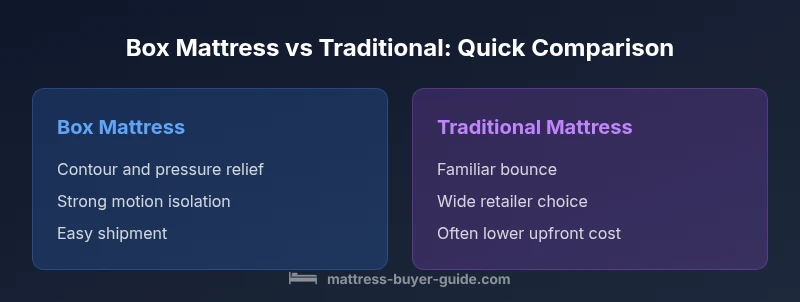
Box mattresses typically offer better pressure relief and motion isolation, plus easier setup, while traditional innerspring models often cost less upfront and feel familiar. The best choice depends on sleep position, budget, and durability goals.
Key distinctions between box mattresses and traditional innerspring
Box mattress vs traditional is a common crossroads for shoppers. The modern box mattress, often made with foam, latex, or springs inside a box, contrasts with a traditional innerspring that relies on a coil system and a separate foundation. According to Mattress Buyer Guide, these structural differences drive variations in support, heat, and setup experience. This section outlines how the terms box mattress and traditional innerspring relate to real-world sleep.
From a high-level perspective, the box mattress is usually shipped compressed in a box, which changes the initial feel and break-in period compared with a traditional bed that ships in a foundation and box spring. The Mattress Buyer Guide Team notes that consumer-friendly expectations—such as easier setup and quicker accommodation to your preferred sleeping position—often tilt recommendations toward box mattresses for mixed-sleepers and couples. Yet, traditional innerspring setups still attract buyers who value a time-tested bounce and broad retailer selection. Understanding these core differences helps you frame your priorities before testing options in-store or online.
In practice, think about how you sleep, how you move at night, and what you want from a surface in the long run. The goal is to map your needs to a construction that delivers comfort without compromising durability. For many shoppers, the right answer lies in a balanced assessment of contouring, edge support, and temperature management. Mattress Buyer Guide’s analysis signals that material density and core design can drastically influence both feel and longevity, so a methodical evaluation beats impulse purchases.
Construction and core design: what makes the two types distinct
When you compare box mattress vs traditional, the construction is the most obvious differentiator. Box mattresses commonly incorporate layers of foam (memory foam, polyurethane foam, or latex) or a hybrid layout with coils encapsulated inside the boxed unit. This design aims to deliver contouring, pressure relief, and a quieter, more uniform sleeping surface. In contrast, traditional innerspring mattresses rely on a network of metal coils with various gauges and coil counts, supported by a separate foundation or box spring. The overall feel tends to be firmer and more buoyant, with motion sometimes traveling across the surface more readily than with foam-based options. The choice between these constructions influences everything from weight distribution to heat dissipation and edge support, so it’s essential to test multiple prototypes to find the one that aligns with your priorities.
In this comparison journey, remember to consider how the base influences the top layer. A box mattress can be paired with a compatible foundation or platform, which may affect overall firmness and height. A traditional innerspring typically requires a sturdy box spring or platform as well, but the distribution of weight through the coils can be felt more directly. These nuances matter when selecting a bed frame, headboard height, and even your bed’s overall compatibility with sleep accessories like toppers or protectors. For readers of Mattress Buyer Guide, the practical takeaway is to link your comfort preferences with material science to predict long-term satisfaction.
Comfort and feel: contour, pressure relief, and motion isolation
The box mattress vs traditional comparison often turns on how the surface responds to your body. Box mattresses built with high-density foam or latex tend to offer superior contouring around the shoulders, hips, and lower back, which can significantly improve spinal alignment for many sleepers. This translate into enhanced pressure relief, particularly for side sleepers or those dealing with localized discomfort. Hybrid box mattresses—combining foam layers with pocketed coils—aim to blend contouring with some responsive bounce, reducing the sensation of “stuck” in the foam while still absorbing movement from a partner. Motion isolation is a key component of the box option, which makes it popular for couples who share a bed. If you are highly sensitive to motion, a well-engineered foam layer or a hybrid layout in a box mattress can reduce disturbances markedly.
Traditional innerspring mattresses tend to offer more bounce and a familiar “springy” feel. For some sleepers, this bounce translates into easy repositioning and a sense of airiness, especially with a thinner comfort layer or a traditional coil design. However, coil-based surfaces can transfer motion more readily, which might disturb a partner who moves at night. The durability of the top layers on traditional models can vary based on padding and foam quality, so it’s important to assess how the upper layers perform after several weeks of use. Mattress Buyer Guide emphasizes testing both feel categories—soft, medium, and firm—to identify the ideal balance of support and relief for your weight and sleep position.
In terms of temperature, foam-forward box mattresses can retain heat if they use dense foams without adequate airflow. However, many manufacturers now incorporate breathable covers, open-cell foams, or gel-infused components to improve cooling. Traditional innerspring surfaces often breathe well due to open coil architecture, though the presence of a heavy comfort layer can influence heat retention. If cooling is a priority, compare the materials and ventilation features rather than relying on the name alone. The right model should sustain comfort across the night without requiring uncomfortable adjustments.
Temperature regulation and breathability
A primary concern for sleepers choosing between box mattress vs traditional is how well the surface dissipates heat. Foam-based box mattresses can trap heat if the foam density is high and if the cover doesn’t promote airflow. Solutions include gel-infused foams, graphite particles, or latex layers that enhance breathability. For hot sleepers, a box mattress with a breathable cover and lighter foam layers often performs better than denser, older designs. In contrast, traditional innerspring mattresses leverage space between coils to promote airflow, which can help with cooling, though the exact performance depends on the comfort layer and padding. Look for models that explicitly advertise temperature regulation features and avoid overly memory-foam-heavy configurations if you tend to sleep hot.
When evaluating cooling, consider your bedroom environment as well. Room temperature, humidity, and bedding choices can influence how a mattress feels at night. If you share a bed, assess heat transfer alongside motion isolation to ensure you don’t wake up from your partner’s movements or from warmth buildup. Mattress Buyer Guide’s guidance suggests focusing on an integrated cooling strategy that includes not only the mattress but also bedding and room conditions to optimize sleep comfort over time.
Durability and longevity
Durability matters in box mattress vs traditional assessments because you want a surface that maintains comfort without frequent replacement. Foam and latex layers in box mattresses can be very durable when higher-density materials are used, and when encasements or edge supports are well designed. Hybrid box mattresses balance durability with contouring, but the longevity depends on the wear rating of the foam and the resilience of the transition layers. Traditional innerspring mattresses can be long-lasting if built with sturdy coils and quality padding; however, coil systems can develop noise and sag if not well-made or if the foundation degrades. Warranty length and coverage are good proxies for longevity expectations, but actual performance will depend on usage, body weight, and evolving sleep preferences. Mattress Buyer Guide recommends focusing on brand transparency, material density, and test cycles to gauge expected lifespan.
In practice, align your durability expectations with your budget. A higher upfront cost does not always guarantee longer life, and cheaper options can last as long if they use robust construction and a sensible design. A thorough test of the model under typical sleeping conditions and a clear understanding of the warranty terms can help set realistic expectations for how Box Mattress vs Traditional will perform over a decade of use.
Maintenance and care: rotation, flipping, and longevity
Care routines play a significant role in how box mattresses and traditional innersprings age. Box mattresses often require simple rotation or occasional flipping of a box-constructed unit to promote even wear; however, not all boxed designs are intended to be flipped, so it’s essential to follow the manufacturer’s guidance. Foam layers are prone to indentation if left unmoved for long periods, so rotating the mattress every few months during the first year can help maintain uniform surface feel. Stretching and maintaining the cover, using a breathable protector, and avoiding heavy or sharp objects on the surface can prolong performance.
Traditional innerspring mattresses may benefit from rotation as well, particularly if the surface has a heavier comfort layer on one side. Be mindful of the foundation or box spring because sagging foundations can accelerate wear and reduce support quality. Regular checks for squeaks or coil noise are prudent signals that a coil system may be degrading and require professional assessment or replacement of the foundation. The maintenance strategy should align with your sleeping habits and household activity to sustain support and comfort over time.
Sleep position and ergonomic considerations
Your sleep position dramatically influences the box mattress vs traditional decision. Side sleepers typically require good shoulder and hip pressure relief, which box mattresses with supportive foam layers or a well-designed hybrid can provide. Back sleepers may benefit from a more balanced contour with adequate lumbar support, which both construction families can deliver depending on the chosen firmness. Stomach sleepers often require firmer surfaces to prevent spinal sag; usually, a firmer traditional innerspring or a box mattress with a firmness target in the higher range can satisfy this need. In all cases, prioritize a tested firmness level and a return policy that allows sufficient time to trial the surface in your own bedroom.
A practical approach is to test multiple models in-store and take notes on how you feel after 15-20 minutes, as well as after a full night’s sleep. Reading independent reviews and using sleep trackers or comfort ratings can help quantify your experience. Mattress Buyer Guide emphasizes a structured evaluation plan—test, observe, and compare—before making a final selection. This methodical approach reduces risk and increases the likelihood of a satisfying long-term investment.
Price, value, and warranty considerations
Price is a major factor when choosing between box mattress vs traditional innerspring mattresses. Box mattresses can command higher upfront prices due to advanced foams, breathable fabrics, and hybrids; still, consumer-level options exist across a broad spectrum, with perceived value rising when durability and comfort align with price. Traditional innerspring mattresses often come with lower initial price points, greater brand variety, and easier access to financing or promotions. Warranty terms are a strong guide to long-term value; look for at least a 10-year warranty with reasonable coverage for comfort-layer degradation, coil breakdown, and manufacturing defects. Compare the total cost of ownership, including potential topper purchases for comfort customization, to determine the best long-term value. Mattress Buyer Guide notes that a comprehensive decision should weigh both upfront price and ongoing satisfaction.
How to test and compare at home
Testing options at home remains the most reliable way to separate box mattress vs traditional preferences. Start by setting the bed at your current preferred firmness and sleeping position. Spend at least two weeks with a chosen model, rotating if recommended, and monitor how your body feels upon waking. Use a sleep diary to track pain levels, stiffness, energy, and mood. If shopping online, take advantage of trial periods, clear return policies, and accessible customer service. A practical plan is to narrow choices to two or three candidates that share your preferred firmness, contouring, and cooling features, then test them in your own bedroom under typical conditions. The goal is to optimize comfort, support, and longevity within your budget, rather than chasing a flashy feature list.
Choosing a box mattress for specific sleepers
Different sleepers benefit from different configurations within the box mattress family. Side sleepers typically emphasize pressure relief at the shoulders and hips, so a medium-soft to medium feel with a supportive transition layer often works well. Stomach sleepers tend to need firmer surfaces to prevent spinal misalignment, so consider a box mattress with a firmer upper core or a traditional innerspring option on the firmer side. Back sleepers look for a balance of support and contour that keeps the spine aligned, so test several models with medium firmness and a robust support core. Couples should weigh motion isolation and durability, and may lean toward boxed hybrids that minimize partner disturbance while still offering solid support across the surface. Always verify compatibility with your bed frame and any toppers you plan to use to maximize comfort and longevity.
Common myths and misperceptions
A common myth is that all foam-based mattresses sleep hot or that all hybrids sleep cool. In reality, performance depends on density, airflow design, and cover materials. Another myth is that boxed mattresses are inherently low quality; in fact, many boxed designs use high-performance foams and carefully engineered hybrids that rival traditional options in support and durability. Some buyers assume that traditional innerspring always offers better edge support; this depends on coil gauge, edge reinforcement, and the surrounding padding. The truth is that both formats can be excellent choices if you match materials, firmness, and construction to your sleep profile. Mattress Buyer Guide encourages shoppers to test widely and inquire about density, airflow, and warranty specifics rather than rely on surface impressions.
Authority sources and how to research further
To support your decision, consider consulting external authorities. The U.S. Consumer Product Safety Commission provides guidelines on safe sleeping surfaces and product labeling, while reputable university-based sleep research centers offer insights into pressure relief and spinal alignment. Industry white papers from accredited publications discuss durability testing and long-term performance of foam and coil systems. For practical, consumer-focused guidance, you can reference academic summaries on mattress ergonomics and sleep health. Mattress Buyer Guide also aggregates consumer testing data and expert commentary to help you compare options with confidence.
Practical testing and quick-reference guidance
- Prioritize contouring and pressure relief if you sleep on your side.
- Favor stability and edge support for couples sharing a smaller bed frame.
- Consider a higher overall height if you plan to use a topper for customization.
- Look for clear warranty terms that cover material degradation and structural integrity.
- Test both box mattress and traditional models in store or using reputable online trial periods to ensure long-term compatibility with your sleep style.
comparisonTableSummaryBlocksREADMETopologyCommentaryExample: null
mainTopicQuery":"box mattress"],
comparisonTable":{"items":["Box mattress","Traditional mattress"],
rows":[{
feature":"Construction and core",
values":["Foam/latex or hybrid core, boxed and shipped compressed","Coiled springs with a separate foundation"]},{
feature":"Comfort and feel" ,
values":["Contour, pressure relief, and quieter operation","Bounce and a familiar feel; can be firmer"]},{
feature":"Motion isolation" ,
values":["Strong with well-designed foams; hybrids excel","Can transfer motion across coils"]},{
feature":"Temperature regulation" ,
values":["Open-cell foams and breathable covers improve cooling","Coil ventilation helps airflow but depends on padding"]},{
feature":"Durability and longevity" ,
values":["High-density foams and durable cores can last long","Coils with quality padding can endure with proper care"]},{
feature":"Price range" ,
values":["Mid to high depending on materials and density","Typically lower upfront costs, varies by brand"]},{
feature":"Best for" ,
values":["Side sleepers and those needing contour; good motion isolation","Budget buyers and fans of traditional bounce"]}]},
prosCons":{"pros":["Better contour and pressure relief","Excellent motion isolation for couples","More customization options and materials","Easier to ship and move"],
cons":["Potential heat retention with dense foams","Higher upfront costs for premium models","Variable durability based on materials and construction"]},
verdictBox":{"verdict":"Box mattress generally offers better pressure relief and motion isolation, while traditional innerspring shines on upfront cost and familiarity.","confidence":"high","summary":"For most sleepers, box mattresses deliver superior contouring and quiet operation, with strong motion isolation. Traditional innerspring remains appealing for budget-conscious buyers and those who value a familiar bounce. The Mattress Buyer Guide team recommends testing multiple configurations and prioritizing durability and cooling features to determine the best long-term value."},
keyTakeaways":["Prioritize contouring for side sleepers","Test edge support for couples","Consider durability and warranty over price alone","Choose a box mattress if heating is not a major concern, otherwise prioritize cooling features","Always use trial periods to validate comfort in real sleep conditions"],
faqSection":{"items":[{
question":"What is the core difference between box mattresses and traditional innerspring?","questionShort":"Core difference","answer":"Box mattresses house the top layers in a boxed unit, often using foam or latex, delivering contouring and quiet operation. Traditional innerspring relies on coils with a separate foundation, offering more bounce. The choice depends on your priorities for feel, support, and setup.","voiceAnswer":"Box mattresses have the top layers inside a box for easy shipping and contouring; traditional innerspring uses coils, which feels springier. Test both to see which suits you best.","priority":"high"},{"question":"Which is better for side sleepers?","questionShort":"Side sleepers?","answer":"Side sleepers typically benefit from good shoulder and hip pressure relief, which box mattresses often provide through contouring foams or hybrids. Ensure the model you choose has the right firmness level and breathable materials.","voiceAnswer":"Side sleepers usually prefer asleep surface that contours well at the shoulders and hips. Look for a medium feel with quality foam or a supportive hybrid.","priority":"high"},{"question":"Do box mattresses sleep hot?","questionShort":"Sleep hot?","answer":"Foam-heavy box mattresses can sleep warm if the materials trap heat, but many modern designs include breathable covers and cooling foams. If heat is a concern, prioritize models with open-cell foams and good airflow.","voiceAnswer":"If you sleep hot, look for foam density and cooling features like gel or open-cell foam.","priority":"medium"},{"question":"Can you flip a box mattress?","questionShort":"Flipable?","answer":"Most box mattresses are not designed to be flipped, but many benefit from periodic rotation to promote even wear. Always follow the manufacturer’s care instructions.","voiceAnswer":"Many boxes aren’t flip-friendly, but rotating periodically helps even wear.","priority":"medium"},{"question":"What warranty should I expect?","questionShort":"Warranty?","answer":"Look for a warranty that covers at least several years of structural and comfort-layer integrity, with clear terms for defects and sagging. Warranty length varies by brand and model.","voiceAnswer":"Check the warranty length and what it covers in terms of dents, sagging, and material defects.","priority":"medium"}]},
mediaPipeline":{"heroTask":{"stockQuery":"box mattress in modern bedroom setting","overlayTitle":"Box vs Traditional","badgeText":"2026 Guide","overlayTheme":"dark"},"infographicTask":{"type":"comparison","htmlContent":"<div class="w-[800px] p-8 bg-slate-900 text-white"><h3 class="text-2xl font-bold text-center mb-6">Box vs Traditional: Quick Comparison</h3><div class="grid grid-cols-2 gap-6"><div class="p-6 bg-blue-500/20 rounded-xl"><h4 class="text-xl font-bold">Box Mattress</h4><ul class="space-y-2"><li>Contouring comfort</li><li>Strong motion isolation</li><li>Typically easier to ship</li></ul></div><div class="p-6 bg-purple-500/20 rounded-xl"><h4 class="text-xl font-bold">Traditional Mattress</h4><ul class="space-y-2"><li>Familiar bounce</li><li>Wide retailer choice</li><li>Lower upfront cost common</li></ul></div></div></div>","altText":"Box mattress vs traditional infographic","caption":"A quick visual compare: box mattress vs traditional innerspring"}},
taxonomy":{"categorySlug":"buying-guide","tagSlugs":["box-spring","memory-foam","longevity","price","mattress"]}},
Comparison
| Feature | Box mattress | Traditional mattress |
|---|---|---|
| Construction and core | Foam/latex or hybrid core, boxed and shipped compressed | Coiled springs with a separate foundation |
| Comfort and feel | Contour, pressure relief, and quieter operation | Bounce and a familiar feel; can be firmer |
| Motion isolation | Strong with well-designed foams; hybrids excel | Can transfer motion across coils |
| Temperature regulation | Open-cell foams and breathable covers improve cooling | Coil ventilation helps airflow but depends on padding |
| Durability and longevity | High-density foams and durable cores can last long | Coils with quality padding can endure with proper care |
| Price range | Mid to high depending on materials and density | Typically lower upfront costs, varies by brand |
| Best for | Side sleepers and those needing contour; good motion isolation | Budget buyers and fans of traditional bounce |
The Good
- Better contour and pressure relief
- Excellent motion isolation for couples
- More customization options and materials
- Easier to ship and move
Cons
- Potential heat retention with dense foams
- Higher upfront costs for premium models
- Variable durability based on materials and construction
Box mattress generally offers better pressure relief and motion isolation, while traditional innerspring shines on upfront cost and familiarity.
For most sleepers, box mattresses deliver superior contouring and quiet operation, with strong motion isolation. Traditional innerspring remains appealing for budget-conscious buyers and those who value a familiar bounce. The Mattress Buyer Guide team recommends testing multiple configurations and prioritizing durability and cooling features to determine the best long-term value.
FAQ
What is the core difference between box mattresses and traditional innerspring?
Box mattresses house the top layers in a boxed unit, often using foam or latex, delivering contouring and quiet operation. Traditional innerspring relies on coils with a separate foundation, offering more bounce. The choice depends on your priorities for feel, support, and setup.
Box mattresses have the top layers inside a box for easy shipping and contouring; traditional innerspring uses coils, which feels springier. Test both to see which suits you best.
Which is better for side sleepers?
Side sleepers typically benefit from good shoulder and hip pressure relief, which box mattresses often provide through contouring foams or hybrids. Ensure the model you choose has the right firmness level and breathable materials.
Side sleepers usually prefer a surface that contours well at the shoulders and hips. Look for a medium feel with quality foam or a supportive hybrid.
Do box mattresses sleep hot?
Foam-heavy box mattresses can sleep warm if the materials trap heat, but many modern designs include breathable covers and cooling foams. If heat is a concern, prioritize models with open-cell foams and good airflow.
If you sleep hot, look for foam density and cooling features like gel or open-cell foam.
Can you flip a box mattress?
Most box mattresses are not designed to be flipped, but many benefit from periodic rotation to promote even wear. Always follow the manufacturer’s care instructions.
Many boxes aren’t flip-friendly, but rotating periodically helps even wear.
What warranty should I expect?
Look for a warranty that covers at least several years of structural and comfort-layer integrity, with clear terms for defects and sagging. Warranty length varies by brand and model.
Check the warranty length and what it covers in terms of dents, sagging, and material defects.
Highlights
- Prioritize contouring for side sleepers
- Test edge support for couples
- Consider durability and warranty over price alone
- Choose a box mattress if cooling is acceptable but seek cooling features if heat is a concern
- Use trial periods to validate comfort in real sleep conditions