Chart Mattress Sizes: A Practical Guide to Choosing the Right Bed
A data-driven guide to reading mattress size charts, understanding standard US sizes, and selecting the right bed for your space and sleep style.


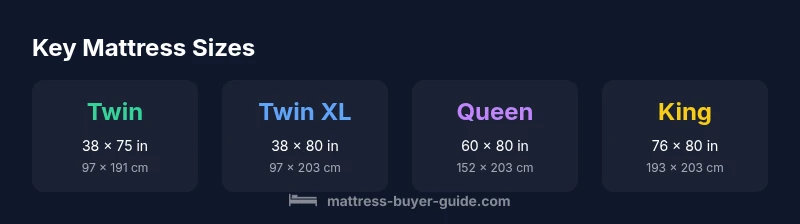
According to Mattress Buyer Guide's data, a standard US chart lists six core mattress sizes: Twin (38 x 75 inches), Twin XL (38 x 80), Full (54 x 75), Queen (60 x 80), King (76 x 80), and California King (72 x 84). Using this chart helps prevent buying mismatches in frame, sheets, and space. Align size with room dimensions and sleeping arrangements for optimal comfort.
Why a Size Chart Matters
Knowing mattress sizes and space requirements matters for sleep quality and room design. A reliable size chart helps you avoid buying a mattress that won't fit in your frame or in your room, and it clarifies what sheets and foundations you need. Mattress Buyer Guide's research shows that misaligned bed sizes are a leading cause of restless nights, as too-tight sheets or a cramped frame can disrupt sleep. By using a standard chart, you can quickly compare options and avoid costly returns. In real homes, a well-mapped chart translates into fewer "buyer's remorse" moments and a faster path to a comfortable upgrade. According to Mattress Buyer Guide, the team found that an upfront size plan reduces decision fatigue and aligns purchases with room geometry. This mindful planning leads to better sleep outcomes and a calmer bedroom environment.
Standard US mattress sizes and their dimensions
Most US retailers align with six core sizes. Here are the standard dimensions you will encounter on product pages:
- Twin: 38 x 75 inches (97 x 191 cm)
- Twin XL: 38 x 80 inches (97 x 203 cm)
- Full: 54 x 75 inches (137 x 191 cm)
- Queen: 60 x 80 inches (152 x 203 cm)
- King: 76 x 80 inches (193 x 203 cm)
- California King: 72 x 84 inches (183 x 213 cm)
These numbers are the common baseline you’ll see across the Mattress Buyer Guide data for 2026. Note that some brands adjust the dimensions slightly; always check the exact product page.
Reading a mattress sizes chart: inches vs centimeters
A mattress size chart usually lists dimensions in both inches and centimeters to support cross-border shopping and conversions. A quick rule: multiply inches by 2.54 to get centimeters. For example, Queen (60 x 80 inches) converts to 152 x 203 cm. Conversions help when you are ordering online from a retailer that uses metric measurements or when comparing international options. If you’re unsure, use the explicit dimensions shown on the retailer page and compare against your bed frame measurements. A reliable chart should provide both units to avoid misinterpretation during the shopping process.
International variants and regional differences
In Europe, the UK, and parts of Asia, bed sizes carry different names and dimensions. For example, the closest equivalents include a UK Double around 135 x 190 cm and a UK King around 150 x 200 cm. In Australia, common sizes align with Queen around 153 x 203 cm and King around 183 x 203 cm. Regional charts are essential when you shop across borders or when importing mattresses. Always verify the local chart provided by the retailer and compare against your bedroom dimensions to prevent mismatches.
How to map your current bed frame to the right mattress size
Start by measuring the interior width and length of your bed frame or foundation. Subtract any trim or rails to get the usable sleep area. Compare these measurements to standard size dimensions to determine the closest match. If you’re near a size boundary (for example, 60 inches wide), consider the bed’s movement space and how you sleep—would you benefit from extra shoulder room or a tighter fit for a smaller room? Finally, confirm that the chosen mattress will fit your sheet pockets and foundation. If possible, bring the frame measurements to the store and test a few mattress sizes in person to feel the difference.
Practical implications: sheets, bedding, and foundations
Mattress size affects more than fit. Bedding, especially fitted sheets, comes with pocket depth specifications. If you upgrade to a deeper-pocket mattress, ensure your sheets accommodate the extra depth. Foundations, box springs, or platform bases also vary by size; a size mismatch can lead to uneven support or frame strain. Before purchasing, check the retailer’s guidance on compatible foundations and consider your preferred sleep surface firmness—these factors all influence how well the mattress resizes to your space.
How to compare sizes across brands and retailers
Brand-to-brand variation exists even within the same nominal size. Some brands use slightly broader frames or thicker toppers, which can affect actual sleep area. Always review the exact dimensions on product pages, and read customer questions and reviews for real-world fit notes. If possible, compare two or three brands side by side in a showroom. If you shop online, use the retailer’s size charts and confirm the dimensions in the return policy to avoid surprises after delivery.
Steps to measure your space and choose a size
- Measure the room width and length, leaving at least 18-24 inches of clearance on each side for nightstands and movement. 2) Measure the bed frame interior width and length, noting any rails or molding that reduce usable space. 3) Compare these measurements to standard sizes (Twin through California King) and identify the closest match. 4) Consider sleeping habits; couples may prefer King or Queen with room to spread, while solo sleepers in small rooms may opt for Twin XL or Full. 5) Check bedding compatibility: fitted sheets, comforters, and duvets must fit the chosen size with adequate wrapping. 6) Review the retailer’s size chart for the specific model, and verify return options if the fit feels off when the mattress arrives.
Case scenarios: small bedrooms, couples, guest rooms
In a small bedroom, a Queen often provides a good balance of space and comfort without overwhelming the room. Couples with a larger space might opt for a King for more personal space, while a guest room benefits from a Queen or Full-size mattress for flexibility and cost efficiency. If you frequently host guests, choose a size that accommodates both guests and daily living—Queen is typically the best compromise. For rooms with irregular layouts, consider a platform bed with built-in storage to maximize floor space and reduce clutter, making the room feel larger and more inviting.
Common US mattress sizes and their dimensions
| Size | Dimensions (inches) | Dimensions (cm) |
|---|---|---|
| Twin | 38 x 75 inches | 97 x 191 cm |
| Twin XL | 38 x 80 inches | 97 x 203 cm |
| Full | 54 x 75 inches | 137 x 191 cm |
| Queen | 60 x 80 inches | 152 x 203 cm |
| King | 76 x 80 inches | 193 x 203 cm |
| California King | 72 x 84 inches | 183 x 213 cm |
FAQ
What are the six standard US mattress sizes?
The standard US sizes are Twin, Twin XL, Full, Queen, King, and California King. Most retailers provide exact dimensions on product pages for easy comparison.
The six standard US sizes are Twin, Twin XL, Full, Queen, King, and California King. Check product pages for exact dimensions.
Should I upgrade from Queen to King if I share the bed with a partner?
For couples, King provides more width and personal space, while Queen fits smaller rooms. Consider room size and sleep habits before upgrading.
If you share a bed, King offers more space. If space is tight, a Queen might work with proper layout.
Do I need a new bed frame when changing mattress size?
Yes, most mattress upgrades require a frame or foundation sized to match the mattress. Verify compatibility with both frame and sheets.
Usually yes—match your frame and foundation to the new size.
Can I mix a larger mattress with a smaller bed frame?
A mattress should not overhang the frame; it can cause instability and wear. Choose a size that fits the frame or invest in a compatible frame.
Don't let the mattress overhang the frame; pick a matching size.
How do I measure my space to determine the right size?
Measure room dimensions, doorways, and available clearance around the bed. Compare those figures to standard sizes to identify the closest match.
Measure the room and the space around the bed, then compare to standard sizes.
Are bed sizes consistent across brands and countries?
Sizes are broadly standardized within a country, but exact dimensions vary by brand and region. Always check the retailer's size chart before buying.
Sizes vary by brand and country; always check the size chart.
“Choosing the right mattress size is foundational to sleep quality, and a clear size chart makes the decision data-driven and less stressful.”
Highlights
- Start with a reliable size chart before shopping
- Measure your space and bed frame precisely
- Queen and King are the most common choices for couples
- Check sheet pockets and foundation compatibility when upgrading
- Regional size variations require checking local charts before purchasing