Hybrid Mattress vs Gel Memory Foam: An Objective Comparison
A thorough, evidence-based comparison of hybrid mattresses and gel memory foam, highlighting comfort, cooling, durability, and value to help homeowners choose the right mattress for better sleep.


Hybrid mattresses and gel memory foam each offer distinct feel and performance. In this comparison, hybrids excel in support and bounce, while gel memory foam emphasizes contouring and motion isolation. For most sleepers, hybrid mattress vs gel memory foam should be chosen based on how you prioritize edge support, temperature, and overall durability. Mattress Buyer Guide's analysis highlights practical trade-offs and the best use cases for each option.
Hybrid Mattress vs Gel Memory Foam: What Sets Them Apart
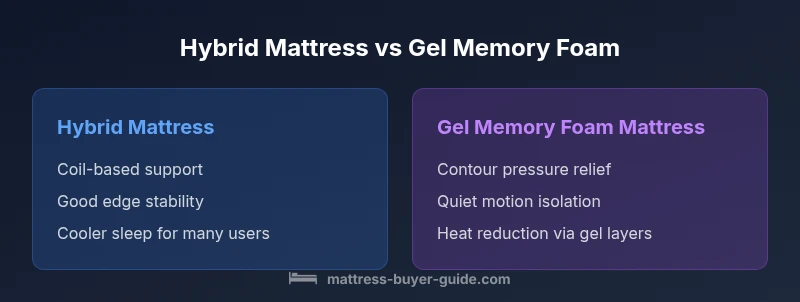
In the world of mattresses, the phrase hybrid mattress vs gel memory foam describes two fundamentally different constructions designed to deliver distinct sleep experiences. A hybrid typically combines pocketed coils with one or more comfort layers of foam, often including a cooling gel component. Gel memory foam, by contrast, uses a high-density memory foam core infused with cooling gel beads or a gel layer to help reduce heat buildup. According to Mattress Buyer Guide, the core distinction is structural: a hybrid relies on a coil system for lift and support, while a gel memory foam mattress relies on foam layers to provide contouring and pressure relief. The end result is a mattress that feels springy and supportive in hybrids, versus a mattress that feels deeply cushioned and body-conforming in gel memory foam designs. For many shoppers, the decision hinges on how you value responsiveness, sinkage, and motion transfer, as well as your tolerance for potential heat retention. The hybrid option usually shines for combination sleepers who move frequently, or couples who want robust edge support, while gel memory foam excels for those who prioritize pressure relief and a snug, minimizing motion transfer. This section will unpack these differences and set the stage for a practical, data-informed choice.
Comparison
| Feature | Hybrid mattress | Gel memory foam mattress |
|---|---|---|
| Comfort feel | Bounce and lift from coils with a supportive foam top layer | Soft, contouring feel with pronounced body-hugging from memory foam |
| Support structure | Pocketed coil system with zoned support in many models | Solid foam core augmented by gel-infused memory foam layers |
| Pressure relief | Good to excellent relief depending on foam depth and coil design | Strong relief due to targeted contouring from memory foam |
| Temperature regulation | Cooler overall due to airflow through coils | Can sleep warmer if foam layers trap heat, though gel aims to mitigate this |
| Durability | Long-lasting coil systems with resilient foams; edge support varies by model | Foam fatigue can occur; higher density foams resist sag but still depend on construction |
| Motion isolation | Moderate motion transfer due to coils, often mitigated by quilted covers | Excellent motion isolation due to slow, viscous foam layers |
| Edge support | Strong edge support in many hybrid designs with reinforced perimeters | Typically weaker edge support than hybrids unless a high-density foam edge is used |
| Ideal sleep position | Combination sleepers who value bounce and easy mobility | Side and back sleepers who want pressure relief and a snug contour |
| Price range | Mid-to-high price range depending on coil quality and foam stack | Mid-range to mid-high depending on foam density and gel integration |
The Good
- Hybrid advantages: strong edge support and durable coil systems
- Gel memory foam advantages: superb pressure relief and quiet, motion-damping performance
- Both can offer long-term value with proper care and rotation
Cons
- Hybrids can be heavier and more difficult to move or rotate
- Gel memory foam can sleep hot for some users unless cooling features are robust
- Edge support and durability depend heavily on construction quality and the foam/coil mix
Hybrid mattresses generally offer a better balance of support, bounce, and cooling, while gel memory foam mattresses excel at contouring and pressure relief; choose based on your priorities for mobility versus conformity.
If you value responsiveness and edge support for couples, pick a hybrid. If you prioritize deep pressure relief and quiet, body-hugging comfort, gel memory foam is usually the better choice.
FAQ
Which is better for back pain: hybrid mattress or gel memory foam?
Back pain sufferers often benefit from the combination of support and conforming pressure relief. Hybrids with zoned coils can support the spine while gel memory foam layers offer relief at hips and shoulders. Mattress Buyer Guide recommends trying both to see which alignment feels best for your unique curvature.
For back pain, try both options. Hybrids provide support and edge stability, while gel memory foam helps cradle the body. A trial period is essential to confirm personal comfort.
Do hybrids sleep cooler than gel memory foam mattresses?
In general, hybrids sleep cooler due to air channels in the coil core that promote airflow. Gel memory foam may be warmer unless the model includes advanced cooling features. Mattress Buyer Guide notes that cooling performance varies by model and cover design.
Yes, hybrids usually sleep cooler because of the coil layer, but check the specific model’s cooling tech.
Which lasts longer: hybrid or gel memory foam?
Durability depends on materials and build quality. Hybrids with quality coils tend to maintain support longer, while dense memory foam layers in quality foams can resist sag. Regular rotation and support from a stable foundation extend lifespan for both.
Both can last many years with proper foundation and rotation; hybrids often edge out in durability when coil quality is high.
Is gel memory foam safe for sensitive sleepers?
Gel memory foam uses standard off-gassing practices and is generally considered safe when certified. Look for CertiPUR-US or equivalent certifications. Always provide proper room ventilation during initial use.
Most gel memory foams are safe, but check certifications and ventilate your room after unboxing.
What should I test when shopping for a hybrid or gel memory foam?
Test for alignment, firmness, edge support, motion transfer, and cooling. Use a sleep trial to assess comfort over several nights and in different sleeping positions.
Test alignment, support, motion, and cooling during a trial period to see what works for you.
Can I use a gel memory foam topper on a hybrid to improve cooling?
Adding a gel memory foam topper can alter feel and cooling characteristics of a hybrid, often enhancing contouring and heat dissipation. Ensure the topper doesn’t interfere with the intended support of the coil system.
Yes, a gel topper can boost cooling and contouring, but verify compatibility with your base mattress.
Highlights
- Assess your sleep posture to match feel: bounce vs contour
- Consider cooling features beyond gel: breathable covers and coil design
- Budget for durability: coil systems often outlast foam in the long term
- Test both types in-store or via trial periods with attention to motion transfer
- Hybrid vs gel memory foam: pick based on preferred sleep feel and heat sensitivity