Hybrid Mattress vs Innerspring: An Analytical Buying Guide
Analytical side-by-side guide comparing hybrid and innerspring mattresses across construction, comfort, durability, temperature, price, and sleeper suitability to help you choose with confidence.


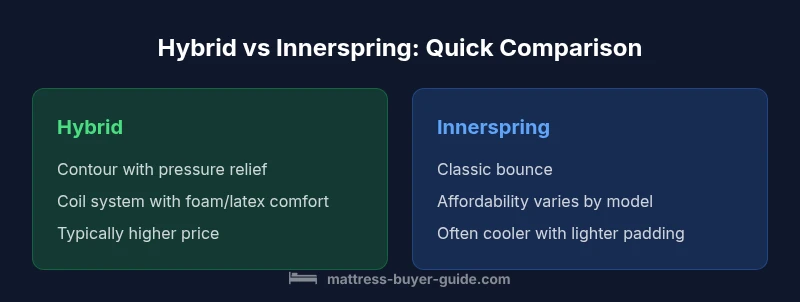
When weighing a hybrid mattress vs innerspring, hybrids generally deliver a better balance of contouring comfort and coil support, with strong motion isolation and cooling potential. Innerspring designs tend to offer traditional bounce and lower upfront costs, appealing to budget-minded shoppers. For most sleepers, the hybrid wins on comfort and durability, while innerspring remains a solid choice for those prioritizing price and simplicity.
What hybrid mattress vs innerspring means
A hybrid mattress blends multiple comfort layers—such as foam, latex, or other padding—with a pocketed coil core. An innerspring mattress relies primarily on a coil-based foundation with padding on top, often lacking a robust integrated comfort system. According to Mattress Buyer Guide, hybrid designs aim to combine the contouring feel of foam with the lift and durability of coils. The Mattress Buyer Guide team emphasizes that the best choice hinges on sleep style, body weight, heat sensitivity, and budget, rather than marketing hype alone.
Construction and feel: hybrid vs innerspring
Construction is the key differentiator here. Hybrids typically feature a thicker comfort stack (foam or latex) atop a pocketed-coil system that provides targeted support and reduced motion transfer. Innersprings use interconnected or open-coil designs with a thinner top layer. Mattress Buyer Guide Analysis, 2026 notes that pocketed coils tend to isolate motion better than traditional open-coil systems, while a well-cushioned top can deliver noticeable pressure relief. Expect hybrids to feel more contouring, whereas innersprings often feel more buoyant and responsive.
Support, durability, and temperature management
Support in hybrid models rests on a combination of coil symmetry and high-quality foams that reduce sag under heavier parts of the body. Durability hinges on coil quality, foam density, and edge reinforcement. In contrast, innerspring mattresses rely on coil strength and padding; durability varies widely with coil type and quality. Temperature management tends to favor hybrids when manufacturers use breathable foams or latex and design for coil airflow. The Mattress Buyer Guide Team notes that cooling performance depends heavily on materials and airflow—hybrids can outperform traditional innersprings when well designed.
Pressure relief and motion isolation
Pressure relief comes primarily from the top comfort layers in hybrids, which can adapt to sleepers’ shapes without sacrificing support. Motion isolation is typically stronger in hybrids due to the combination of foam and pocketed coils, meaning less partner disturbance. Innersprings can transfer more motion, especially if they rely on simpler coil systems, though higher-end models with zoned coils and plush top layers can improve isolation. For couples and light sleepers, hybrids often offer a more stable, sleep-promoting surface.
Height, weight range compatibility and edge support
Many hybrids are built with thicker profiles to accommodate multiple comfort layers, which helps heavier sleepers and different sleeping positions, but can feel too plush for some. Innerspring options vary widely in height and construction; cheaper models may feel firmer and offer less pronounced edge support, while premium models with reinforced edges perform better. Edge support matters for people who sleep near the bed edge and for those who sit on the edge during nighttime routines.
Price and value considerations
Price is a major differentiator. Hybrids generally sit in the mid-to-high price range due to their material stack and coil quality, whereas innersprings span a broader spectrum from budget to premium. Value depends on build quality, including the density of foams, type of coils, and any cooling features. Mattress Buyer Guide notes that the best value often comes from choosing a model with durable foams and high-quality coils that match your sleep needs, rather than chasing the lowest price.
Who should consider each type
Hybrids are well-suited for sleepers who want contouring comfort, good motion isolation, and cooling potential without sacrificing coil durability. They are popular among side and combo sleepers who need pressure relief at the shoulders and hips. Innersprings attract budget-minded shoppers, those who prefer a traditional bounce, and sleepers who prioritize simplicity and broad availability. Heavyweight sleepers might favor hybrids for their added support, though premium innerspring models with robust coil systems can also meet that need.
How to choose the right model: buyer's checklist
Use a consistent framework to evaluate options:
- Sleep position and weight: prioritize pressure relief zones for side sleepers and sustained support for back/stomach sleepers.
- Material quality: look for high-density foams or latex in hybrids and durable coils in innersprings.
- Cooling features: seek breathable fabrics, aerated foams, and coil-forced airflow.
- Edge support: test the perimeter firmness in-store or review model specs.
- Warranty and trial: favor brands offering long trials and robust warranties to protect your investment.
Care and longevity tips
Rotation, proper foundation, and regular cleaning extend mattress life. Follow manufacturer guidelines on rotation frequency and vacuuming, especially in hybrids where dense foams can trap heat if left unventilated. Use a quality mattress protector to guard against spills and stains. For hybrids, periodic inspection of the coil system can catch wear early and prevent sagging.
Industry trends and guidance from Mattress Buyer Guide
Industry trends show growing demand for hybrids that balance contour with coil support, while innovations aim to improve cooling and durability. Mattress Buyer Guide research highlights that buyers increasingly seek models with enhanced edge support and more durable cushion layers. The trend favors thoughtful design rather than simply chasing novelty, reinforcing the value of a quality build and credible brand guidance.
Common myths debunked
Myth: Hybrids always sleep hot. Truth: cooling depends on foam density and airflow features, not just the hybrid label. Myth: Innersprings are always cheaper. Truth: premium innersprings with advanced coils can rival mid-range hybrids. Myth: A higher coil count guarantees better support. Truth: coil quality, zoning, and overall construction matter more for support and durability.
Final considerations for different sleeping styles
Back sleepers often benefit from stable spinal alignment provided by hybrids with medium firmness, while side sleepers may prefer hybrids with softer foams to cushion shoulders and hips. Stomach sleepers typically require a firmer surface to prevent sagging, which can be achieved with certain innerspring configurations. Always tailor your choice to your preferred feel, movement needs, and temperature comfort.
Comparison
| Feature | Hybrid Mattress | Innerspring Mattress |
|---|---|---|
| Core construction | Comfort layers (foam/latex) + pocketed coil system | Coil-based core with top padding |
| Coil system | Pocketed coils with zoned support in many models | Open-coil or traditional pocketed coils in higher-end options |
| Comfort layer materials | Foam, latex, or hybrid foam atop coils | Padding varies; often lighter than hybrid stacks |
| Motion isolation | Excellent to good (foam layers plus pockets reduce transfer) | Moderate to good depending on coil design and padding |
| Temperature regulation | Breathable foams and enhanced airflow through coils | Airflow depends on padding; can be cooler with less padding |
| Edge support | Strong with reinforced edges in many models | Can vary; cheaper models often have weaker edges |
| Durability/longevity | Long-lasting with high-quality materials (varies by brand) | Depends on coil quality and padding; cheaper models sag earlier |
| Best for | Sleepers seeking contour, pressure relief, and balanced feel | Budget-conscious buyers; classic bounce; simple support |
The Good
- Balanced contouring and bounce for a wide range of sleepers
- Strong motion isolation with properly constructed hybrids
- Broader feel options and customization through materials
- Often better edge support when designed with reinforced perimeters
Cons
- Higher upfront cost than many innerspring options
- Quality variance is common; cheap hybrids may sag sooner
- Padding and foam density affect cooling and durability
- Some models can be too firm or too soft for certain sleepers
Hybrid mattresses offer the best overall balance for most sleepers; innerspring remains a solid, affordable choice.
If you want contour with coil-backed support and cooling potential, choose a well-made hybrid. If budget and traditional bounce are your priorities, an innerspring can be a smarter pick—especially at the lower end of the price spectrum.
FAQ
What is the main difference between hybrid and innerspring mattresses?
The main difference lies in construction: hybrids fuse a comfort layer with a pocketed coil system, while innersprings rely primarily on coils with a thinner top layer. Hybrids tend to offer better pressure relief and motion isolation, whereas innersprings emphasize classic bounce and often lower upfront cost.
Hybrids combine foam comfort with coils for a balanced feel, while innersprings focus on traditional bounce and affordability.
Are hybrids cooler to sleep on than traditional innersprings?
Cooling performance depends on materials and airflow. Hybrids can sleep cooler if they use breathable foams and design for airflow through the coils; however, poorly ventilated hybrids can overheat like some innersprings.
Cooling is not guaranteed; it depends on materials and design.
Do hybrids last longer than traditional innerspring mattresses?
Durability depends on materials and construction quality in both categories. High-density foams and high-quality coils in hybrids can last longer, but premium innersprings with robust coils may also offer long lifespans. Avoid low-density components.
Durability varies by build quality; both can last if well-made.
Is a hybrid mattress a good choice for back pain?
Hybrids often provide strong spinal alignment with zoned support and contouring that can relieve pressure points. However, the best choice depends on your body weight, sleeping position, and personal comfort. Always test for proper support.
Hybrids can support better alignment, but test to be sure it fits you.
Can I use a hybrid mattress with any foundation or bed frame?
Most hybrids require a solid, flat foundation or a compatible bed frame. Some bases and adjustable foundations support hybrids, but always confirm compatibility with the manufacturer.
Check foundation compatibility before buying.
Which is better for motion isolation: hybrid or innerspring?
Generally, hybrids offer better motion isolation due to foam layers and pocketed coils, reducing partner disturbance. Innersprings vary; premium designs with layered padding and zoned coils can approach hybrids, but isolation isn’t guaranteed.
Hybrids usually isolate motion better, but some innersprings do well too.
Highlights
- Identify your sleep position before choosing feel
- Hybrids favor contour and cooling; innersprings favor price and bounce
- Prioritize build quality over labels for longevity
- Test edge support and movement for couples
- Look for credible warranties and trial periods