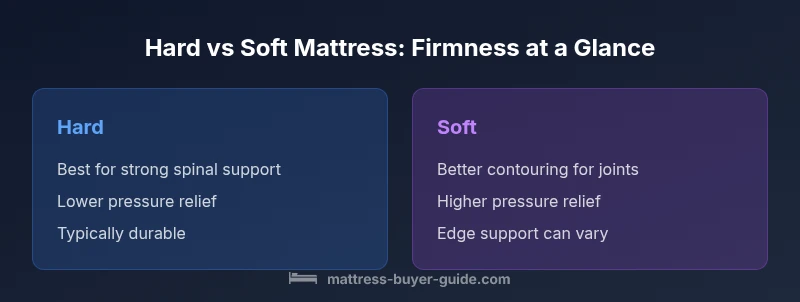
Is It Better to Sleep on a Hard or Soft Mattress? A Data-Driven Guide
Explore whether a hard, medium, or soft mattress is better for your sleep. This analytical guide covers firmness basics, weight and position interactions, and practical testing tips to help you find neutral spine and lasting comfort.


Is it better to sleep on a hard or soft mattress? The best choice depends on your sleep position, weight, and comfort goals. For most people, a medium-firm feel offers balanced support and pressure relief. Hard mattresses can help back sleepers who need spinal alignment, while soft surfaces may benefit side sleepers who need contouring—though neither is universally superior.
Understanding Firmness and Sleep Mechanics
Firmness describes how a mattress responds to pressure and how your body settles into the surface. When people ask, is it better to sleep on a hard or soft mattress, they’re really weighing spinal alignment against comfort. A bed that’s too firm can push on pressure points at the shoulders and hips, while a bed that’s too soft may allow the body to sink excessively and shift the spine out of its neutral alignment. The right firmness creates a neutral spine with even weight distribution, so muscles can relax. The Mattress Buyer Guide team notes that firmness is not an absolute number; it’s a subjective feel that depends on materials, your body weight, and movement. In practice, many sleepers start with a medium-firm option, then fine-tune with a topper or a different model. Remember: comfort is personal, but spinal alignment is non-negotiable for restful sleep. According to Mattress Buyer Guide, firmness choices should be tested with real sleep trials to confirm long-term satisfaction.
How Body Weight and Sleep Position Interact with Mattress Firmness
Weight and position dramatically affect how firmness translates into comfort. Lighter sleepers may experience a soft or medium mattress as sufficiently supportive, while very firm surfaces can cause stiffness and reduce blood flow to joints. Heavier sleepers often need more support to prevent sagging that disrupts spinal alignment and shifts pressure to the neck and lower back. Sleep position matters just as much: back sleepers generally benefit from stable support that keeps the hips and shoulders aligned, side sleepers usually crave a bit of contouring to relieve shoulder and hip pressure, and stomach sleepers often require firmness to prevent the midsection from bowing downward. Mattress Buyer Guide analysis shows that the same firmness can feel different across bodies, so personal testing remains essential. Start with a middle-ground firmness and use a trial period to verify comfort as you move through the night.
Pressure Relief vs. Support: Breaking Down the Trade-offs
Pressure relief and support are two sides of the same coin. A very soft mattress may cradle the body and reduce pressure at the hips or shoulders, but it risks poor spinal alignment for back and stomach sleepers. A very hard mattress can maintain an even surface for the spine but may create localized pressure points in joints, leading to tossing and turning. The ideal firmness offers sufficient support to keep the spine straight while also allowing shoulders and hips to sink enough to avoid stiffness. The practical takeaway: aim for a balance where your skeleton stays neutral and your soft tissues are comfortable. Medium-firm options are widely recognized as providing this balance for a broad range of sleepers, weights, and positions. Test across multiple nights and adjust with toppers if needed.
How to Choose the Right Firmness for Your Body Type
Choosing the right firmness starts with your body weight and typical sleep position. Light sleepers (roughly under a certain weight threshold) often prefer soft to medium firmness for cushioning, but too-soft models can cause misalignment if your spine sinks. Midweight sleepers can usually tolerate a wide range, with medium-firm being a reliable baseline. Heavier individuals may need firmer construction to prevent sagging and maintain alignment. Your choice should also consider the mattress’s materials: memory foam contours for pressure relief but can feel too soft for some; latex often offers a more buoyant feel with better edge support; traditional innerspring models vary widely by coil gauge and comfort layers. The strategy is to pick a firmness you can live with for several weeks, then refine with a topper or alternative model if needed. Mattress Buyer Guide emphasizes testing in real sleep conditions and collaborating with a retailer’s trial program to confirm your selection.
Real-World Scenarios: Back Sleepers, Side Sleepers, Stomach Sleepers
Back sleepers often benefit from a core that supports the lumbar region without letting the hips sink. A medium-firm mattress frequently works well, though very small-framed individuals may prefer slightly softer surfaces for shoulder and hip comfort. Side sleepers commonly want more contouring around the shoulders and hips to relieve pressure points; a soft-to-medium range can be comfortable here if edge support remains adequate. Stomach sleepers tend to require a firmer feel to prevent the midsection from bowing, which can strain the lower back. The key is to balance contouring with upright support; the goal is neutral spine alignment in all sleep positions. Remember that personal comfort is subjective, and a longer trial period will reveal whether your chosen firmness remains comfortable through different nightly movements.
How to Test Mattress Firmness at Home
A practical home test starts with a controlled trial: lie on your back and sides and observe spinal alignment, shoulder and hip sinking, and how your neck feels. If the spine stays in a neutral line and your weight distributes evenly without excessive pressure, the firmness might be right. Spend at least 15-20 minutes in each position on the bed during testing, and consider sleeping on the mattress for 4–6 weeks to account for break-in and adaptation. Use this period to note whether you awaken with stiffness, soreness, or reduced range of motion. Track mobility, sleep quality, and any heat buildup (some materials sleep warmer when soft). The goal is a calm, uninterrupted night with no pressure-induced awakenings, achieved through a stable but comfortable firmness.
Common Myths About Firmness
A common misconception is that “hard equals better for back pain.” In reality, excessive firmness can create pressure points and disrupt alignment. Conversely, “soft equals more comfortable” is not universal because too-soft surfaces can cause the spine to sag. Another myth is that firmness remains constant for a lifetime; many beds soften over time, reducing support. In practice, the best firmness adapts to body changes, weight fluctuations, and aging. The truth is that there is no one-firmness-fits-all; the right choice depends on your unique anatomy and sleep habits. Mattress Buyer Guide highlights the importance of testing, adjusting, and prioritizing spinal alignment over cosmetic impressions of firmness.
Practical Trial Protocol: How to Verify Comfort
Begin with a clearly defined trial period and a process for verification. Use a recommended 30-90 day trial window, depending on the retailer’s policy, to accommodate break-in and habit formation. During the trial, rotate sleeping positions, track morning stiffness, and evaluate sleep duration and quality. If available, use a posture evaluation or sleep-tracking app to quantify changes in spinal alignment, pressure relief, and overall comfort. If you discover persistent soreness, reassess with a sprung or foam topper to tweak the feel without compromising support. Always document whether the bed maintains contour and alignment in multiple positions over several weeks.
Special Considerations for Couples and Sleep Partners
When sharing a bed, firmness must account for two bodies with potentially different preferences. Look for options that offer consistent support across zones or offer split firmness solutions. A high-quality mattress with reinforced edge support reduces partner disturbance and reduces roll-off. If a split setup isn’t feasible, consider a queen or king with adjustable toppers or two smaller toppers that create a similar effect. Temperature, motion transfer, and warranty are also important; they affect long-term satisfaction and investment value. The best approach combines informed testing with a plan for adjustments through toppers or exchange programs.
Feature Comparison
| Feature | Hard | Medium-firm | Soft |
|---|---|---|---|
| Best For | Back sleepers needing stable spinal alignment | Most sleepers seeking balanced support | Side sleepers needing contouring and pressure relief |
| Pressure Relief | Lower relief, firmer support | Balanced relief for shoulders/hips | High relief in contouring zones |
| Spine Alignment | Maintains neutral line with heavier bodies | Neutral for a wide range of bodies | Can compromise alignment for heavier individuals |
| Durability / Longevity | Generally durable with solid materials | Balanced durability depends on layers | Soft materials may indent sooner if poorly constructed |
| Edge Support | Often firmer edges, better support | Good edge support in many mid-range designs | Edge sag risk with very soft surfaces |
| Price / Value | Often mid-to-high range depending on materials | Typically good overall value across brands | Soft models can be budget-friendly but wear faster if low quality |
The Good
- More firmness options increase the chance of a true match
- Better long-term comfort when firmness aligns with body type
- Trial-period testing reduces post-purchase regret
- Quality designs exist across firmness levels for durability
Cons
- Trial-and-error testing can be time-consuming
- Extreme firmness levels can cause pressure points
- Soft models may sag with heavier weights if not well-made
- Cost can rise with premium materials used for specific firmness
Medium-firm is the most versatile starting point for most sleepers
For back sleepers, firmer options may help spinal alignment; side sleepers often benefit from more contouring. If you share a bed, look for a setup that minimizes compromises for both partners. Use extended trials to confirm comfort across positions and movements.
FAQ
Is it better to sleep on a hard or soft mattress for back pain?
Back pain relief depends on spinal alignment. Too hard or too soft can worsen discomfort. Start with a firmness that maintains a neutral spine and adjust with a trial period and, if needed, a topper.
Back pain relief comes from proper spinal alignment, not extreme firmness. Start near mid-range and adjust during your trial.
How do I know what firmness is right for me?
Consider your weight, sleep position, and personal comfort. Begin with a mid-range firmness and test with a sleep trial, noting alignment and sleep quality.
Try a mid-range firmness first, assess alignment and comfort during a multi-week trial.
Can a mattress topper change the feel of a firm mattress?
Yes. A topper can soften or firm up a mattress and adjust pressure relief. Choose a topper with appropriate thickness and material to match your needs.
A topper can tweak firmness without buying a new bed. Pick the right thickness and material.
Are memory foam or latex mattresses better for firmness?
Both come in various firmness levels. Memory foam contours for pressure relief but can feel softer; latex tends to be more buoyant with better edge support. Your choice depends on desired feel and heat considerations.
Foam contours and relieves pressure; latex feels more buoyant and can sleep cooler.
How long should I test a new mattress before deciding?
Most sleepers should allow 4-6 weeks for adaptation, with retailers offering longer trial periods. Use this time to evaluate alignment, comfort, and sleep quality.
Give it at least 4-6 weeks to judge if it’s truly comfortable.
What if my partner and I want different firmness levels?
Consider a split firmness setup or a mattress with zones that support diverse needs. Alternatively, add toppers to tailor comfort for each side.
Split firmness or toppers can help both sleep partners get what they want.
Highlights
- Test firmness with a multi-week trial
- Medium-firm fits most sleepers for balance
- Weight and sleep position drive firmness needs
- Use toppers or exchanges to fine-tune feel
- Prioritize spinal alignment over initial comfort impression