Mattress and Frame: A Comprehensive Buying Guide
A rigorous, objective comparison of mattress and frame setups to help homeowners choose the best sleep solution. Covers comfort, durability, maintenance, and value with practical test tips.


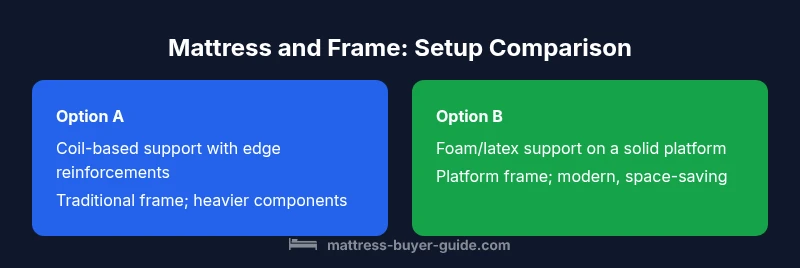
Two common sleep setups are a traditional frame with an innerspring mattress and a low-profile platform frame paired with foam or latex. The choice hinges on space, edge support, motion isolation, and long-term durability. Mattress Buyer Guide emphasizes that the best pair balances room layout, personal comfort, and maintenance preferences—not just upfront cost.
Why mattress and frame choice matters
Choosing the right mattress and frame is more than a matter of taste; it affects spine alignment, sleep quality, and long-term durability. The two most common setups—traditional frame with an innerspring mattress and a platform frame with foam or latex—offer distinct advantages. Your choice should account for room size, ease of movement, noise, edge support, and how easy it is to replace components over time. Throughout this guide, we’ll compare these two paths in concrete terms and show how a well-matched pair can improve sleep quality night after night. According to Mattress Buyer Guide, the right combination aligns structural support with your sleeping habits, ensuring you wake refreshed and without aches, rather than simply matching aesthetics.
Quick look: Traditional frame + innerspring vs platform frame + foam
In a traditional frame plus innerspring setup, you typically get strong edge support and a familiar “springy” feel. Platforms with foam or latex offer a sleeker look, reduced motion transfer, and often better breathability. The main differences come down to foundation type (box spring vs solid/slatted base), material behavior (coil versus foam), and how each handles partner movement. Consider your bedroom dimensions, whether you share the bed, and how easy it is to move the pieces for cleaning or reconfiguration. In most scenarios, platform frames shine in modern spaces, while traditional frames excel in rooms where edge support and a heavy, robust feel are priorities.
Comfort and support considerations
Comfort is a function of both mattress and frame. A coil-based innerspring mattress paired with a sturdy frame tends to offer responsive support and durable edge strength, which helps when sitting on the edge or getting in and out of bed. Foam or latex mattresses perform differently: they often pair best with a platform frame because the flat, stable foundation minimizes motion transfer and contouring. If you share your bed with a partner who moves a lot at night, platform frames with foam can reduce disturbances while maintaining adequate support. For people with back pain, ensure the combination supports neutral spine alignment; the frame should be compatible with the mattress’s targeted pressure points and resilience.
Edge support, motion isolation, and temperature regulation
Edge support matters for seating comfort and bed stability, especially for couples. Traditional innerspring systems can offer strong edge support when paired with reinforced frames and perimeter coils; however, edge performance varies by coil design. Platform frames paired with foam or latex mattresses tend to deliver superior motion isolation, which benefits sleepers who share a bed. Temperature regulation is influenced by material choices: breathable coils can promote air flow under the mattress, while open-cell foams and latex layers often enhance cooling. Your choice should prioritize comfort in your typical sleeping posture and climate.
Durability, warranty, and maintenance
Durability depends on materials, build quality, and how well the foundation supports the mattress’s intended use. Innerspring systems are proven survivors in many bedrooms, but coil sag and frame loosening can occur if the foundation or bed frame isn’t robust. Foam and latex mattresses on platform frames tend to resist sagging when paired with a solid, well-spaced slat system or a compatible foundation. Warranty coverage often depends on the integrity of the base; verify foundation requirements with the mattress maker to avoid inadvertent warranty voidance. Regular inspection of joints, slats, and fasteners is a simple but important maintenance task.
Size, weight, and compatibility considerations
Size matters: ensure the frame fits the mattress size securely and leaves room for movement. Traditional frames with box springs can be heavier and harder to move, especially in tight spaces. Platform frames are typically lighter and flush with the floor, offering easier setup and cleaning. Compatibility matters: verify that the mattress’ foundation requirements align with the frame’s design. A mismatch could compromise support, feel, and warranty coverage. Measure doorways and stairwells to confirm you can bring the components into the room without damage.
Price and value context
Price ranges reflect materials, construction quality, and brand reputation rather than a single metric. Traditional setups with high-quality coil systems and sturdy frames can be pricier upfront, but they offer durable edge support and long-standing compatibility with various mattress types. Platform frames with foam mattresses can be cost-effective, particularly in compact spaces, and often combine a modern aesthetic with straightforward setup. Focus on total cost of ownership: initial price, delivery, assembly, replacement parts, and potential warranty considerations.
Sleep profiles and recommendations
Different sleep profiles demand different pairings. Back sleepers often benefit from a firmer, supportive surface that maintains spinal alignment; platform frames with foam mattresses can provide that with balanced conformity. Side sleepers may prefer softer foams that relieve pressure points, which platforms can accommodate when paired with appropriate slat spacing. Stomach sleepers generally require firmer support; traditional coils with a sturdy frame may deliver the required stability. When choosing, consider your weight distribution, preferred sleeping positions, and any prior comfort issues. Test both configurations if possible and consult the mattress warranty for foundation requirements.
How to test at home
If you can, use a sleep trial to compare configurations. In-store, lie in your typical positions for several minutes to assess contour, support, and movement. At home, rotate or flip tests can reveal subtle sagging or edge issues. Check for noise when moving, vibration transfer when a partner shifts, and whether the frame creaks under load. For a side-by-side evaluation, set up your two preferred configurations and track your sleep quality, morning stiffness, and overall comfort over a week or two. Documentation helps quantify what feels subjective.
Installation tips and common pitfalls
Plan ahead for installation with a clear checklist: verify compatibility, measure fit, and confirm that all slats, screws, and brackets are included. Common pitfalls include using the wrong foundation for a mattress, improper slat spacing, and overtightening frame joints, which can warp the structure. Keep tools ready and consider professional help if moving heavy components. Regularly re-tighten hardware after a few weeks of use to prevent looseness that can degrade support.
When to upgrade both mattress and frame
There are scenarios where upgrading both parts at once makes sense: if you notice chronic morning stiffness, persistent pressure points, or if your current frame shows signs of lagging support (sagging, creaking, or loose joints). A synchronized upgrade ensures that the new mattress and frame complement each other from the outset, preserving warranty requirements and maximizing sleep quality. If space or budget allows, replacing both components in the same cycle can simplify setup and improve overall sleep outcomes.
Practical next steps and checklists
- Measure your room and doorways to confirm fit. - List your sleep priorities (edge support, motion isolation, cooling). - Compare two configurations side by side with a trial period. - Verify warranty requirements with mattress and frame manufacturers. - Schedule delivery or setup assistance if needed. - Create a maintenance routine to keep joints tight and slats aligned.
Comparison
| Feature | Option A: Traditional Frame + Innerspring Mattress | Option B: Platform Frame + Foam Mattress |
|---|---|---|
| Support system | Coil-based innerspring with potential edge reinforcement | Solid platform base with foam/latex |
| Edge support | Strong with reinforced outer coils and perimeter support | Typically strong due to solid platform; varies by foam type |
| Motion isolation | Moderate to high depending on coil design | Generally high with dense foam and platform isolation |
| Breathability/temperature | Typically cooler on surface with coil ventilation | Open-cell foams and latex often improve cooling |
| Durability | Longstanding design; coil wear possible over many years | Durable with proper foundation; less risk of sag with quality foam |
| Maintenance | Frame components may loosen; occasional tightening needed | Foam wear is gradual; platform base requires less frequent upkeep |
| Weight/installation | Heavier components; more difficult to move | Lighter and easier to maneuver; simpler setup |
| Price range | Mid to high depending on coil design and frame quality | Mid to high depending on foam type and platform quality |
| Best for | Traditional feel with robust edge support | Space-saving, modern aesthetics, strong isolation |
The Good
- Widely available components and replacements
- Good compatibility with a range of mattresses
- Established warranties and service options
- Resale value for traditional setups
Cons
- Heavier and harder to move components
- Potential for coil sag or frame loosening over time
- Box springs can add cost and height
- Platform frames require correct slat or foundation specs
Platform frame with foam is generally a better fit for modern bedrooms, while traditional innerspring setups excel in edge support and durability.
If space and ease of maintenance matter most, choose a platform frame with foam. If you value edge support and a traditional feel, opt for a traditional frame with an innerspring mattress. Always verify foundation compatibility with warranty requirements.
FAQ
What is the main difference between a traditional frame with an innerspring mattress and a platform frame with foam?
The main difference lies in the foundation: traditional frames rely on a box spring or coil-based base to support an innerspring mattress, while platform frames use a solid or slatted base to support foam or latex. This affects edge support, motion transfer, and cooling.
The main difference is the base: coils and box springs versus a solid or slatted platform for foam.
Can you mix a memory foam mattress with a traditional box spring frame?
Yes, you can pair memory foam with a traditional frame, but make sure the box spring provides a flat, sturdy surface to prevent sagging and minimize edge roll-off.
Yes, but ensure the base is flat and sturdy.
Do platform frames require a foundation or slats?
Platform frames can use built-in slats or a solid base. Foam or latex mattresses benefit from a sturdy, evenly spaced slat pattern or a compatible low-profile foundation.
Usually yes—slats or a solid base are needed depending on the mattress.
How does frame choice affect mattress warranty?
Most mattress warranties require a proper foundation. An incompatible frame or foundation can void coverage, so verify foundation requirements with the manufacturer before buying.
Foundation matters for warranty—use a compatible frame.
Which setup is better for couples with different sleeping styles?
Platform frames with foam mattresses typically offer better motion isolation, reducing disturbances. Traditional frames can work if the mattress type and frame support are well matched to both partners' preferences.
Platform frames usually reduce motion transfer; traditional can work if matched well.
Highlights
- Measure room dimensions before choosing a setup
- Platform + foam favors motion isolation and space efficiency
- Traditional + innerspring favors edge support and durability
- Check warranty and foundation requirements before purchase
- Test configurations and use sleep trials when possible