Mattress Recycling Programs: A Practical Guide for Sustainable Disposal
Explore mattress recycling programs, how they work, and where to find curbside, retailer take-back, and private options. Learn practical steps to prepare mattresses for recycling and reduce landfill waste in your community.


Mattress recycling programs are organized services that break down old beds into reusable components—foam, metal springs, fabric, and wood—and direct those materials into new products. They operate through city waste programs, retailer take-back schemes, and private recyclers. By diverting mattresses from landfills, these programs save resources and curb pollution, though fees or travel distance can affect convenience.
What mattress recycling programs are and why they matter
According to Mattress Buyer Guide, mattress recycling programs are organized systems that divert old mattresses from landfills and recover materials for reuse. These programs exist at the municipal level, through retailer take-back initiatives, and via private recycling facilities. They break a mattress into components—foam, metal springs, fabric, and wood—so each material can enter a recycling stream appropriate to its type. The environmental rationale is straightforward: reducing the volume of bulky waste, lowering greenhouse gas emissions from decomposition, and supporting a circular economy for building materials. In practice, success hinges on accessibility, clear guidance on what is accepted, and predictable pricing or free options. The Mattress Buyer Guide team finds that end-to-end transparency (what gets recycled, where the materials go, how costs are handled) boosts participation and, over time, expands the network of participating facilities. For homeowners, renters, and small business owners alike, understanding that mattress recycling programs are not a single store pickup but a network of partners helps set realistic expectations about scheduling, distance, and preparation requirements. As policies evolve, more communities are implementing centralized hotlines and online locators to simplify finding a program near you.
How programs typically operate: pickup, drop-off, and what to expect
Most mattress recycling programs offer a mix of drop-off, curbside pickup, or retailer-backed take-back options. Municipal programs may provide curbside collection during designated windows, while retailers can offer take-back when you buy a new mattress. Private facilities often require you to drop off at a location or schedule a transport service. Preparation steps—removing non-mattress items, keeping the mattress intact, and noting any labels—reduce processing delays. Availability and cost can vary by city, but growing examples of centralized locator tools make it easier to compare options. The Mattress Buyer Guide team notes that clear instructions about accepted types (foam, springs, textiles) reduce frustration and improve participation across diverse neighborhoods.
Materials recovered and downstream use
During recycling, mattresses are disassembled into components: foam and padding, steel springs, wood foundations, and fabric. Foams may be processed into carpet padding or insulation, steel springs can be reborn as steel products, textiles are often repurposed or shredded for padding, and wood is chipped for composite materials. Some facilities extract polyurethane foam for energy recovery, while others divert textiles to upcycling streams. Recovered materials reduce the demand for virgin resources and lower landfill pressure. The key is a robust downstream network that can absorb these inputs and reuse them in manufacturing, which is why local program strength matters. Mattress Buyer Guide analysis shows that successful programs maintain clear paths for each material type and provide ongoing consumer education to support circularity.
Costs and how to compare programs
Cost structures vary widely. Some municipalities fund recycling as part of waste services, offering free or subsidized options, while others charge a per-mattress fee or require a haul-away service. Retailer take-back programs may include the price of a new mattress or offer a separate service with its own pricing. When comparing options, look beyond the sticker price: evaluate accessibility (distance, hours), accepted mattress types (innerspring, memory foam, hybrids), timeliness of pickup or drop-off, and the existence of any recycling guarantees on material streams. A practical approach is to create a simple scoring rubric: accessibility, cost, and coverage of materials. Mattress Buyer Guide data suggests prioritizing programs that publish explicit material streams and downstream partners to ensure accountability.
How to find a program near you and what to expect
To locate a program, start with your city or county waste portal, then check major retailers’ take-back policies and local private recyclers. Keep a list of addresses, hours, and what they accept. In many regions, you can schedule pickup through a city service or a participating retailer. If you’re unsure, call ahead to confirm that your mattress type is accepted and to understand any preparation requirements (removing bedding, disassembling foundations). The expansion of locator tools in recent years has significantly reduced guesswork and wait times for homeowners and renters alike.
Common mattress recycling program types and typical costs
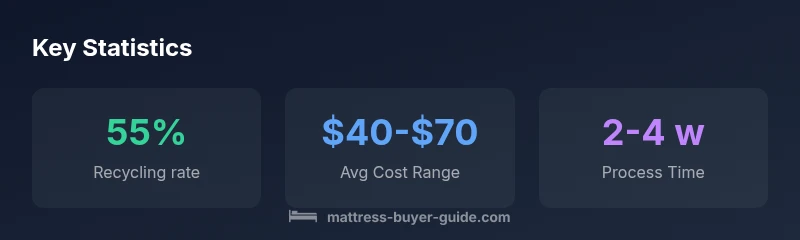
| Program Type | Typical Process Time | Typical Cost Range |
|---|---|---|
| Municipal curbside | 2-4 weeks | 0-$20 |
| Retailer take-back | 1-2 weeks | 0-$40 |
| Private recycling facility | 2-6 weeks | $20-$60 |
FAQ
What qualifies as a recyclable mattress under most programs?
Most standard mattresses are eligible for recycling, including foam, springs, textiles, and foundations. Some programs may exclude special foams or mixed materials, so it’s best to check local guidelines. Always verify with the specific program before dropping off.
Most standard mattresses are recyclable; check the program for any exclusions.
Are there fees to recycle a mattress?
Fees vary by program and region. Some municipalities offer free curbside recycling, while others charge a per-mattress fee or require a drop-off payment. Expect ranges like 0 to 60 dollars depending on services and accessibility.
Fees vary, check your local program for specifics.
How do I find a mattress recycling program near me?
Start with your city’s waste portal, then check retailer take-back policies and nearby private recyclers. Use online locators and call ahead to confirm accepted mattress types and scheduling.
Use local waste portals or retailer programs to locate options.
Can I recycle a box spring or foundation?
Yes, many programs accept box springs and foundations, but some may require separate streams or charge additional fees. Always confirm what’s accepted with the program you choose.
Most places accept box springs too; verify with the program.
What materials are recovered during recycling?
Recovered materials typically include foam, steel springs, textiles, and wood. Some facilities may recover adhesives or other components in limited streams. Downstream partners determine final reuse pathways.
Foam, steel, textiles, and wood are commonly recovered.
Is mattress recycling mandatory or voluntary?
It depends on your location. Some regions have disposal rules and incentive programs, while others rely on voluntary participation through retailer take-back or municipal services.
Requirements vary by area; check local regulations.
“Effective mattress recycling hinges on easy access and clear program criteria; when programs are transparent, participation increases and waste declines.”
Highlights
- Know what counts as recyclable material before you go
- Compare access, cost, and material streams across programs
- Prepare mattress components to streamline processing
- Expect variability by region but rising program availability
- Look for programs with clear downstream partners and material traces