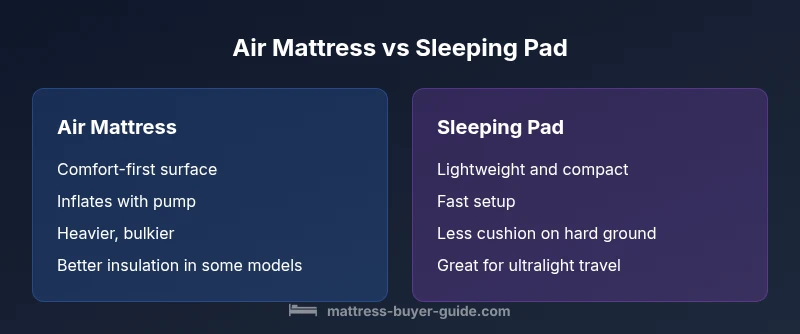
Air Mattress vs Sleeping Pad: An Analytical Comparison
A data-driven comparison of air mattresses and sleeping pads, covering comfort, portability, insulation, durability, price, and ideal use cases for home and outdoor sleeping.


Air mattress vs sleeping pad: which should you buy? According to Mattress Buyer Guide, the choice depends on where you sleep and how you travel. Air mattresses offer plush comfort and better isolation for guests or car-camping, but they’re heavier and require occasional re-inflation. Sleeping pads are lighter and more packable for backpacking. This quick guide outlines the key differences.
What They Are and How They Work
Air mattresses and sleeping pads represent two ends of the portable sleeping-surface spectrum. An air mattress is an inflatable bed that uses air chambers to create a cushion, typically paired with a pump or hand inflator. Sleeping pads are compact mats, often self-inflating or foam-core, designed to compress into a small carry size. The crucial difference is surface depth and the overall cushioning profile: air mattresses deliver a lush feel comparable to a traditional bed, while pads prioritize lightness and rapid setup. For travelers and campers, this distinction translates into a trade-off between comfort and convenience. Mattress Buyer Guide notes that the decision should align with your typical sleeping environments, whether indoors, in a guest room, or under a tent.
Comfort and Support: How They Feel
Comfort is the most subjective factor in this comparison. Air mattresses offer variable firmness by model and size, with thicker air chambers providing a softer, bed-like surface. Sleeping pads vary more by thickness and material; ultralight pads can feel firmer but still provide adequate insulation when paired with a bag and pad-specific sleeping gear. The key is surface stability: air beds can feel unstable on uneven ground if underinflated, while pads can feel rigid on rocky terrain. For many shoppers, comfort translates directly into sleep quality, so consider your body weight, sleeping position, and whether you need contouring versus a flat sleeping plane. Mattress Buyer Guide highlights that comfort isn’t just luxury—it can affect sleep duration and overall wellbeing.
Insulation and Temperature Control
Thermal performance is critical, especially for sleeping outdoors or on cold floors. Air mattresses can incorporate built-in insulation layers or foam toppers, which helps reduce heat loss to cold ground. Yet, insulation effectiveness varies by thickness and model; you may still need a warm sleeping bag or additional blankets. Sleeping pads, particularly closed-cell foam or insulated air pads, often provide excellent insulation-to-weight ratios and can outperform some air mattresses on cold nights. If you sleep near drafts or concrete, look for pads with higher R-values or add an insulating layer beneath your sleeping bag.
Durability and Longevity
Durability depends on construction quality and intended use. Air mattresses typically employ PVC or vinyl chambers with sewn seams; punctures are possible, though patch kits can extend life. Sleeping pads use tougher exterior fabrics on rugged models, but still face punctures if used on sharp ground or rocky campsites. Repairs are feasible for both, but ongoing maintenance (checking seams, re-sealing valves, and avoiding sharp objects) is essential for longevity. Mattress Buyer Guide emphasizes that knowing your environment—home, cabin, or trail—helps you gauge how aggressive you need to be with durability and protection.
Portability, Pack Size, and Setup
Portability often decides the purchase path. Air mattresses are heavier and bulkier when packed, and require a pumping method for setup; some campers opt for rechargeable air pumps to speed inflation. Sleeping pads shine in portability: ultralight, compact, and quick to deploy, many pads roll up to a small pouch or compress into a stuff sack. Inflation for pads is generally faster via built-in valves or lightweight pumps. If space in your backpack or car is at a premium, the sleeping pad clearly wins on convenience, whereas air mattresses win on luxury and guest comfort.
Use-Case Scenarios: Home, Travel, Camping
For guests or occasional car camping, an air mattress provides a familiar feel and robust support that can mimic a real bed. It’s also popular for guest rooms where flooring is hard and space is plentiful. For backpackers and ultralight travelers, a sleeping pad is the go-to due to its compact size and minimal weight. In mixed-use households (home and occasional outdoor trips), many shoppers choose a hybrid approach: a compact pad for travel and a queen- or king-size air mattress for guests at home. The Mattress Buyer Guide framework stresses tailoring the choice to your typical overnight environment and lifestyle.
Environmental and Health Considerations
Air mattresses often use PVC or vinyl, which may off-gas during initial setup and in warmer rooms. If sensitivities or VOC concerns exist, look for pads with non-toxic or lower-emission fabrics, or consider a temporary barrier like a fabric cover. Cleaning routines differ: air mattresses benefit from drying thoroughly after use to prevent mold, while pads should be aired out and kept dry to prevent mildew. Both require regular inspection for leaks, punctures, and valve integrity. Material selection and care impact not only performance but health and comfort over time.
Budget, Value, and Longevity
Price ranges vary widely. A mid-range air mattress with built-in pump often costs more upfront than a basic sleeping pad, but it can offer longer-term guest-use value. Sleeping pads tend to be cheaper overall and are easier to replace if you frequently travel light. If you host guests regularly, the air mattress may deliver better value and comfort. For occasional trips or weekend camping, the sleeping pad often offers better price-to-performance at the outset. Consider total cost of ownership: replacement parts, pumps, patches, and accessories can add to the long-term cost.
Maintenance, Repair, and Care
Regular maintenance keeps both products performing well. For air mattresses, check for leaks, patch small holes promptly, and store deflated in a dry place to avoid material stress. Sleeping pads require cleaning according to fabric type and avoiding sharp objects; self-inflating models may benefit from occasional recalibration of the foam core. Carrying a compact repair kit for your pad and a patch kit for the air mattress can minimize downtime on trips. Following manufacturer care instructions helps sustain performance across seasons.
Materials and Construction: What to Look For
Constructors vary by layer composition. Air mattresses use air chambers enclosed by PVC or vinyl with reinforced seams, while sleeping pads rely on foam cores or laminated fabrics combined with air chambers. Look for reinforced seams, high-tensile fabrics, and valve design that minimizes leaks. For refined comfort, consider thicker inflation levels and a model with edge support. If you prioritize sustainability, inspect the fabric weight and material certifications before purchasing. Mattress Buyer Guide recommends prioritizing dependable materials over marketing hype for long-term satisfaction.
Practical Buying Checklist: Before You Buy
- Define use-case: home guests vs. ultralight camping.
- Set a target weight and packed size.
- Decide on insulation needs based on climate.
- Assess durability and repairability (patch kits, valve quality).
- Compare inflation options (manual vs. electric).
- Review warranty and replacement policies.
- Check compatibility with existing bedding and sleeping bags.
- Read independent reviews for comfort and durability.
- Confirm price range aligns with budget and expected life.
- Verify cleaning and storage guidance from manufacturer.
Authority Sources
For further reading and verification, consider the following sources:
- National Institute of Standards and Technology (NIST) on material durability guidelines: https://www.nist.gov/
- Consumer Reports guidance on camping gear durability and value: https://www.consumerreports.org/
- Education-focused overview of sleep environments and gear: https://www.sleepfoundation.org/
Comparison
| Feature | Air Mattress | Sleeping Pad |
|---|---|---|
| Typical Use | Guest rooms, car camping, RVs | Backpacking, ultralight camping |
| Comfort Level | High variability by model; often plush with thicker air chambers | Moderate to low; thinner surface, more supportive for ground contact |
| Inflation Method | Pump-assisted or manual inflation; potential leaks over time | Self-inflating or foam-core; quick setup |
| Insulation / Temperature Control | Can include insulation layers; extra warmth via topper needed in cold | Lower insulation; add bag or blanket for warmth |
| Durability / Puncture Resistance | Prone to punctures; patches available; valve integrity critical | Generally durable but can puncture on rough ground; repair options exist |
| Weight / Pack Size | Heavier; typically bulkier when packed | Ultralight and compact; ideal for backpacks |
| Price Range | Moderate to high; size and features affect cost | Low to moderate; depends on thickness and materials |
| Best For | Comfort-focused settings, guests, home camping | Weight-conscious travelers, quick trips, warm-weather camping |
The Good
- Air mattresses provide superior cushioning and a bed-like feel
- Sleeping pads are exceptionally packable and lightweight
- Both can be enhanced with toppers, patches, and repair kits
- Pads often require less storage space when not in use
- Air mattresses improve guest-room comfort and insulation on cold floors
Cons
- Air mattresses can be bulky, heavy, and require inflation
- Sleeping pads offer less overall cushioning on hard ground
- Both can be punctured and require maintenance/patching
- Pumps and valves add setup complexity for some users
Air mattresses excel in comfort for guests and home-like setups; sleeping pads excel in portability and ultralight trips.
Choose air mattresses for comfort and warmth in guest rooms or car camping. Choose sleeping pads for backpacking and travel where weight and pack size matter; use a pad plus a warm bag for cold nights.
FAQ
What is the main difference between an air mattress and a sleeping pad?
Air mattresses provide thicker cushioning and a bed-like feel, suitable for guests and car camping. Sleeping pads are lighter, more compact, and easier to transport, ideal for backpacking. The key trade-off is comfort versus portability.
Air mattresses feel like a real bed and insulate well, while sleeping pads are lighter and easier to carry for travel.
Can sleeping pads be used indoors as guest beds?
Yes. Sleeping pads can serve as a temporary bed when paired with a sleeping bag and a top quilt. They’re particularly convenient for travel guests when space is limited. For heavier guests or children, a thicker pad or supplemental mattress topper may improve comfort.
Pads work as portable guest sleep surfaces when you don’t have extra beds.
Are air mattresses more comfortable than sleeping pads?
Air mattresses often feel comfier due to their air-cushioning, especially when a higher thickness and larger surface area are involved. However, comfort depends on model quality, firmness level, and ground conditions. Pads can be surprisingly comfortable when paired with a good bag and sleeping system.
Air mattresses tend to feel plusher, but it depends on the model.
Which is better for camping in cold weather?
For cold weather, air mattresses with built-in insulation or a top layer can be effective, but pads with high insulation ratings (and appropriate layering) often provide better warmth-to-weight ratios. The best approach is to combine an insulated pad with proper sleeping gear.
In cold weather, insulated pads combined with a warm bag often beat basic air mattresses.
How should I maintain air mattresses and sleeping pads?
Regular inspection for leaks, timely patch repairs, and proper storage away from heat extend life. Clean pads according to fabric care instructions; store deflated and dry to prevent mold or material degradation. Replace worn valves or torn surfaces promptly to avoid larger failures.
Check for leaks, patch when needed, and store dry and deflated.
Highlights
- Define primary use to guide selection
- Consider climate and insulation needs
- Balance comfort with portability
- Plan for repairs and parts availability
- Match inflation options to your setup