Euro Top Mattress vs Pillow Top: A Thorough Comparison
A detailed, analytical comparison of euro top vs pillow top mattresses, covering construction, feel, durability, temperature, and care to help you decide which top style suits your sleep needs.


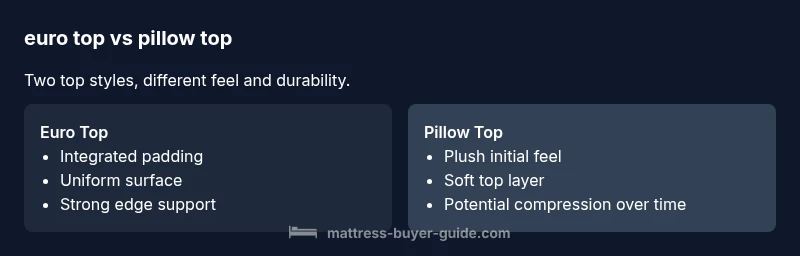
The euro top mattress vs pillow top comparison guides you to a comfort choice that fits your sleep style. Euro top builds a single, integrated top surface for a smooth, uniform feel and often stronger edge support, while pillow top adds a plush, separate layer that feels very soft at first but can compress over time. The right pick hinges on your preferred balance of initial softness, long-term support, and bedding compatibility.
euro top mattress vs pillow top: Understanding the basics
Both euro top and pillow top describe the surface finish of a mattress, not the core support system. The critical distinction is how the top layer is constructed and how that affects feel, durability, and care. According to Mattress Buyer Guide, the choice often hinges on your weight, sleeping position, and whether you prioritize a uniform surface or plush immediate comfort. A euro top is an integrated padding that is sewn flush with the mattress edges to produce a smooth, uniform profile. A pillow top sits as a distinct, thicker layer on top, delivering a cushy initial sensation. In practice, a euro top tends to offer more consistent surface firmness and edge support, while a pillow top provides noticeable plushness at the outset and may require more frequent rotation or replacement to maintain feel over years. This distinction matters for hot sleepers, couples sharing a bed, and people who care about spine alignment over long horizons.
Construction and feel: what actually makes euro top different from pillow top
The core difference between euro top and pillow top lies in surface construction. A euro top’s padding is integrated into the mattress cover, creating a seamless feel with minimal shifting. This often yields a firmer, more uniform surface, especially near the edges where support is critical for sleeping positions that involve side lying or edging against the frame. A pillow top uses a separate layer that adds initial softness and height; depending on the materials, it can feel incredibly plush at first contact but may compress more quickly with repeated use. Both designs can be used on coil-based and foam-based cores; the overall performance also depends on the core system’s support, responsiveness, and airflow. The choice should account for how you move during sleep and whether you want a surface that keeps its shape from night to night.
Durability and longevity: which top holds up over time?
Durability for euro top versus pillow top depends heavily on the materials and the underlying core. Euro top surfaces tend to wear more slowly because the padding is integrated, reducing movement and edge collapse across the surface. Pillow tops, while offering plush initial comfort, can sag or compress where weight concentrates, especially in zones with shallow padding or low-density foams. However, a high-quality pillow top combined with a strong core can perform well for several years if you rotate the bed, use a supportive foundation, and monitor edge wear. In either case, the longevity is ultimately tied to the core mattress quality, the density of the top layer, and how you care for it over time. Mattress longevity is also influenced by alignment and partner use, which the Mattress Buyer Guide notes is often underappreciated in quick shopping decisions.
Comfort profiles: who benefits from each top style?
If you prefer a surface that feels consistently firm or medium-firm across the entire bed, the euro top is often the better match. It tends to reduce localized sinking and provides reliable support for back and stomach sleepers who need stable spinal alignment. Pillow tops excel for those seeking immediate plushness—lighter weight sleepers, side sleepers, or anyone who enjoys a soft initial sink before deeper pressure points engage. Heavier sleepers might still benefit from a pillow top if paired with a strong core and a robust support system; otherwise, euro top with a denser core might prevent excessive compression. The key is to assess how soon you feel pressure relief and how the surface responds as you move throughout the night—because the feel can evolve with use.
Edge support and motion isolation: key differences for couples
Edge support is often stronger on euro top setups because the integrated padding reduces edge collapse when you sit or sleep near the edge. This can matter for couples sharing a queen or king, where you want to maximize usable surface and minimize roll-off. Pillow tops may exhibit slightly less edge stability if the top layer compresses, but a high-quality micro-foam top with a solid core can still offer solid edge performance. Motion isolation tends to be governed more by the core and the presence of pocketed coils or dense foams than by the top layer alone, meaning both euro top and pillow top can perform well for couples who move at night. If you partner frequently shifts position, a thicker pillow top could feel less stable over time, whereas euro top tends to maintain surface consistency longer.
Temperature regulation and moisture management
Breathability is influenced by the core materials, cover fabric, and padding. Euro tops often use integrated padding that can be slightly more breathable when paired with a breathable cover and coil base. Pillow tops, depending on padding density and fabric, may trap more heat, creating a warmer feel for hot sleepers. If you sleep hot, look for products with moisture-wicking fabrics and breathable foams; consider a bed that includes edge coil support, or a densely woven cover that promotes airflow. Remember that top finishes are only one part of thermal performance—the mattress core, foundation, and room environment all play significant roles in how cool or warm you sleep.
Price ranges and value: cost considerations
Because euro top and pillow top are surface finishes, price often reflects the overall core quality and padding density rather than a fixed top style. In general, euro top configurations tend to be priced to reflect their integrated construction and longer-lasting surface; pillow tops may offer lower upfront costs for softer, instantly plush feel, but premium padding and higher-density cores can push prices up. Value depends on how long you intend to keep the bed, your budget, and how much you value ongoing feel stability versus initial softness. When evaluating price, compare the total package: core support, padding density, cover material, and warranty terms, rather than focusing solely on the presence of a euro top or pillow top, says Mattress Buyer Guide.
How to test at home: sensory tips for euro top vs pillow top
When testing either option in a showroom or at home, do a full-body roll from back to side to simulate your normal sleeping pattern. For euro top, press along the edge and center to feel uniformity; check for any soft spots that develop with weight. For pillow top, test both the initial plushness and how long the surface remains supportive as you adjust positions during the night. Bring a partner and compare perceived feel, as what feels soft for one person may feel too flexible for another. If possible, lie in your typical sleeping position for 10–15 minutes per option to assess pressure relief, alignment, and edge feel. Ultimately, the best choice is the one you don’t notice after the first night—comfort should feel natural, not designed to impress upon first contact.
Maintenance and care tips
Care for euro top and pillow top mattresses mirrors that of most quality hybrids or foam cores. Use a fitted protector that fits securely to prevent shifting, rotate the mattress 180 degrees every 3–6 months to promote even wear, and avoid heavy weight on one spot to reduce indentations. For pillow tops with removable-looking layers, check the care label for cleaning instructions, but in most cases spot-cleaning and protective covers are recommended. Avoid jumping on the bed or using high heat; this can accelerate padding compression and cover wear. Regular rotation and a solid foundation will help maintain feel and edge support across both top styles, and regular vacuuming of the mattress surface can reduce dust buildup that affects breathability.
Real-world scenarios: match to sleep position and body weight
Back sleepers often prefer euro top configurations because they maintain spinal alignment with a stable surface across the entire bed. Side sleepers who value initial plushness may lean toward pillow top designs, provided the core offers consistent support. Heavier sleepers should prioritize a dense core with adequate edge support, regardless of top type; in some cases, euro top with a robust core provides the best long-term comfort and durability. Lighter sleepers can enjoy the gentler initial sink of a pillow top while still benefiting from a strong underlying support system. The better option is the one that aligns with your body weight distribution, sleep position, and how you move during the night.
Debunking myths and common misperceptions
A common myth is that euro tops are always firmer than pillow tops; in reality, the surface softness depends on padding density and core support. Another misconception is that pillow tops always sag faster; modern pillow tops with high-density foams or latex can maintain plushness for years when paired with a solid foundation. Some shoppers assume that top finishes alone determine durability; in truth, the core and foundation play the most significant role in longevity. Finally, many buyers think plush means bad for alignment; the right combination of top softness and core support can provide both pressure relief and consistent spinal alignment when chosen to suit your weight and sleep position.
Comparison
| Feature | euro top mattress | pillow top mattress |
|---|---|---|
| Surface feel and integration | Integrated padding for uniform surface | Separate plush layer on top for initial softness |
| Edge support | Typically stronger due to seamless edge | Can vary; may feel less stable if top layer compresses |
| Durability over time | Generally more uniform wear | Prone to localized compression at padding |
| Maintenance | Lower top-layer maintenance | Higher top-layer maintenance if padding shifts |
| Best for | Sleepers who want consistent surface and edge stability | Sleepers who want plush initial feel and softer entry |
The Good
- Clear differentiation helps decision-making for buyers
- Euro tops often provide stable edge support and surface uniformity
- Pillow tops offer immediate plushness for comfort-focused sleepers
- Helps tailor feel without changing the core mattress
Cons
- Pillow tops may compress or sag sooner if padding density is low
- Euro tops can feel too firm for those who crave softness
- Performance depends on core quality; top style alone is not enough
Neither top style is universally better; choose based on comfort preference, sleep position, and core support.
If you prioritize long-term surface stability and edge support, euro top is typically the safer bet. If you crave plush initial comfort and don’t mind potential future compression, pillow top can be a good match—so long as the core is solid and the padding density is appropriate.
FAQ
What is the main difference between euro top and pillow top mattresses?
The main difference lies in construction: euro top padding is integrated into the mattress, creating a smooth, uniform surface, while a pillow top is a separate, plush layer on top that adds softness but may compress over time. The decision depends on your preference for initial softness versus long-term surface stability.
The main difference is how the top layer is built. Euro tops are built in, pillow tops sit on top for plushness.
Which top type is better for back sleepers?
Back sleepers generally benefit from euro top designs when paired with a supportive core, as they offer a consistent surface that helps maintain spinal alignment. A plush pillow top can be comfortable temporarily, but the core quality remains a critical factor for ongoing support.
Back sleepers usually prefer euro tops with solid cores for steady alignment.
Do euro tops sag less than pillow tops?
Sag depends on padding density and core quality rather than the top type alone. Euro tops often sag less because the integrated padding reduces movement and edge collapse, but a high-density pillow top with a strong core can also hold up well.
Sag is more about core quality and padding density than the top style.
Can euro tops and pillow tops be used with memory foam?
Yes. Both can be paired with memory foam cores or layers, but the choice should consider heat retention and contouring. Memory foam works well with euro tops for even pressure distribution and with pillow tops for a plush feel if the foam density is appropriate.
You can use memory foam with either top type, but check density and heat management.
How should I test euro top vs pillow top in a showroom?
Test by lying in your usual sleep position for 10–15 minutes per option, focusing on pressure relief, spinal alignment, and edge feel. Bring your partner for a side-by-side comparison if possible, and press along the edge to simulate real-use conditions.
Spend a few minutes on each option in your sleep position to feel the differences.
What maintenance is required for euro top and pillow top mattresses?
Regular rotation and a good mattress protector help both top styles last longer. Avoid exposing either top to heavy direct weight and keep the room cool and dry to preserve padding and cover materials.
Rotate regularly and protect the surface; keep the room cool to extend life.
Highlights
- Assess your firmness preference first
- Test edge support with a seated edge test
- Consider core quality as the bigger durability factor
- Choose pillow top for plush initial feel, euro top for uniform surface
- Match top style to your sleep position and weight