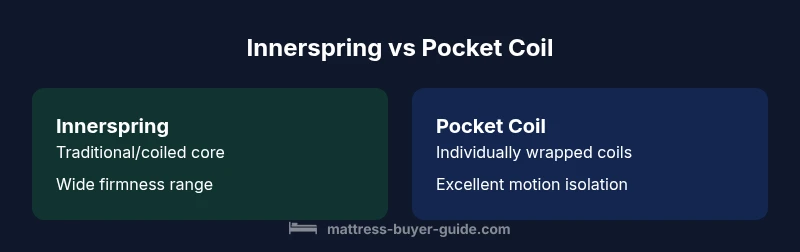
Innerspring Mattress vs Pocket Coil: A Practical Mattress Comparison
A comprehensive, data-informed comparison of innerspring and pocket coil mattresses. Learn construction, performance traits, cooling, durability, price, and what to test for to choose the best option for your sleep needs.


Pocket coil mattresses generally offer superior contouring and motion isolation thanks to individually wrapped coils, while innerspring models remain reliable, affordable, and widely available with a broad firmness range. If you share a bed or want cooler sleep, pocket coil is usually preferable; otherwise, an innerspring can be a solid value. Always test comfort in-store.
What the comparison means for sleepers
When evaluating an ‘‘innerspring mattress vs pocket coil’’ decision, the core differences lie in coil architecture, comfort layers, and how those choices translate to real-world sleep. Innerspring systems rely on a traditional coil network that provides bounce and durable support, while pocket coil designs use individually wrapped springs that bend independently to follow your body's curves. This subtle distinction affects motion transfer, contouring, edge support, and cooling. According to Mattress Buyer Guide, understanding these architectural basics helps you predict how a bed will feel in different sleeping positions and across nights. The goal of this section is to translate technical terms into practical expectations—so you can assess comfort, support, and longevity without being overwhelmed by jargon. As you read, keep in mind your sleep style, partner movement, and preferred firmness. The keyword here is balance: a bed should cradle pressure points while resisting excessive sink and maintaining stable alignment.
Construction and coil architecture
Innerspring mattresses typically use a network of steel coils that may be interconnected or zoned. Interconnected springs share load paths, which can yield solid overall support but may transfer motion more than a system with individual coils. Zoned coils are designed to concentrate support where the body needs it most, such as the lumbar region. Pocket coil mattresses, by contrast, place each coil inside its own fabric pocket. This arrangement allows each coil to respond to pressure independently, reducing motion transfer and often offering more precise contouring. The upholstery and comfort layers above the coils—such as memory foam, latex, or polyfoam—drive the feel more than the core coil design. The Mattress Buyer Guide team emphasizes that the choice between these architectures often hinges on how you value contour vs. bounce, and whether you prioritize motion isolation or edge support.
Feel, firmness, and intended feel profiles
Feel is a function of both coil design and the comfort system layered above it. Innerspring beds tend to offer a livelier, bouncier feel with a wide firmness spectrum—from plush to firm—making them a flexible option for sleepers who vary their preference over time. Pocket coil setups tend to lean toward crisper contouring and a more “perceived” hug due to the independent motion of each spring, especially when paired with latex or memory foam layers. Individuals who want a bed that adapts to weight distribution across the torso and hips may appreciate the pocket coil’s targeted support, while combination sleepers who enjoy a snappier surface might gravitate toward traditional innerspring. Across both families, matching the comfort layer to your anatomy and preferred sleeping position is essential for achieving optimal spinal alignment and pressure relief.
Motion isolation and edge support compared
Motion isolation can be a decisive factor for couples. Pocket coil designs consistently outperform many traditional innerspring setups in reducing motion transfer because each coil works independently, dampening disturbances from a partner’s movement. However, a high-quality innerspring with zoned coils and a well-designed comfort layer can approach similar performance. Edge support—how well the perimeter remains supportive when you sit or sleep near the edge—varies by model. Pocket coil beds often improve edge strength when reinforced with high-density foams or additional edge coils, which is beneficial for those who sleep near the perimeter or use the bed for seating. If motion is your primary concern, prioritize pocket coil options or innerspring beds with robust edge reinforcement.
Cooling, breathability, and temperature control
One frequent reason sleepers prefer pocket coil mattresses is enhanced airflow through the core, driven by the open gaps between coils and breathable upholstery. Innerspring beds can also sleep cool, especially when paired with breathable foams and natural latex or when the coil arrangement promotes air movement. The overall cooling experience depends on the combination of coil design, cover materials, and the density of the comfort layer. If you run warm at night or share a body with a partner, prioritize models that emphasize airflow, cooling foams, and open-construction coil systems. Mattress Buyers Guide notes that cooling performance is highly model-specific, so it’s wise to test “feel” and temperature on the bed during an in-store trial.
Durability, longevity, and how to gauge value
Durability in both innerspring and pocket coil beds correlates with coil gauge, coil count, edge reinforcement, and the quality of the comfort layers. Innerspring mattresses have a long history of robust performance, especially when built with higher-gauge coils and proper edge support. Pocket coil designs can offer excellent durability, particularly when paired with high-quality foams or latex and reinforced edges. The key is to examine coil counts and gauges, the presence of reinforced edge systems, and the warranty terms. As a rule, higher-quality manufacturing and durable interior materials tend to translate into longer-lasting sleep surfaces, though price naturally rises with these features.
Sleep-position considerations: back, side, and stomach sleepers
Back sleepers often benefit from a balance of support and a slightly cradling surface, which can be achieved by both innerspring and pocket coil configurations depending on the comfort layer. Side sleepers usually require more pressure relief at the shoulders and hips, which pocket coil beds can deliver when paired with softer top layers; however, an overly plush pocket coil bed may lack essential support. Stomach sleepers benefit from a firmer, more stable base to prevent lower-back sagging, a condition that both architectures can meet depending on the selected model. A practical approach is to identify your primary sleep position and test beds with medium to medium-firm feels, then confirm alignment and comfort through a full-night trial.
Price, value, and buying considerations
In general, innerspring mattresses offer strong value across a broad price spectrum, especially at mid-range options with good edge support. Pocket coil models that emphasize contouring and motion isolation can command higher price points, particularly when combined with high-end foams, latex, or premium fabrics. When evaluating price, consider the total cost of ownership, including the warranty length, potential delivery fees, and the cost of a compatible foundation. The most important factor is not the sticker price alone but the long-term comfort and support you derive from the bed over years of use. Mattress Buyer Guide highlights that a bed’s true value comes from how well it maintains spinal alignment and comfort after months of use, not just the initial price.
Care, maintenance, and setup considerations
Care requirements for innerspring and pocket coil mattresses are broadly similar: rotate or flip where applicable, keep a solid foundation, and use a proper mattress protector to guard against spills and allergens. Some pocket coil beds rely on a specific orientation of the mattress to maximize the pocket system’s benefits, so follow the manufacturer’s guidelines for rotation and setup. If you switch between bed frames, confirm compatibility with the included foundation and edge reinforcement. Regular cleaning and adherence to warranty terms help ensure your mattress retains performance characteristics over time.
Comparison
| Feature | innerspring mattress | pocket coil mattress |
|---|---|---|
| Core construction | Traditional coil network (interconnected or zoned) with comfort layers | Individually wrapped coils in fabric pockets with varied comfort layers |
| Motion transfer | Moderate to good; varies by model and coil design | Excellent in most cases due to isolated coils |
| Contour and support | Good contour with traditional bounce; support depends on layer quality | Strong contouring with precise pressure relief per body curve |
| Edge support | Variable; strong in models with reinforced edges | Usually robust, often enhanced by edge coils or dense foams |
| Cooling and breathability | Dependent on cover and foam; can sleep cool with breathable layers | Typically excellent airflow due to individual pockets |
| Firmness options | Wide range from plush to firm depending on model | Wide range, frequently paired with layered foams for customization |
| Price range | Mid-range to premium depending on materials and brand | Mid-range to premium, often higher with premium coils |
| Best for | Budget-conscious buyers; traditional feel and bounce | Couples, hot sleepers, and those who want contouring |
The Good
- Reliable support and bounce typical of traditional innerspring
- Wide firmness and price options to fit many budgets
- Strong edge support on many models
- Proven durability with proper construction
Cons
- Motion transfer can be higher than pocket coil in lower-end models
- Some models may sleep hotter without breathable layers
- Potential for coil squeaks over time in cheaper builds
Pocket coil mattresses generally offer better motion isolation and contouring, while innerspring remains a strong value with broad firmness options.
Choose pocket coil if you share a bed or value targeted contouring and cooling. Choose innerspring for budget-friendly options and a traditional bounce, then test models in-store to confirm comfort and support.
FAQ
What is the core difference between innerspring and pocket coil mattresses?
The core difference lies in coil construction: innerspring uses a traditional coil network, while pocket coil uses individually wrapped coils. This affects contouring, motion transfer, and edge support, influencing overall sleep feel.
Innerspring uses traditional coils; pocket coil uses individually wrapped coils for better motion isolation and contouring.
Which type is better for motion isolation?
Pocket coil mattresses typically offer superior motion isolation due to independent coil movement. Innerspring can approach this level on higher-end builds with optimized zoning and layers.
Pocket coils usually isolate motion best; innerspring can be close on premium designs.
Are innerspring mattresses cooler than pocket coil?
Cooling largely depends on the overall comfort system; both can sleep cool, but pocket coil designs often promote better airflow due to the open coil structure.
Both can sleep cool, but pocket coils often have better airflow.
Do pocket coil mattresses cost more?
Pocket coil mattresses can carry a higher price, especially in premium configurations with high-quality foams or latex, but there are affordable pocket coil options as well.
Pocket coils can be pricier, especially in premium setups, but there are affordable choices too.
Which is best for back sleepers?
Back sleepers benefit from good spinal alignment and balanced support. Both architectures can work well when paired with appropriate comfort layers, with personal preference playing a big role.
Back sleepers should test for proper spinal alignment in either type.
How long do these mattresses typically last?
Durability depends on coil quality and upholstery. With proper care and warranty coverage, both innerspring and pocket coil beds can last several years, particularly at mid to high performance tiers.
Durability varies by build, but with good care, both can last several years.
Highlights
- Evaluate coil architecture first to estimate motion transfer
- Match comfort layers to your body and sleep position
- Prioritize edge support and durability in purchasing decisions
- Test cooling performance during in-store trials