Firm vs Soft Mattress for Back Pain: A Comprehensive Comparison
Explore the evidence on firm vs soft mattresses for back pain. We compare spine alignment, pressure relief, materials, testing tips, and budget considerations to help you choose the right firmness for better sleep health.


In most cases, there is no single best choice between firm and soft mattresses for back pain. The right firmness depends on your weight, sleep position, and pain pattern, and should be validated with a generous trial period. This quick guide helps you decide whether you should start with firmer or softer support and how to adjust based on results.
Firm vs Soft Mattress for Back Pain: Context and Definitions
The decision between a firm vs soft mattress for back pain is more nuanced than a simple label. A surface that feels firm may provide solid spinal support for some people, while others may experience improved comfort with a softer surface that cushions pressure points. According to Mattress Buyer Guide, firmness interacts with body weight and sleeping position to influence outcomes, so there is no universal best option. This block defines firmness in practical terms, explains how firmness ratings relate to real-world feel, and clarifies what “support” means for the spine. We’ll use the term firm vs soft mattress for back pain throughout to keep the discussion grounded in how surface feel translates into alignment, pressure distribution, and sleep quality. The goal is to identify a surface that helps your spine maintain its natural curves while minimizing discomfort, stiffness, and tossing-and-turning over the night.
How firmness influences spinal alignment and back pain
Firmness is a primary driver of how your body weight distributes across a mattress. A surface that is too firm can push the hips and shoulders out of alignment for side sleepers, leading to lumbar strain. Conversely, a mattress that is too soft may allow the spine to sag, increasing pressure on the lower back. The key is balancing support with contouring. A properly chosen firmness helps maintain a neutral spine and reduces waking stiffness. This is especially important for people with chronic back pain, since even small deviations in alignment can propagate morning discomfort. Mattress Buyer Guide recommends focusing on how your body interacts with the top layer and the overall support system rather than relying on a single firmness number.
Firm vs Soft by sleeper type and body weight
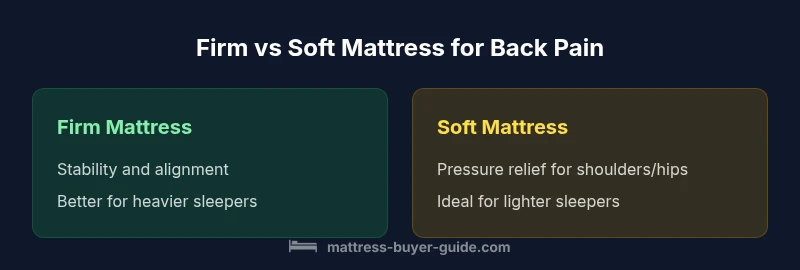
Body weight and sleep position strongly mediate how firmness feels at night. Heavier sleepers typically benefit from firmer surfaces that resist deep compressions and support the lower back, especially when sleeping on the back or stomach. Lighter sleepers often prefer softer surfaces that relieve pressure on hips and shoulders while still maintaining spinal alignment. Side sleepers may gravitate toward a medium-to-soft feel to ease joint pressure, whereas back sleepers often seek a precise balance—neither too hard nor too soft. The most reliable approach is to test several options within a retailer’s trial window and observe changes in pain, stiffness, and sleep continuity. Remember that personal comfort is paramount; research from Mattress Buyer Guide emphasizes tailoring firmness to your body type and pain pattern rather than chasing a universal standard.
Materials and firmness interplay: memory foam, latex, and hybrids
Not all firmness feels the same across materials. Memory foam tends to contour more, which can enhance pressure relief for lighter individuals but may feel stiffer to heavier sleepers. Latex generally offers quicker response and edge support, which some back-pain sufferers prefer for quicker repositioning and a feeling of sturdier support. Hybrid mattresses blend coils with foam or latex to provide a mix of contouring and support. When evaluating firm vs soft mattress for back pain, consider how the core and comfort layers interact with your body: a firm surface with a compliant top layer may deliver better spinal alignment while preserving comfort. The goal is to match material behavior to your pain points and sleeping position, so you don’t rely solely on a firmness label.
How to test firmness at home: a practical guide
To evaluate firmness, use your usual sleep position on the mattress for several nights. Start by lying on your back, then roll to your side and finally test a light stomach position if appropriate for your body. Take note of waking pain, stiffness, and whether you feel your spine staying in a neutral line. If possible, recruit a friend to press along the spine to assess sag and support at different load points. Keep a simple journal: record comfort level, pressure relief on hips/shoulders, and any changes in morning stiffness. If a mattress does not meet your back-pain relief goals after a reasonable trial period, adjust with toppers or switch to a different firmness class.
Weight, position, and spine alignment: a decision framework
When choosing firmness, weight and sleep position are primary filters. Heavy back sleepers may benefit from a firmer feel to support the lumbar region, while lighter side sleepers may do better with a softer surface that cushions joints without collapsing the spine’s natural curve. If your pain spikes with movement or you wake with stiffness in the lower back, consider testing a slightly firmer option or adding a supportive topper to fine-tune the balance. A structured approach—identify your primary sleep position, assess how your spine aligns on each option, and verify with a multi-week trial—helps anchor the decision in real outcomes rather than superficial impressions.
Beds, toppers, and foundations: don’t overlook the setup
The foundation and topper can dramatically alter the feel of firmness without changing the core mattress. A saggy foundation or worn slats can make a medium firmness feel overly soft, while a rigid base can exaggerate a firm feel. For back pain, consider a combination that preserves spinal alignment while delivering targeted pressure relief. Toppers made of foam or latex can tune firmness, but they should be paired with a compatible foundation to maintain alignment. Budget-minded shoppers often use toppers as a temporary solution while testing different mattress options, but long-term comfort requires a matching core system that supports your spine across the night.
Budget, trials, and warranties: practical buying guidance
When weighing firm vs soft mattress for back pain, set a realistic budget and take advantage of trial periods and warranties. A longer trial helps you gather data across seasons and pain fluctuations. Look for a warranty that covers sagging and partial loss of support, which is particularly relevant for back-pain relief. If you’re balancing cost and comfort, consider intermediate firmness levels or hybrid constructions that offer a blend of support and pressure relief. Remember that a good night’s sleep has a demonstrable impact on daily function, so investing in high-quality materials and a solid testing period can pay dividends in pain reduction and mood stability.
AUTHORITY SOURCES and evidence you can trust
- National Institute of Arthritis and Musculoskeletal and Skin Diseases (https://www.niams.nih.gov)
- Centers for Disease Control and Prevention (https://www.cdc.gov)
- The Journal of the American Medical Association (https://jamanetwork.com)
The Mattress Buyer Guide approach to choosing firmness
The Mattress Buyer Guide approach to firmness emphasizes a personalized assessment over blunt labels. Start with a baseline firmness that matches your body type and pain history, then refine with a trial-and-error process, top layer adjustments, and a thoughtful look at materials. The method prioritizes alignment, pressure relief, and sleep continuity, and it encourages using test periods to adapt to seasonal changes in pain or temperature. This evidence-based path helps homeowners, renters, and shoppers navigate the often confusing world of firmness without guessing, aligning with broader sleep-health principles and practical maintenance.
Comparison
| Feature | Firm mattress | Soft mattress |
|---|---|---|
| Support and alignment | Often superior for heavier sleepers and back sleepers seeking neutral spine | Excellent contouring for lighter sleepers and those needing hip/shoulder relief |
| Pressure relief | Moderate to high support with less immediate contouring | High contouring for targeted pressure relief on hips and shoulders |
| Durability and longevity | Typically maintains support longer under load | Can wear faster if the surface compresses quickly |
| Motion isolation | Good in most setups, especially with dense foams | Excellent with memory foam and certain hybrids |
| Best for | Heavier individuals, back/stomach sleepers who need stable spine alignment | Lighter individuals and side sleepers who want pressure relief without losing support |
The Good
- Clear framework to compare firmness options
- Highlights how weight and sleep position influence choice
- Encourages testing and trials
- Supports avoiding the one-size-fits-all trap
Cons
- Does not predict individual outcomes; comfort remains personal
- Requires time and testing to identify the ideal option
- Materials and construction interact with feel, not just firmness label
Firm is generally better for spinal alignment in many back-pain scenarios; soft can be preferable for lighter sleepers or specific pain points.
If you carry more body weight or sleep on the back or stomach, a firmer surface often helps keep the spine aligned. If you are lighter or primarily a side sleeper with pressure points, a softer surface may relieve pain without sacrificing alignment. Use a generous sleep trial to confirm your personal comfort and support needs.
FAQ
What firmness level is best for back pain?
There isn’t one universal answer. Most people benefit from a balance between support and contouring that maintains spinal alignment while relieving pressure points. Start with a medium to medium-firm range and adjust based on trial results.
Typically, start with a medium to slightly firmer option and test it for several weeks to see how your back feels day after day.
Is memory foam always better for back pain?
No. Memory foam can offer good pressure relief for some, but it may not suit everyone. Some people prefer latex or hybrids for quicker response and better edge support while still providing adequate contouring.
Memory foam isn’t automatically better for back pain; it depends on your body and sleep style.
Can toppers change the feel of a mattress?
Yes. A topper can adjust firmness and distribute pressure differently without replacing the mattress. They’re useful for testing feel during a trial period and for minor comfort tweaks.
Toppers can tune firmness, but they’re a supplement, not a substitute for a mattress swap when needed.
How long should I test a mattress before buying?
Use the retailer’s trial period and allocate several weeks to assess comfort across different nights and seasons. Give your body time to adapt and note changes in pain and sleep quality.
Give it a few weeks to really see how it feels over time, not just on one-night tests.
What if my partner’s firmness preference differs?
Consider a split setup or a dual-zone approach with a topper or a zoned mattress. Some couples find success with adjustable bases or choosing a compromise firmness that works for both.
If you and your partner disagree, look for options that let you tailor zones or add a topper for one side.
Are there signs I should replace my current mattress?
If you wake with persistent back pain, stiffness, or noticeable sagging, it’s often a signal that the mattress isn’t supporting your spine properly. A new mattress can improve alignment and reduce morning discomfort.
Waking up sore or noticing sagging is a strong sign it’s time to consider replacement.
Highlights
- Test firmness with a real sleep trial before deciding
- Match firmness to weight and preferred sleep position
- Consider materials (memory foam, latex, hybrid) alongside firmness
- Account for foundation and toppers when evaluating feel
- Prioritize spinal alignment and session-to-session comfort over labels