European Mattress Sizes vs US: A Practical Guide for Shoppers
Compare European mattress sizes with US standards, understand conversions, and learn practical tips to minimize bedding mismatches, find compatible foundations, and choose the right size for better sleep.


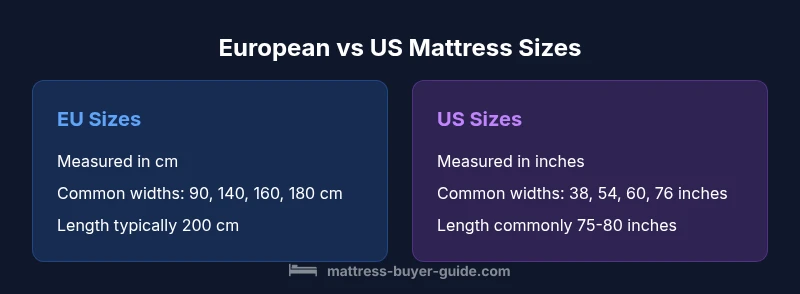
European mattress sizes vs US: The main difference is measurement units and standard dimensions. Europe relies on centimeters, with common sizes like 160x200 cm and 180x200 cm; the US uses inches, with Twin 38x75, Full 54x75, Queen 60x80, and King 76x80. This gap affects sheets, foundations, and bedding compatibility, so always check frame measurements and bedding inventories before buying.
What european mattress sizes vs us means for sleepers
Size labels and measurement units shape every purchase decision. In the context of european mattress sizes vs us, the clash between metric and imperial conventions, plus the bedding ecosystem, drives how you compare products and how sheets, toppers, and foundations fit. According to Mattress Buyer Guide, the two systems often differ in width and length, which can lead to mismatches when you move between markets or shop online from abroad. The Mattress Buyer Guide team emphasizes understanding these core differences to avoid wrong size orders and to minimize returns, all of which impact sleep quality over time.
This guide maps common European size categories to their US equivalents, discusses practical implications for sheets and foundations, and offers real-world strategies to choose a size that works in your home. By focusing on frame dimensions, bedding inventories, and bed base compatibility, you’ll navigate euromattress size decisions with confidence. This awareness also helps when planning international purchases or relocations in 2026.
Reading EU and US size charts: a practical approach
To navigate european mattress sizes vs us effectively, you must read size charts with a clear eye for units. EU sizes are labeled in centimeters (width x length), while US sizes use inches. A European 160x200 cm bed translates to roughly 63x79 inches, which is not an exact match to any single US standard. Practically, measure your frame or foundation and compare it against both systems’ charts; use a reliable cm-to-inch conversion and verify diagonal measurements to prevent misfit.
Best practices when reviewing charts:
- Confirm both width and length—don’t rely on area alone.
- Look for “closest US size” notes or conversion tables on product pages.
- Check length first: many US beds are 75 inches long, while some European designs target 79–80 inches. Tall sleepers should verify length before purchase.
As Mattress Buyer Guide analysis shows, length mismatches drive a significant portion of returns in cross-market shopping, so prioritize a length match to ensure bedding and toppers fit properly.
Common European sizes and their US equivalents
Europe uses several standard widths and lengths that don’t always align perfectly with US sizes. Here are the most common European options and their best-US approximations:
- 90x200 cm (Single): Closest US options are Twin (38x75) or Twin XL (38x80); length differences can matter for taller sleepers.
- 140x200 cm (Double): Closest US option is Full (54x75); length often aligns with 75 inches, so consider a 80-inch length when available.
- 160x200 cm (Euro King): Roughly aligns with a US Queen in width (60 inches) but is wider at 63 inches; length typically 80 inches—nearly a US Queen or a snug King depending on your frame.
- 180x200 cm (King): Closest US size is King (76x80); the EU width is slightly narrower, but length matches US King profiles. Some buyers prefer custom sheets to account for the width difference.
- 200x200 cm (Grand Euro King): Not a standard US size; often requires bespoke bedding or two separate mattresses joined as a “split king” setup in the US.
In practice, expect near-miss matches rather than exact equivalents. A European 160x200 cm bed is commonly thought of as a “king-ish” size in the US market but requires careful sheet selection and frame verification. Mattress Buyer Guide notes that many shoppers end up choosing the US Queen or King as the closest functional option, depending on the bed frame and the availability of long-length sheets.
Depth, foundations, and regional differences in bed bases
Depth and foundation systems differ across Europe and the US, and these differences amplify the effect of size disparities. European beds may be designed for closer-fitting platform bases or slatted foundations with less emphasis on a separate box spring, whereas many US setups rely on box springs or hybrid foundations that add height. The result is twofold: a) you may need deeper fitted sheets or toppers to accommodate bed height, and b) compatibility between a European mattress and a US foundation can be uncertain without adapters or a compatible frame.
When shopping, check not just length and width but also mattress thickness and the base’s maximum supported thickness. If your plan is to mix a European mattress with a US foundation, confirm the compatibility and consider a euro-specific bed frame or an adjustable connector kit. This alignment reduces the risk of sagging edges, uneven support, and premature wear, ultimately preserving comfort and longevity.
Bedding, sheets, and pillow cases: compatibility across borders
Bedding compatibility is a practical pain point when comparing european mattress sizes vs us. Even when the mattress itself is a near-match, sheets, duvet covers, and toppers may not fit as expected due to minor dimensional differences. European bedding often uses integrated sheet systems and different corner style conventions, while US sheets commonly assume a specific standard pocket depth and corner wrap. The practical workaround is to measure your mattress and verify pocket depth on any sheet set, with a preference for four-way stretch or deep-pocket designs if you’re mixing systems.
If you rely on online shopping, search for products marketed as “universal” or “calibrated” for cross‑border use, or buy from brands that explicitly offer dual-standard sheet sets. Mattress Buyer Guide notes that sheet fit issues are among the most common reasons for dissatisfaction after a cross-border purchase, underscoring the value of careful measurement and reading product details.
Practical buying strategies for cross-border shoppers
Buying a mattress across regions requires careful planning. When in Europe, you may find a broader selection in width options but must be mindful of US import constraints if delivery is to the US, or vice versa. For global shoppers, consider these steps: (1) measure your bed frame, foundation, and the room’s layout; (2) compare the EU dimensions against a US size chart using both width and length; (3) check with the retailer about long-length options (80 inches) and about whether the set includes a compatible foundation; (4) confirm return policies for international orders. A measured, patient approach helps you avoid expensive mistakes and returns.
If you need to decide quickly, a practical rule is to pick a US size that’s closest in both width and length to your dominant European option, and then confirm sheet and foundation compatibility before checkout. This approach balances practicality with the realities of regional size norms.
Conversion tips and fast-reference rules you can use today
A reliable approach to conversions reduces confusion and saves time. Use these quick-reference tips:
- cm to inches: multiply by 0.3937; inches to cm: divide by 0.3937.
- 1 inch ≈ 2.54 cm; multiply each US dimension by 2.54 to get cm and compare with EU numbers.
- When in doubt, aim for an official closest fit on both width and length, and prefer 80-inch lengths where available for taller sleepers.
- Always verify thickness and foundation compatibility separately from the size.
This practical toolkit helps you navigate european mattress sizes vs us with confidence and reduces the risk of misfit purchases.
Regional trends and consumer preferences across Europe and North America
Market trends show that European buyers often prioritize longer length options (80 inches equivalents) and varied widths to maximize space in compact rooms, while US buyers place emphasis on universally available standard sizes and easy-to-find bed linens. The regional differences influence how you approach shopping: in Europe, you may see more “customizable” or region-specific dimensions, whereas the US market benefits from a dense ecosystem of standardized sizes and bed-in-a-box solutions. Understanding these preferences helps you pick a size that aligns with your sleep habits, room geometry, and bedding inventory, reducing the friction of cross-border purchases.
mainTopicQuery":"mattress sizes"],
comparISON_TABLE_PLACEHOLDER_PLACEHOLDER?
Comparison
| Feature | EU Standard | US Standard |
|---|---|---|
| Unit of measurement | centimeters (cm) | inches (in) |
| Typical size labels (width x length) | 90x200, 140x200, 160x200, 180x200 cm | Twin 38x75, Twin XL 38x80, Full 54x75, Queen 60x80, King 76x80, California King 72x84 inches |
| Common sheet/bedding ecosystems | EU-focused, metric sizing with region-specific linens | US-focused, imperial sizing with broad global availability |
| Foundation compatibility | Platform/slatted bases common; less universal box springs | Box springs and slatted/hybrid foundations common in US |
| Best-fit guidance | Choose the EU size closest in length to your frame; plan sheets accordingly | Choose the US size closest to both width and length of your frame; verify sheet depth and toppers |
The Good
- Reduces bedding mismatches when buying across regions
- Encourages awareness of regional sizing differences for better planning
- Broadens exposure to international mattress options
- Promotes careful verification of bed frame and foundation compatibility
Cons
- Cross-border shopping can require mental conversions and extra checks
- Sheet and foundation compatibility can be challenging across regions
- Length mismatches often drive returns and dissatisfaction
- Not all EUUS sizes map cleanly to a single US standard
Balanced approach wins: choose the size that best matches your bed frame and local sheet ecosystem, then verify the foundation and toppers.
There isn’t a universal winner between European and US sizes. The smart path is to align the chosen size with your frame and your bedding inventory, especially when mixing regions. With careful measurement and a clear understanding of length, width, and foundation compatibility, you can minimize mismatches and preserve comfort.
FAQ
What is the most common European mattress size?
There isn’t a single European standard all shoppers use; the most common options are 160x200 cm and 180x200 cm, with 140x200 cm also widely found. Actual popularity varies by country and retailer. When possible, verify the frame and bedding inventory before choosing.
There isn’t one EU size that rules them all; 160x200 cm and 180x200 cm are common, but you should check your frame before buying.
Can I use US sheets on a European mattress?
US sheets may not fit European mattresses perfectly due to unit and depth differences. Look for sheets labelled with the European size closest to your bed or consider adjustable, deep-pocket sheets if you are crossing systems.
US sheets might not fit EU mattresses perfectly, so check the closest European size or choose deep-pocket sheets if needed.
How do I convert cm to inches quickly?
Multiply the centimeter value by 0.3937 to get inches. For a quick estimate, multiply by 0.4 for a rough result. Always confirm with an exact conversion for precise sizing.
Multiply by 0.3937 to convert cm to inches, or use a calculator for exact results.
Are California King and European King equivalent?
They are not exact equivalents. US King is 76x80 inches; European King typically refers to 180x200 cm in width, which is about 71x79 inches. Lengths can differ, so always compare both width and length.
US King and EU King aren’t exact matches; check both dimensions before buying.
What should I consider if buying a mattress abroad?
Consider import rules, shipping costs, lead times, warranty coverage, return policy, and whether the mattress and foundation will be compatible with local bedding and frames. Planning in advance reduces post-purchase challenges.
Plan for shipping, returns, and warranty when buying a mattress abroad.
Do European thicknesses affect compatibility with US foundations?
Yes. European mattresses may be thinner or thicker than typical US foundations. Thickness can affect fit with foundations, bed frames, and toppers; verify maximum supported thickness and ensure the foundation is compatible with the mattress you plan to use.
Thickness matters for foundation compatibility; check limits before buying.
Highlights
- Know your frame size in both cm and inches
- Always verify length before width when mapping EU to US sizes
- Check bedding depth and foundation compatibility early
- Use reliable conversion references to avoid misfit orders
- Plan for possible custom sheets or adapters in cross-border purchases