How Long Do Mattresses Last in a Box? Lifespan, Factors, and Care
Discover how long boxed mattresses last, what affects longevity, and practical tips to extend life across foam, hybrid, and innerspring boxed designs. Learn from Mattress Buyer Guide's 2026 analysis.


Most mattresses shipped in a box last about 7-10 years, but the exact lifespan varies by model and how you use and care for it. Foam-only boxes tend to be toward the lower end, hybrids and higher-density foams toward the upper end, and proper rotation, support, and clean, dry sleeping conditions can add several years of useful life.
Lifespan ranges by mattress type
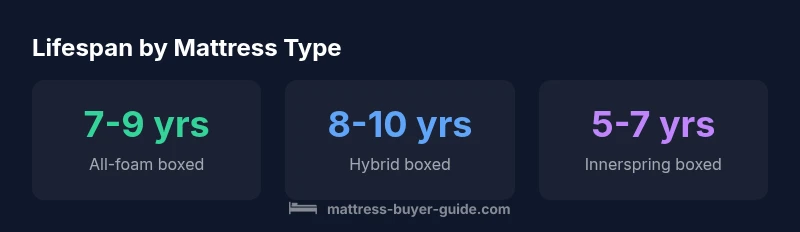
According to Mattress Buyer Guide analysis, the longevity of a boxed mattress largely tracks with its core materials and density, as well as how often it’s rotated and kept dry. In practice, standard, all-foam boxed mattresses typically fall in the 7-9 year window, while higher-density foams and premium hybrids can reach 8-10 years. Innerspring boxed mattresses are often shorter, typically 5-7 years, due to coil wear and sag points. It’s important to differentiate between density, durability, and performance: a mattress that feels supportive initially may sag earlier if the foam breaks down or the springs become misaligned. Warranties, finishing materials like edge support, and manufacturing quality all influence actual performance years beyond the nominal lifespan. Selecting a boxed mattress with robust edge support, a solid foundation, and higher-density foam layers tends to deliver better long-term value.
Factors that influence longevity
Longevity isn’t a fixed number; it’s an interaction of materials, construction, usage, and care. Density matters: higher-density foams resist softening and compression better over time. Coil systems in hybrids add resilience when paired with quality foams, but cheap coil systems can topple earlier due to sag points. Sleep position and body weight also shape wear patterns: heavier sleepers may experience faster compression in the same mattress. Environment matters too—excess moisture, temperature swings, or exposure to humidity can accelerate material breakdown. Finally, proper care, such as rotating every 1-3 months and using a supportive foundation, can help extend the usable life by several months to a few years depending on the baseline quality.
How mattress-in-a-box compares to traditional mattresses
Boxed mattresses offer comparable life expectancy to many traditional models when built with solid materials, but there can be differences in warranty terms and consumer behavior. Traditional mattresses may come with exchanges or trial periods that influence perceived longevity, while boxed models often emphasize density, edge support, and ease of transport. In general, foam-heavy boxed mattresses trend toward the 7-9 year range, hybrids toward 8-10, and innerspring toward 5-7, assuming similar maintenance. The key takeaway is to look for density metrics, warranty coverage, and proper support systems rather than rely on price alone.
Care, rotation, and usage patterns to extend life
Small habits add up. Rotate your boxed mattress 180 degrees every 1-3 months during the first year, then twice a year to distribute wear evenly. Use a proper foundation or slatted frame that provides uniform support and air circulation—this reduces moisture buildup and sag. Keep the sleeping environment clean and dry; moisture can degrade foam and encourage mold. If you notice visible sag or reduced edge support, address it early with a compatible foundation or mattress topper. Cleaning should be gentle—spot-clean spills promptly and avoid harsh chemicals that can weaken foam).
Warranty, price, and value when evaluating longevity
A longer warranty can signal confidence in durability, but read the fine print for sag and indentation thresholds. Compare the cost per year of expected lifespan to assess value: if a higher-quality boxed model lasts longer, annualized cost may be lower despite a higher upfront price. Consider the brand’s return policy and trial period; a lenient trial may reduce the risk of buying a mattress that doesn’t live up to expectations. In sum, longevity is about materials, construction, and care, not just the sticker price.
Material differences: memory foam, latex, and hybrids
Memory foam tends to contour well but can soften over time, offering 7-9 years of use in many boxed models. Latex tends to be more resilient and can push toward 8-12 years in some cases, though latex-filled boxed designs are less common and sometimes pricier. Hybrids combine coils with foam layers to balance comfort and support, often achieving 8-10 years when built with quality components. When shopping, check density figures (pounds per cubic foot) for foams and the coil count and gauge for springs to gauge possible longevity. Remember, a well-supported frame and proper room conditions still matter for all materials.
How to interpret longevity claims in product listings
Listings may advertise “lifetime comfort” or “up to 10 years” without disclosing indentation specs. Look for objective metrics: indentation limits (inches of sag), foam density, and the warranty’s coverage of sag beyond a threshold. Also consider real-world user reviews about long-term comfort. Longevity claims should be regarded as ranges with caveats tied to usage, body weight, and environmental conditions. The best approach is to pair the claim with the warranty and trial period to assess long-term fit for your sleep needs.
Practical decision framework by lifespan
When planning a purchase, segment options by your typical sleep profile and budget. If you’re a side sleeper with a lighter frame, a high-density foam or hybrid with good edge support may deliver reliable longevity in the 8-10 year range. If you’re heavier, prioritize thicker gauge coils and denser foams to resist sagging longer. Use this framework: (1) identify materials and density, (2) review warranty terms, (3) check support foundations, (4) estimate annualized cost per year of expected life, (5) factor in trial period and return options. This approach helps align expectations with actual lifespan.
2026 outlook: trends and shopper tips
In 2026, manufacturers continue to optimize boxed mattresses for durability with new foams and hybrid constructions. Shoppers should prioritize density, support, and warranty coverage, while remaining mindful of the total cost of ownership over time. As always, reading independent reviews, understanding the return policy, and considering a protective cover can help maintain longevity. Mattress Buyer Guide’s ongoing analysis emphasizes longevity as a function of both build quality and care routines—so commit to consistent rotation and a proper foundation to maximize value.
Estimated longevity by major boxed-mattress types
| Mattress Type | Estimated Lifespan | Notes |
|---|---|---|
| All-foam | 7-9 years | Higher-density foams improve longevity |
| Hybrid (foam + coils) | 8-10 years | Coil support plus foam durability |
| Innerspring | 5-7 years | Sag risk with coil wear |
| Latex (boxed where applicable) | 8-12 years | Natural resilience; less common in boxed formats |
FAQ
What is the typical lifespan of a boxed mattress?
Most boxed mattresses last between seven and ten years, depending on materials, density, and care. A good warranty and proper foundation can help you maximize that lifespan.
Most boxed mattresses last seven to ten years, depending on materials and care. A solid warranty and proper foundation can help you maximize that lifespan.
Do memory-foam boxed mattresses last longer than innerspring?
Memory foam boxed mattresses commonly fall in the seven to nine-year range, while innerspring boxed options typically run five to seven years. Hybrids often land in the eight to ten-year range when well constructed.
Memory foam boxes usually last seven to nine years; innerspring boxes around five to seven. Hybrids often reach eight to ten years with good build quality.
How can I extend the life of my boxed mattress?
Rotate regularly, use a supportive foundation, keep the sleeping environment dry, and address sagging early. Clean spills promptly and avoid moisture buildup.
Rotate it regularly, use a strong foundation, keep the room dry, and address sagging early.
What should I look for in a warranty for longevity?
Look for clear sag thresholds (e.g., inches of indentation) and what is covered, plus the duration and whether exchanges or refunds apply after a trial period.
Check sag thresholds, what's covered, how long it lasts, and if exchanges are available after the trial.
Does weight or sleeper type affect mattress longevity?
Yes. Heavier sleepers may experience faster wear, especially in foam layers or coil systems. Choose higher-density foams and sturdier coils if applicable to your body type.
Yes, weight and sleep style affect longevity; heavier sleepers should pick higher-density foams and stronger coils when available.
Is sagging always a sign to replace a boxed mattress?
Sagging beyond the manufacturer's threshold typically indicates reduced support and should be addressed, often via warranty or replacement options within the trial period.
Sagging beyond the threshold usually means it’s time to consider replacement or warranty options.
“"Durability for boxed mattresses comes down to materials, build quality, and care routines. Understanding the material differences (foam, latex, hybrids) helps shoppers set realistic expectations for lifespan."”
Highlights
- Know your mattress materials and density to gauge longevity
- Rotate regularly and use proper foundations to extend life
- Warranty length and coverage signal expected durability
- Consider total cost of ownership, not just price