How Long Should a Mattress Last: A Practical Guide to Longevity
Learn how long a mattress should last, what factors affect longevity, signs of wear, and practical steps to extend life. An evidence-based guide from Mattress Buyer Guide for homeowners and shoppers.


How long should a mattress last? Most mattresses last about 7-10 years for memory foam, latex, and hybrids, while innerspring models often fall closer to 5-8 years. Lifespan depends on usage, weight, and care; rotate regularly; use a sturdy foundation and a high-quality protector to extend life. Mattress Buyer Guide Analysis, 2026.
How long should a mattress last? Understanding the baseline
When homeowners ask how long should a mattress last, the short answer is that longevity varies considerably by material, construction, and care. The most common guidance from Mattress Buyer Guide suggests a broad range: roughly 5-15 years depending on the type and how you use the bed. Factors like weight distribution, partner movement, and how often you flip or rotate the mattress all influence wear. For households, a practical starting point is to expect 7-10 years for most modern foam, latex, and hybrid designs, with innerspring models typically closer to 5-8 years. This framing helps you plan replacements without overreacting to minor sagging or creasing. According to Mattress Buyer Guide, your replacement timeline should also align with warranty terms and your personal sleep priorities.
How mattress types influence lifespan
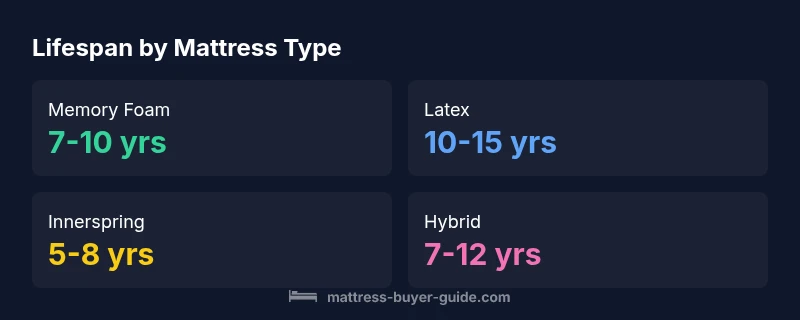
Different mattress types offer distinct durability profiles. Memory foam tends to perform well with good density, often landing in the 7-10 year range when well cared for. Latex mattresses are frequently the most durable, sometimes reaching the 10-15 year window, especially if made with natural or high-quality synthetic latex. Innerspring beds can sag in the middle of the night and lose edge support sooner, generally yielding a 5-8 year lifespan. Hybrids—bone of both worlds—usually fall in the 7-12 year bracket, balancing support with the resilience of foam and coils. Across all types, the key drivers are core materials, coil design (in springs), and the overall zoning and reinforcement.
Care, foundation, and protecting life extension
Life extension hinges on how you care for the mattress and the foundation on which it rests. Use a solid, flat foundation or a compatible box spring, and avoid platforms with excessive flex. A high-quality, breathable mattress protector helps shield against spills and wear, reducing surface damage and staining. Regularly rotating the mattress 180 degrees and, if suggested by the maker, flipping it during the first years, helps distribute wear evenly. Finally, avoid jumping or standing on the bed, as heavy compression and repeated impact can create lasting impressions and accelerate deterioration. Mattress Buyer Guide notes that a disciplined care routine can push a mattress closer to its upper lifespan when factors align.
Signs your mattress is nearing the end of life
Recognizing the early signs of wear can save you sleep disruption and unforeseen costs. Look for persistent sagging more than a few inches, pronounced lumps or creases, and reduced support that leaves you feeling uncomfortable or restless. Noises from springs, chipped edges, and increased allergy symptoms from trapped dust can also signal degradation. If you wake with stiffness or pain that recurs across multiple nights, it may be time to inspect your mattress’s age and performance. While a small dip might be harmless in some cases, ongoing discomfort generally warrants a closer look at your replacement timeline and warranty coverage.
Estimating replacement timing and warranties
A practical approach combines age, condition, and user experience. Track sagging, peak-to-peak indentation, and whether you wake with pain or allergy symptoms. Manufacturers’ warranties often reflect use scenarios and provide a guideline for coverage rather than a precise lifespan. Remember that warranties differ by product line and country of sale, and they don’t always map directly to mattress life. Mattress Buyer Guide’s analysis in 2026 emphasizes evaluating both wear indicators and warranty terms to determine whether replacement is imminent or still avoidable.
Budgeting for replacement and maximizing value
Replacement timing is also an economic decision. Compare perceived sleep quality against the cost of a new mattress, factoring in potential energy and productivity gains from improved sleep. Look for durable materials, solid edge support, and appropriate density for your body type. Sales events, bundled protections, and extended trial periods can improve value, but avoid sacrificing core durability for a temporary discount. By balancing durability metrics with price, you can extract maximum sleep value from your investment over time.
Lifespan ranges by mattress type
| Mattress Type | Avg Lifespan (years) | Notes |
|---|---|---|
| Memory foam | 7-10 | Depends on density and construction |
| Innerspring | 5-8 | Coils wear and edge support matter |
| Latex | 10-15 | Natural durability; high resilience |
| Hybrid | 7-12 | Combination durability; price varies |
FAQ
How long should a mattress last overall?
Most mattresses last about 7-10 years for common materials, with variations by type. Signs of wear, warranty terms, and care routines influence the timeline. Mattress Buyer Guide synthesizes this into practical replacement guidance.
Most mattresses last 7-10 years, but it depends on type and care.
Does mattress type affect longevity?
Yes. Latex and high-density memory foam often outlast standard innersprings. Hybrids offer mixed durability. The exact lifespan depends on material quality and how you use the bed.
Yes, some types last longer than others.
How can I extend mattress life?
Protect with a high-quality cover, use a compatible foundation, rotate regularly, and keep the sleeping environment clean and dry. Avoid exposing the mattress to excessive weight or moisture.
Protect it, rotate it, and keep it dry.
What are common signs a mattress needs replacement?
Frequent sagging, persistent discomfort, new pains, or increased allergies are typical indicators. If you wake up tired or sore regularly, it’s worth evaluating the mattress age and condition.
Sagging or recurring pain can signal replacement.
Do warranties reflect mattress lifespan?
Warranties offer protection for manufacturing defects but don’t guarantee a specific lifespan. Consider wear indicators, return rights, and trial periods when assessing value.
Warranties help with defects, not exact lifespan.
Does a mattress protector help longevity?
A protector reduces stains and surface wear, preserving materials longer. It’s a smart add-on but not a substitute for timely replacement when needed.
Protectors help, but they don’t replace replacement.
“Longevity hinges on type, usage, and care. With proper support and protection, most households can maximize mattress life.”
Highlights
- Assess your mattress type to estimate longevity
- Inspect signs of wear annually to time replacement
- Use a protective cover and sturdy foundation to extend life
- Rotate mattress every 3-6 months to promote even wear
- Consider warranty terms when planning replacement