What Mattress Lasts the Longest: A Durability Guide
Find which mattress lasts the longest and why durability depends on material, density, and construction. Compare memory foam, latex, hybrids, and innersprings to help you choose a long-lasting bed.


If you’re asking what type of mattress lasts the longest, the answer hinges on material quality and construction. Durable options typically feature high-density foams or natural latex, a strong support core, and reinforced edge support. In practice, latex, high-density memory foam, and well-made hybrid builds often outlast standard polyfoam or flimsy innersprings. Always check density, warranty, and coil gauge when evaluating longevity.
Why durability matters when answering what type of mattress lasts the longest\n\nDurability is the single most practical criterion when shopping for a long-lasting mattress. If you’re trying to answer what type of mattress lasts the longest, you can’t rely on luxury features alone; you need to verify core materials, density, and construction. According to Mattress Buyer Guide, durability is a function of material resilience, core support, and edge stability. In practice, the best-performing mattresses combine a robust core with resilient comfort layers that resist sag over years of use. The foundation also matters: a weak base or improper bed frame can dramatically shorten a mattress’s useful life, even if the top layers are excellent. Sleep consistency and supportive alignment depend on the bed staying flat and uniform, without soft spots that develop into permanent indentations. For homeowners and renters evaluating options, it is worth investing time to understand how material choices interact with your sleeping position, body weight, and established bedding setup. If you want a quick rule of thumb: durability signals—density, build quality, and warranty—usually predict long-term satisfaction more reliably than initial softness.\n
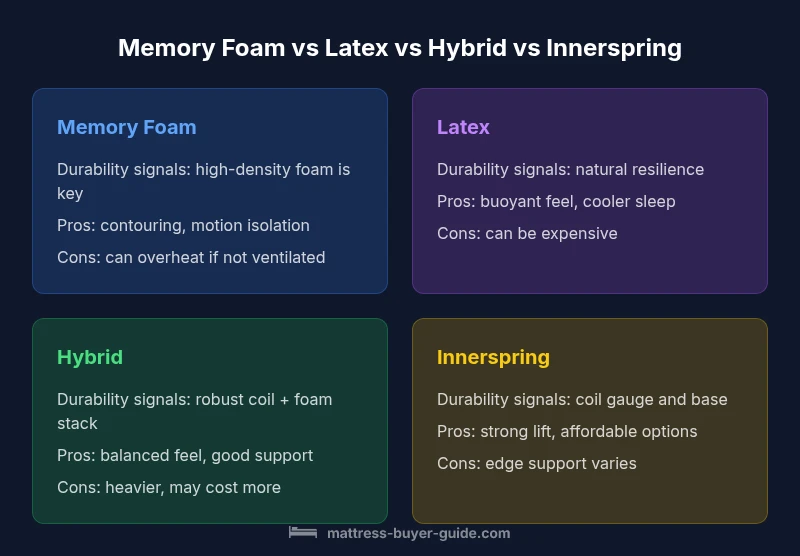
Core mattress types and their longevity expectations\n\nMemory foam vs latex vs hybrids vs innerspring each carry distinct durability profiles. Memory foam longevity hinges on density and how well the support core resists compression. Higher-density foams resist deep impressions longer and maintain contour. Latex tends to be exceptionally durable due to natural resilience and a robust cell structure; when real latex is used, durability improves with proper curing and density. Hybrids blend foam comfort with coil support; longevity depends on coil gauge, coil count, and the quality of the foam layers above and below. Traditional innersprings vary widely: entry-level models may sag sooner under heavier use, while higher-gauge coils and reinforced edge supports extend life. For buyers pondering what type of mattress lasts the longest, a balanced approach often yields the best results: choose a dense, well-supported core and ensure the top layers won’t prematurely compress.\n
Factors that influence longevity\n\nDurability is affected by multiple interacting factors. Material choice matters, but density, thickness, and the way layers are layered influence wear patterns. Strong edge support helps prevent roll-off and sag along the sides, a common failure point in cheaper mattresses. The bed foundation and frame must be stable; even the best mattress will sag if the base is weak or uneven. Temperature regulation and breathability influence how the foam ages; poor ventilation can cause accelerated breakdown in certain foams. Sleep position and weight distribution also matter: heavier individuals may experience more rapid compression in softer foams, revealing sag earlier than lighter sleepers. Finally, warranty terms and retailer replacement policies reflect manufacturer confidence and protect against early defects. When evaluating options, look for explicit density ratings, coil gauges, and edge reinforcement as durability indicators.\n
Materials and construction: memory foam vs latex vs hybrids\n\nMemory foam durability varies with density and formulation; latex durability depends on whether the latex is 100% natural and the grade used (Dunlop vs Talalay). Hybrids combine foam with coils; longevity hinges on the coil system and the foam stack above the base. The Mattress Buyer Guide team notes that high-density memory foam (3.5 pounds per cubic foot and above) tends to outlast lower-density foams, while natural latex offers resilience when properly manufactured. For many shoppers, longevity is optimized when the foam layer isn’t too soft and sits atop a solid core. A robust coil system with individual pocketed coils or a reinforced continuous coil layout supports the top layers and reduces wear from motion. In the end, durability is about the intersection of material resilience and architectural design: a durable foam that’s too soft or an inadequate coil system will fail to deliver long-term support.\n
Common longevity myths vs reality\n\nMyth: Latex lasts forever. Reality: latex is durable, but no material defies aging under constant load. Myth: Firm mattresses never sag. Reality: longevity depends on core quality and foundation, not just surface firmness. Myth: All-foam models wear faster than spring models. Reality: there are durable all-foam designs with high-density foam that outperform cheap springs. Myth: Longer warranties guarantee longer life. Reality: coverage details matter more than the number of years. By separating myths from reality, you’ll better interpret durability signals like density, coil gauge, edge reinforcement, and foundation quality.\n
How to estimate lifespan and plan replacements\n\nEstimate lifespan by evaluating three signals: material resilience, structural build, and foundation compatibility. Check warranty terms to understand coverage, and review what counts as a defect versus normal wear. Sag indicators—visible dips that impair support—are red flags. Your weight, sleep style, and frame compatibility influence wear; if you wake with stiffness or numbness, the bed may be aging. Instead of fixating on a year-count, use these durability cues to plan replacements within a general window based on materials and usage. Regular maintenance and rotation can slow aging and preserve evenness across the surface.\n
Maintenance and care to maximize durability\n\nTo maximize longevity, rotate the mattress every 3–6 months, use a proper foundation, and keep the cover clean and dry. Employ a breathable protector and avoid heavy, concentrated loads on one area. Vacuum the surface periodically and spot-clean stains promptly. Choose a frame with center support and avoid jumping on the bed or placing heavy items on it. Temperature control and airflow influence foam aging; keep the room within reasonable ranges and avoid damp environments. With thoughtful care, you can retain surface integrity and support longer.\n
Buying guide: durability signals to watch for\n\nWhen shopping, look for clear density ratings for memory foam, and verify the type and thickness of latex. For hybrids and innersprings, inspect coil gauge, coil count, and the presence of reinforced edge support. Foundation quality matters; verify the base and ensure it matches the mattress type. Compare warranties and return policies; a longer, comprehensive warranty often reflects durable construction. Seek third-party certifications (e.g., CertiPUR-US) for foam quality. Test for balanced support, consistent edge stability, and adequate contour without excessive compression. Finally, consider your budget in relation to total ownership cost—durable models may cost more upfront but save replacement costs over time.\n
Practical scenarios: families, couples, guests, and budgets\n\nDurability matters across many scenarios. In busy households with kids or pets, a resilient mattress resists wear and maintains support longer. Couples with different weights benefit from a durable core and edge reinforcement that keeps both partners on a level plane. For guests or vacation homes, a long-lasting mattress reduces replacement frequency and ongoing maintenance. Budget constraints require a smart trade-off: identify a model with proven durability signals rather than chasing the lowest price. When evaluating, imagine a full lifecycle—from initial comfort to several years of consistent sleep—and choose a mattress that remains supportive as it ages.\n
Feature Comparison
| Feature | Memory Foam | Latex | Hybrid | Innerspring |
|---|---|---|---|---|
| Core durability signals | High-density foam core or layered support | Natural or high-density latex core | Sturdy coil system with resilient foam stack | Reinforced coils with solid base and good edge support |
| Edge support | Moderate to good in many models | Excellent with robust edging and latex frameworks | Strong when coils and foam are well integrated | Varies; budget coils can sag at edges |
| Lifespan indicators | Density rating and warranty depth | Latex resilience and density | Coil gauge, counts, and foam quality | Coil quality and foundation compatibility |
| Best use case | Contouring with motion isolation for singles and couples | Natural resilience and cooler sleep | Balanced feel with strong support for diverse sleepers | Affordability with reliable basic support |
The Good
- Better long-term value due to resilience
- Lower sag risk with dense materials
- Strong support with reinforced cores in hybrids and latex
- Good overall performance across sleeping positions
Cons
- Higher upfront cost for durable options
- Heavier and harder to move
- Latex can be expensive and not allergy-friendly for some
- Potential heat retention in some memory foams without ventilation
High-density latex and memory foam options typically offer the longest lifespan; hybrids can match durability with robust coils.
Durability hinges on density, coil quality, and edge support. For lasting comfort, prioritize materials with proven longevity and ensure a solid foundation.
FAQ
Which mattress lasts the longest?
Latex and high-density memory foam tend to last longest; durability depends on density, core construction, and foundation. Always verify materials and warranty.
Latex and high-density memory foam are typically the longest lasting, depending on build quality.
Do hybrids last longer than memory foam?
Hybrid durability depends on coil quality; a robust coil system can extend life, but it also depends on foam layers. Compare coil gauge and layer thickness when evaluating longevity.
Durability of hybrids depends on the coil and foam stack; robust coils often result in longer life.
Is warranty a good predictor of durability?
Warranty length signals manufacturer confidence, but read the terms to understand what qualifies as a covered defect and what isn’t wear. Don’t rely on the years alone.
Warranty length helps, but terms and coverage matter more than the number of years.
Can bed frame affect mattress longevity?
Yes. A solid foundation prevents sagging and reduces premature wear. Ensure your frame complements the mattress type and provides center support where needed.
A good foundation and frame are essential for lasting durability.
How often should I replace a mattress for longevity?
Assess sagging, indentations, and loss of support. Replace when comfort or alignment deteriorates noticeably, not solely based on age.
Look for sagging or lost support to decide replacement.
Are memory foam mattresses durable for side sleepers?
Memory foam can be durable for side sleepers if density is high and pressure relief is adequate. Prioritize density and proper contouring without excessive compression.
Durability depends on density and how well the foam relieves pressure for side sleepers.
Highlights
- Check density and core signals before buying
- Latex and high-density memory foam commonly last longer
- Ensure edge support and a sturdy foundation
- Verify warranty terms and coverage specifics
- Maintain the mattress to maximize lifespan