Nectar Mattress vs DreamCloud: An In-Depth Comparison
A detailed, independent comparison of Nectar vs DreamCloud mattresses, focusing on construction, feel, cooling, durability, and value to help you pick the right bed for your sleep style and budget.


Nectar mattress vs DreamCloud: for most sleepers, a foam Nectar offers soft pressure relief and a budget-friendly option, while DreamCloud's hybrid delivers stronger edge support and cooler airflow. The right pick depends on your sleep position, budget, and tolerance for bounce. According to Mattress Buyer Guide, evaluate feel, temperature, and durability before deciding.
Nectar vs DreamCloud: what this comparison covers
When evaluating nectar mattress vs dreamcloud, the core question is whether you want an all-foam feel or a hybrid design that blends foam comfort with a coil system. Nectar is primarily an all-foam model, delivering generous pressure relief and a softer, cradle-like feel ideal for side sleepers who want to contour around the shoulders and hips. DreamCloud, by contrast, pairs a memory-foam comfort layer with a pocketed coil core, offering more lift, stronger edge support, and generally more bounce. This article uses a practical, user-centered lens to help homeowners, renters, and shoppers compare these two popular choices without relying on marketing claims. Mattress Buyer Guide perspective emphasizes real-world considerations like sleeping position, heat management, durability, and long-term value.
Key takeaway: the Nectar vs DreamCloud decision hinges on your preferred balance between softness, support, and cooling dynamics, plus how much you value a hybrid construction versus a pure foam option.
Construction and feel: foam vs hybrid
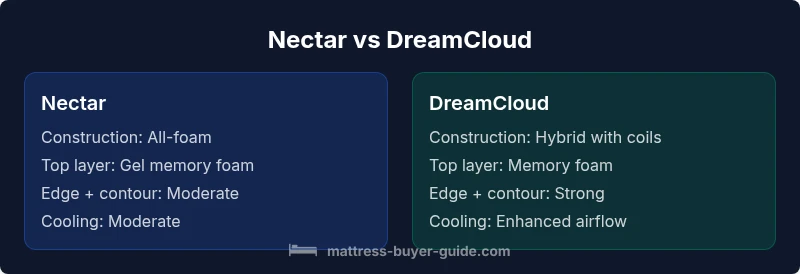
Nectar’s construction is predominantly all-foam, featuring a gel-infused memory-foam comfort layer designed to cushion pressure points and adapt to body shape. The support core consists of high-density foam that provides foundational stability while keeping the overall feel relatively soft. This combination yields a plusher, body-hugging experience that is especially appealing for lighter-to-average-weight sleepers who prioritize pressure relief over springy bounce. DreamCloud, on the other hand, uses a hybrid configuration: memory-foam comfort layers sit above a pocketed-coil system that supplies more lift and resilience. The coils contribute to a more buoyant feel, improved responsiveness, and enhanced edge support, which can be advantageous for larger sleepers or couples who share the bed. In practical terms, expect Nectar to feel more contouring and DreamCloud to feel more neutral with a touch of bounce.
Comfort profiles across sleeping positions
Side sleepers typically benefit from Nectar’s generous contouring across the shoulder and hip regions, which reduces pressure points in the hips and shoulders. Back sleepers often appreciate DreamCloud’s hybrid lift, which can promote spinal alignment with a slightly firmer midsection. Stomach sleepers may prefer the firmer support of the DreamCloud’s coil system to prevent excessive sinkage, though comfort is ultimately dependent on body weight and mass distribution. If you share the bed with a partner, consider how each mattress handles motion transfer: foam surfaces like Nectar excel at limiting motion transfer, while hybrids like DreamCloud offer reliable support with slightly more room for movement without disturbing your partner. According to Mattress Buyer Guide, matching the feel to your preferred sleep position is a decisive factor in long-term satisfaction.
Edge support, motion transfer, and bounce
Edge support is a practical concern for couples who sleep near the sides of the bed or sit on the edge to put on shoes. Nectar’s all-foam structure provides solid relief but can show softer edges, especially as the bed wears. DreamCloud’s pocketed coils reinforce the perimeter, delivering stronger edge support that helps you use more of the mattress surface. Motion transfer is typically excellent with Nectar, thanks to its dense foam layers damping movement, which can be beneficial for light sleepers and shift workers who share a bed. The DreamCloud hybrid offers noticeable bounce from its coil core, improving ease of movement and getting in/out of bed, but you may notice slightly more motion transmission than a pure foam model.
Temperature regulation and materials
Foam-based mattresses can trap heat for some sleepers, and Nectar is no exception, though gel-infused foams aim to mitigate warmth. DreamCloud’s hybrid construction tends to promote better airflow through the coil grid, potentially delivering a cooler sleep surface for people who overheat at night. The cover materials differ as well; Nectar typically uses a breathable, knit cover, while DreamCloud emphasizes a breathable blend that complements the open coil system. Mattress Buyer Guide notes that cooling performance varies by individual, so consider your own sleep temperature patterns when evaluating these options.
Durability, warranty, and sleep-trial philosophy
Durability is strongly influenced by the core materials: dense all-foam cores can resist sagging but may soften unevenly with heavy use, whereas hybrids combine foam comfort layers with a coil base that can resist long-term indentation. Both Nectar and DreamCloud offer substantial sleep trials and multi-year warranties, which provide important protections if you discover sagging or comfort issues after moving the mattress into your own bedroom. Mattress Buyer Guide highlights that a robust warranty and a generous trial period increase confidence in any purchase, especially when choosing between foam and hybrid designs.
Price, value, and buying considerations
Price is a central factor in many shoppers’ decisions. Nectar is generally positioned as a more budget-friendly option within the foam category, while DreamCloud sits in the premium-for-hybrid tier due to its coil system and additional materials. When evaluating value, consider how long you expect to keep the mattress, your sleep position, and how the feel aligns with your personal preferences. The ultimate value is not just the sticker price but how well the mattress supports restorative sleep over time, reduces pressure points, and minimizes the need for replacements or secondary toppers. Mattress Buyer Guide suggests weighing total cost of ownership, including potential maintenance and shipping returns, to determine true value.
Comparison
| Feature | Nectar Mattress | DreamCloud Mattress |
|---|---|---|
| Construction type | All-foam | Hybrid (memory foam over pocketed coils) |
| Top layer material | Gel-infused memory foam | Memory foam over coils with plush top |
| Core support | High-density foam base | Pocketed coil system with reinforced core |
| Edge support | Moderate edge support | Excellent edge support due to coils |
| Cooling | Moderate cooling; foam can trap heat | Better airflow from coils; cooler feel for many sleepers |
| Motion isolation | Excellent motion isolation (foam) | Very good motion isolation with pocketed coils |
| Bounce | Low bounce; contouring feel | Moderate bounce from hybrid core |
| Trial period and warranty | Long trial; multi-year warranty (exact terms vary by retailer) | Long trial; multi-year warranty (exact terms vary by retailer) |
| Price range | Mid-range, value-oriented | Premium price tier for hybrids |
The Good
- Strong pressure relief and contouring for many side sleepers
- Long sleep trials and robust warranties across both options
- Nectar offers excellent value for budget-conscious shoppers
- DreamCloud delivers strong edge support and cooler airflow in practice
- Both options suit a range of sleeping positions with appropriate weighting
Cons
- Foam models can run warmer for some individuals
- Hybrid designs tend to be heavier and more expensive upfront
- Motion transfer and bounce may be more noticeable on hybrids
- Some sleepers may prefer a firmer or firmer-feel option beyond these two
DreamCloud edges Nectar on edge support and cooling, but Nectar wins on value for budget-minded shoppers.
If you want a cooler, more supportive feel with easier edge use, choose DreamCloud. If you prioritize cost-efficiency and deep pressure relief from foam, Nectar is the better value. The final call depends on your sleep position and temperature preference.
FAQ
What are the main differences between Nectar and DreamCloud?
Nectar is an all-foam mattress focused on contouring and pressure relief, while DreamCloud combines memory foam with a pocketed coil system for lift and edge support. The feel, temperature dynamics, and durability profiles reflect these core constructions.
Nectar is a soft foam bed, and DreamCloud is a foam-on-coil hybrid. Your choice should hinge on whether you want more contouring or more support with airflow.
Which mattress is better for side sleepers?
Side sleepers generally benefit from Nectar’s plush contouring, which helps relieve shoulder and hip pressure. DreamCloud also works for many side sleepers but may feel firmer due to its hybrid core.
If you sleep on your side, Nectar might be gentler on pressure points, but try DreamCloud if you need more lift and edge support.
Is Nectar cooler than DreamCloud?
DreamCloud’s coil core usually promotes better airflow, which can translate to cooler sleep for many people. Nectar relies on gel memory foam to reduce heat but can still feel warmer for some.
DreamCloud often stays cooler due to its coils, while Nectar relies on gel foam to manage heat.
Do Nectar and DreamCloud offer trials and warranties?
Both brands provide extended sleep trials and multi-year warranties, designed to protect your investment and allow for at-home testing before fully committing.
Both come with long trial periods and strong warranties, so you can try them at home and know you’re protected.
How do these mattresses compare in durability?
Durability depends on core materials: foam cores tend to resist compression but can sag with heavy use, while hybrids benefit from coil systems that resist indentation. Expect both to perform well with proper care, though hybrids may maintain edge support longer.
Foam beds can sag, but hybrid coils usually hold up well. With care, both can last several years.
Which one is more affordable?
Nectar generally sits in a lower price tier for foam mattresses, while DreamCloud sits higher in the hybrid market. Your final choice should balance upfront cost with long-term value and durability.
Nectar is typically cheaper; DreamCloud costs more but offers hybrid benefits.
Highlights
- Compare foam versus hybrid when sleep position matters
- Consider cooling needs and edge support priorities
- Factor in trial periods and warranties for long-term value
- Nectar suits budget-conscious, side-sleepers; DreamCloud suits those who want support and airflow
- Test both options at home to verify comfort before deciding