Air Mattress vs Regular Mattress: Which Should You Choose?
Explore air mattresses vs regular mattresses: comfort, support, durability, price, and care. Make an informed choice with practical guidance for better sleep and smarter purchases in 2026.


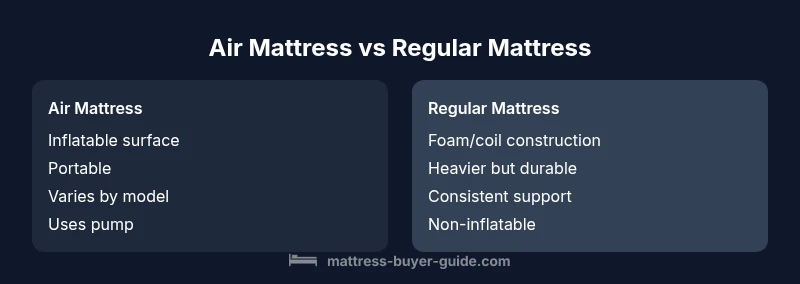
Air mattress vs regular mattress represents a balance between flexibility and long-term comfort. For guests, travel, or temporary spaces, an air mattress shines with setup speed and portability. For daily sleep and lasting support, a regular mattress typically provides better spinal alignment and durability. Your choice should align with use, space, budget, and maintenance willingness.
Overview: Air mattress vs Regular mattress in everyday life
When you compare air mattress vs regular mattress, the decision hinges on how you plan to sleep, where the bed will live, and how often you'll move it. For many households, an air mattress is a flexible tool for guests, college dorms, or temporary setups. It inflates quickly, stores flat, and can be used in rooms that don’t have a dedicated bed. In contrast, a traditional regular mattress is designed for daily, long-term use and tends to deliver more consistent support, zoning, and temperature regulation over time. Mattress Buyer Guide, drawing on analysis from 2026, emphasizes that the choice should align with your sleep goals, space constraints, budget, and maintenance tolerance. Understanding the trade-offs helps you avoid buyers’ remorse and improves sleep quality, because the right mattress is not simply the cheapest or newest, but the one that matches your body's needs and your home's routines.
Comparison
| Feature | Air mattress | Regular mattress |
|---|---|---|
| Comfort and sleep feel | Variable; depends on model and built-in surface/topper | Generally more uniform due to stable foam or coils |
| Support and spinal alignment | Can be sag-prone on low-end models; high-quality air beds with good toppers can offer solid support | Typically better-long term alignment with foam/coil systems |
| Durability and longevity | Varies; puncture risk and seam wear | Longer lifespan with durable materials and construction |
| Portability and storage | Inflates/deflates; packs flat for easy storage | Bulkier and heavier; less portable when not in use |
| Maintenance and cleaning | Requires pump, regular checks for leaks; topper may be needed | Lower maintenance; occasional cleaning and rotation |
| Price range | $40-$300 (entry to mid-range) | $400-$1500 (mid to high end) |
| Best for | Temporary guests, travel, rental homes, camping setups | Long-term daily sleep in bedrooms, master suites, or guest rooms |
The Good
- Lower upfront cost on many models
- Extraordinary portability and easy storage
- Versatile for guests, travel, and temporary spaces
- Can be used with toppers to improve comfort
Cons
- Generally shorter lifespan and more susceptibility to leaks
- Comfort and support vary widely by model
- Requires pump and accessories for optimal use
- Less durable for daily, year-round sleep
Regular mattresses excel for daily, long-term sleep; air mattresses shine for guests, travel, and temporary setups.
Choose a regular mattress when sleep quality and durability are priorities for everyday use. Opt for an air mattress if you need fast setup, easy storage, or a flexible guest/travel solution. Balance cost, space, and how often the bed will be used to guide your decision.
FAQ
Can I use an air mattress as my main bed every night?
It can work with high-quality models and proper support, but most people find it less ideal for long-term daily sleep due to durability and consistency concerns.
You can, but for daily use most people prefer a regular mattress for better long-term comfort and support.
Are air mattresses comfortable for back sleepers?
Comfort depends on firmness, surface stability, and topper use. Many back sleepers prefer a firmer surface; adding a topper can improve alignment.
Back sleepers often do best with a firmer air mattress or a topper to support the spine.
What sizes are available for air mattresses vs regular mattresses?
Air mattresses come in common sizes like twin through king. Regular mattresses span standard sizes from twin to king, with many comfort and height options.
Air mattresses come in typical bed sizes, and regular mattresses cover standard sizes from twin to king.
How should I care for an air mattress to extend its life?
Protect from sharp objects, avoid over-inflation, rotate occasionally, and inspect for leaks. Use a fitted sheet or topper to reduce wear on the surface.
Keep it clean, check for leaks regularly, and don’t over inflate.
Do air mattresses require a topper or memory foam layer?
A topper or padded mattress pad significantly improves feel and support on many air mattresses.
A topper can make a big difference in comfort on an air mattress.
What about warranties for air vs regular mattresses?
Warranties vary by brand. Air mattresses often have shorter or more limited warranties; read the terms before buying.
Check the warranty details to understand coverage for punctures or seam failure.
Highlights
- Assess your primary use: daily bed vs temporary setup
- Prioritize durability for daily use and convenience for guests
- Consider toppers to improve air mattress comfort
- Budget for maintenance: pump, sheets, and potential leaks
- Choose regular mattress for a permanent sleep space; air mattress for travel or guest rooms