Coil Mattress vs Spring Mattress: A Practical Comparison
Compare coil mattress vs spring mattress to understand coil design, support, cooling, durability, and price. Learn which innerspring option fits your sleep style and budget with practical guidance from Mattress Buyer Guide.


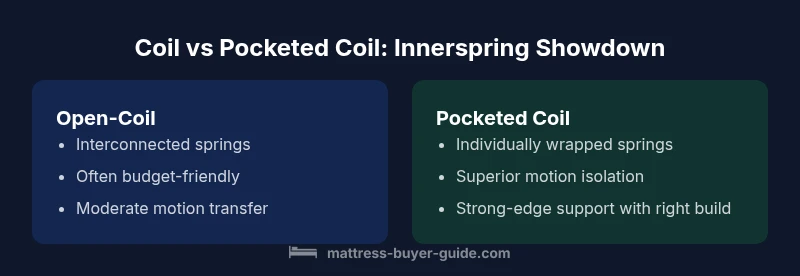
Coil mattress vs spring mattress: both refer to innerspring constructions, but they differ in coil design and performance. Pocketed or individually wrapped coils tend to isolate motion better and contour more precisely, while open-coil systems often feel plusher and cost less but transfer movement more and may wear unevenly. This quick comparison helps you decide which innerspring option fits your sleep style.
What is a coil mattress? Defining terms
A coil mattress is an innerspring bed built around a support core made of metal coils. The term “coil mattress” is often used interchangeably with “spring mattress,” but the coil design matters more than the label. Traditional open-coil systems use interconnected coils, creating a shared spring network that can feel plush but may allow motion to transfer across the quilted top. Pocketed-coil, or individually wrapped coils, encase each spring in fabric and move independently. This distinction matters for support, contouring, and durability. According to Mattress Buyer Guide, the label you see on a mattress is less predictive than how the coils are arranged and how the comfort layers interact with the core. When shopping, focus on the coil type, coil count, gauge, and how the top layers complement the core.
Coil designs and what they mean for support
Coil design is the backbone of comfort in innerspring mattresses. Open-coil systems use continuous or interconnected springs; their shared movement can yield a more uniform feel but often sacrifices precise contouring. Pocketed coils, by contrast, respond to individual body regions, enabling targeted support and reduced partner disturbance. The result is often improved spinal alignment for many sleepers, particularly when paired with well-chosen comfort foams or latex. The Mattress Buyer Guide team notes that the best choice depends on your weight distribution and preferred firmness, not just the advertised firmness rating. Always verify the coil configuration (open vs pocket) and pair it with an appropriate comfort layer to achieve your desired feel.
Comfort and contouring: how you’ll actually feel the support
Comfort is a product of the entire stack, not just the coils. A pocketed-coil design can offer cradling contour with less movement transfer, while open coils may feel bouncier and more forgiving for certain sleepers. The top layer—whether memory foam, latex, or standard polyfoam—controls pressure relief and responsiveness. For side sleepers who need shoulder and hip relief, a well-cushioned top layer over pocketed coils often provides better pressure distribution. Stiffer options tend to resist deep compression, which can be favorable for back and stomach sleepers seeking spinal alignment, provided the top material still permits adequate contour. Mattress Buyer Guide emphasizes trying multiple configurations in-store or via trial periods to assess comfort across positions.
Motion isolation and noise: who benefits most
Motion transfer is a common concern for couples or sleepers who move frequently during the night. Pocketed coils generally reduce motion transfer because movements do not travel through a single rigid core. Open-coil designs, especially budget variants, tend to transfer more movement, making it easier to feel a partner’s turns. Noise levels vary by coil quality, the core’s stiffness, and the top layers. Higher-quality pocketed designs can minimize squeaks and creaks, while budget options—whether open or pocketed—may produce audible disturbances over time. Badly maintained or low-density padding can amplify noise and reduce the perceived stability of the sleep surface.
Temperature regulation and breathability
Breathability largely depends on the overall sleep surface, not just the coil type. Traditional open-coil cores can promote air exchange, but dense padding can trap heat. Pocketed coils paired with breathable fabrics and lightweight foams tend to stay cooler for many sleepers, especially when the cover includes moisture-wicking properties. If you sleep hot, look for combinations featuring open-core airflow plus a breathable top layer, or consider adding a breathable mattress protector to improve airflow. The best approach is to evaluate both the coil type and the surrounding materials designed for temperature control.
Edge support and long-term durability
Edge support is essential for sitting on the mattress edge, minimizing roll-off, and maximizing usable surface area. Pocketed coils with a reinforced edge often maintain shape longer, providing consistent support across the entire surface. Open-coil mattresses may show edge compression earlier, particularly with lower-density foams or thinner edge reinforcements. Durability hinges on coil gauge, the number of coils per square meter or foot, and the robustness of the comfort layers. A well-constructed pocketed-coil unit can sustain performance longer, but cheaper open-coil designs may degrade quickly if padding or border wire is compromised.
Maintenance, care, and lifecycle expectations
Maintenance is straightforward for most innerspring mattresses: rotate as recommended, use a mattress protector, and keep a consistent support system (bed frame or foundation). Regular rotation helps distribute wear evenly, reducing the risk of localized sag. If your coils begin to creak or you notice uneven indentation, it may indicate an impending failure, particularly in lower-end open-coil designs. Lifespan varies by build quality, with higher-end pocketed coils and thicker padding typically delivering longer service, while budget options may need replacement sooner. Mattress care plays a crucial role in preserving comfort and structural integrity. Mattress Buyer Guide recommends pairing any innerspring with a compatible foundation and periodic re-evaluation of sleep needs as bodies and preferences evolve.
Price, value, and what you’re really paying for
Price differences between coil designs reflect coil quality, count, and padding. Pocketed-coil mattresses often command higher upfront costs due to individualized coil movement and enhanced durability, while good open-coil configurations can offer excellent value when paired with well-chosen top layers. Don’t rely on price alone; compare coil type, edge reinforcement, padding thickness, and warranty terms. A higher upfront price can translate into longer lifespan and better sleep quality, but only if the core construction and top layers are sound. Mattress Buyer Guide notes that the best value emerges when you balance initial cost with expected lifespan, comfort, and warranty protection.
Sleep position, weight, and choosing the right coil system
Your ideal coil mattress depends largely on your sleep position and weight distribution. A pocketed-coil design with zoned support can be beneficial for back and side sleepers who require targeted alignment, while firmer open-coil mattresses may suit stomach sleepers who prioritize a stable, flat surface. Heavier individuals often benefit from denser coils and stronger edge support to prevent sag, whereas lighter sleepers may prioritize contouring and motion isolation to reduce partner disturbance. Take into account your typical sleep position, weight range, and whether you share the bed with someone else when evaluating options.
Brand quality, warranty, and certifications to watch for
Select brands that clearly disclose coil type, density, and warranty coverage. Certifications regarding emissions or durability claims provide added reassurance, but always cross-check with independent reviews. Look for generous trial periods, robust return policies, and clear guidance on how to interpret durability claims. For reference, the Mattress Buyer Guide team emphasizes emphasizing long-term comfort and warranty coverage over short-term price advantages.
Real-world scenarios: when to choose coil design A vs design B
If you’re a couple who moves during the night and values minimal disturbance, pocketed coils with a breathable top layer are often preferable. If you’re on a tighter budget and want a straightforward, cooler sleeping surface, a high-quality open-coil mattress with a light comfort layer can offer good performance while remaining affordable. For back pain, prioritize zoned support with reliable edge reinforcement and a firm but comfortable top layer, regardless of coil type. In mixed-sleep scenarios, aim for a balanced setup: pocketed coils for motion isolation and a well-designed comfort system to keep the spine neutral.
Buying checklist: steps to take before purchase
- Confirm coil type and count; higher counts with pocketed coils usually correspond to better support and durability.
- Check for zoned support options that align with your primary sleep position.
- Assess edge support and pillow-top or comfort layer thickness to ensure durability.
- Evaluate dust-mmite resistance and fabric breathability for long-term hygiene.
- Test firmness across several sleep positions, and verify warranty and return terms.
- Read independent reviews and compare across retailers to assess real-world performance.
Summary of where coil designs typically shine
Pocketed-coil mattresses excel in motion isolation, contouring, and targeted support, especially when paired with quality top layers. Open-coil mattresses often provide excellent value and simpler construction, with softer initial feel and robust cooling potential when designed with breathable padding. The best choice depends on your priorities: budget, motion needs, temperature preferences, and desired longevity. Mattress Buyer Guide suggests testing multiple configurations to identify the surface that best matches your sleep health goals.
comparisonTableVersionedInline":true},
Comparison
| Feature | Open-coil innerspring | Pocketed-coil innerspring |
|---|---|---|
| Coil design | Traditional interconnected coils | Individually wrapped coils |
| Motion isolation | Low to moderate | Excellent when well-made |
| Edge support | Variable; weaker in budget models | Typically strong with reinforced edges |
| Durability | Good in mid-range; varies by padding | Strong in high-quality builds; longer lifespan |
| Cooling/breathability | Can be cooler with airy top layers | Excellent with breathable cores and materials |
| Price range | Lower upfront costs common | Higher upfront costs for premium options |
| Best for | Budget buyers, value-conscious shoppers | Partners, hot sleepers, those seeking contouring |
The Good
- Widely available and affordable entry options in both designs
- Good foundation for various comfort layers and toppers
- Clear labeling helps buyers compare features
- Opportunity to tailor firmness with top layers and padding
Cons
- Open-coil can transfer motion and sag more with cheaper builds
- Pocketed coils may be pricier and require careful selection of padding
- Quality varies widely; lower-cost models may underperform durability and edge support
- Not all pocketed designs deliver strong edge support unless reinforced
Pocketed-coil innerspring generally offers better motion isolation and contouring, provided you choose a high-quality build; open-coil remains a solid budget-friendly option when paired with thoughtful padding.
If you sleep with a partner or value zoned support, pockets coils are often worth the extra cost. For solo sleepers on a budget, a well-made open-coil mattress can still deliver solid comfort and cooling.
FAQ
Is a coil mattress the same as a spring mattress?
The terms are often used interchangeably, but the coil system matters more. Coil mattresses refer to the core design (open-coil vs pocketed), while “spring” is a broader label. Performance depends on coil arrangement and the comfort layers that surround the core.
Coil and spring mattresses are often the same idea, but the coil type is what really counts.
Which is better for back pain: open-coil or pocketed coils?
For many people, pocketed coils with zoned support provide better alignment and targeted comfort, especially when paired with a supportive top layer. Back-pain sufferers should prioritize spine alignment, firmness balance, and edge support rather than coil type alone.
Pocketed coils with good zoning often help with back pain, but every sleeper is different.
Are coil mattresses cooling compared to foam?
Coils themselves don’t trap heat like high-density foam; airflow is influenced by the coil arrangement and top layers. Pocketed designs with breathable padding can stay cooler, but overall cooling depends on the entire mattress stack.
Coils breathe better than foam, but the top layers matter too.
How long do innerspring mattresses last?
Lifespan varies with build quality and use. Higher-quality pocketed coils with durable padding tend to last longer than budget open-coil options, which may sag sooner with heavy use.
Quality counts—good pocketed coils can last many years with proper care.
What should I look for when buying a coil mattress?
Check coil type and density, coil gauge, edge reinforcement, and the comfort layer. Test firmness across positions, review warranty terms, and consider trial periods to ensure lasting comfort.
Look for coil quality, edge support, and a solid warranty.
Do coil mattresses sag over time?
All mattresses sag with use, but higher-quality coils and sturdy padding reduce premature sag. Avoid very low coil counts and weak border support to minimize long-term indentation.
Sag can happen, but better builds resist it longer.
Highlights
- Prioritize coil type and contouring, not just advertised firmness
- Pocketed coils usually excel in motion isolation and edge support
- Open-coil options can offer strong value with proper padding
- Check warranty and foundation compatibility to avoid sag
- Test multiple configurations to find the best sleep surface for you