Foam Mattress vs Spring: A Comprehensive Comparison
Compare foam and spring mattresses across support, cooling, motion isolation, durability, and price. This Mattress Buyer Guide analysis helps sleepers choose the right mattress type for their sleep style and budget.


In the foam mattress v spring comparison, foam mattresses typically offer contouring and motion isolation, while spring models emphasize bounce and airflow. The best choice hinges on your priorities: pressure relief, cooling, durability, and how you sleep. For couples or those who share a bed, foam often delivers quiet, pressure-relieving sleep, whereas spring options can provide responsive support and better edge strength.
What foam mattress v spring comparisons mean for sleep
When we talk about the foam mattress v spring debate, the core distinction is how each system delivers comfort and support. Foam mattresses rely on polyurethane foams of varying densities (and sometimes memory foam or gel-infused foams) to contour to your body. This contouring can reduce pressure points, align the spine, and minimize motion transfer. Spring mattresses, by contrast, use coil systems—whether pocketed coils or Bonnell/open-coil designs—to offer a different balance of lift, bounce, and airflow. For sleepers who value a quick response and a traditional bounce, springs can feel more energetic. For those who prioritize sleep ergonomics and a cloud-like feel, foam often wins. Mattress Buyer Guide’s team notes that the final choice should align with your primary sleep priorities and room conditions, such as heat dissipation and space constraints.
Core technologies and how they shape feel
The technology behind foam and spring mattresses drives the difference in comfort zone and durability. Foam types span memory foam for slow recovery and deeper contour, to high-resilience polyfoam for more bounce and quicker rebound. Gel-infused foams and open-cell structures are designed to improve breathability, yet the degree of cooling varies by density and manufacturing. In the spring realm, the coil type—pocketed vs grid, gauge thickness, and coil count—determines support, edge strength, and motion transfer. Sleepers with a heavier build often notice that high coil counts or zoned support systems dampen sinkage and help maintain spinal alignment, while lighter sleepers may enjoy the gentler feel of dense foams.
Comfort and pressure relief dynamics
Pressure relief is a frequent reason to choose foam, especially for side sleepers who target the shoulders and hips. Foam’s conforming nature provides a cushiony cradle that can reduce hotspots but may feel different at the hips for back sleepers. Spring mattresses can deliver a responsive lift that keeps the hips from sinking too deeply, which some back and stomach sleepers prefer. In many cases, a hybrid approach—combining foam comfort layers with a coil support core—offers a middle ground with both contouring and bounce. Mattress Buyer Guide emphasizes trying both options in a real sleep test to assess whether your preferred positions and movements remain comfortable through the night.
Support and spinal alignment considerations
Support systems are central to how well a mattress maintains neutral spine alignment. Foam must be sufficiently dense to prevent excessive sinkage under heavier parts of the body, which some foam models achieve with higher-density foams and reinforced transitional layers. Springs rely on the coil network to provide lift; rigid spring designs can offer sturdy edge support but may be less forgiving around the shoulders and hips if the top foam layers are too plush. For people with back pain, a well-constructed foam mattress with zoned support or a hybrid that places a supportive middle layer can deliver consistent alignment across sleep positions. The Mattress Buyer Guide team notes that testing alignment in side, back, and stomach positions is essential when evaluating foam v spring.
Temperature regulation and cooling performance
Cooling is a perennial concern for many shoppers. Foam tends to trap heat more than springs when the foam density is high or the structure is dense, though modern foams incorporate gel infusions, open-cell architectures, and phase-change materials to address this issue. Springs typically facilitate better airflow through the grid-like coil system, which can help with cooling, especially in warmer climates or for hot sleepers. However, a poorly designed spring mattress with dense padding can still sleep warm. The right combination of comfort layers and ventilation is key to achieving the temperature profile you desire.
Durability and edge strength over time
Durability depends on materials quality, usage, and care. High-density foams tend to hold their shape longer than cheaper foams but may still soften with time, leading to more pronounced impressions. Spring systems can maintain bounce longer with quality coils and proper encasement, but sagging can occur around the edges if edge supports are weak or coils wear unevenly. Hybrids, which blend foam comfort layers with a coil core, aim to balance durability and contouring. Mattress Buyer Guide highlights that periodic rotation and avoiding excessive weight on the edges can extend the life of either design.
Motion transfer and suitability for couples
Motion isolation is typically stronger in all-foam mattresses, making them popular for couples when one partner moves or shifts position. Springs often allow more movement to be felt across the surface, though pocketed-coil designs can offer good isolation if paired with dense top foams. For couples who wake easily from partner movement or who share a bed with different temperature preferences, foam can provide a quieter and more stable surface, while a well-designed spring or hybrid can offer a more balanced blend of responsiveness and isolation.
Noise, odor, and environmental considerations
All-foam beds are generally quiet, emitting minimal mechanical noise since there are no springs to creak. Spring models can produce some noise over time as coils settle or when worn. Both types can have initial off-gassing odors from new foams or adhesives; most odors dissipate after a short break-in period with proper ventilation. From an environmental perspective, some foams are offered in recycled or plant-based formulations, and coil manufacturing practices vary by brand. Consumers who are sensitive to odors or who value eco-friendly options may wish to explore certifications and materials lists during the shopping process.
Care, maintenance, and lifecycle costs
Maintenance influences long-term comfort and value. Foam mattresses typically benefit from rotating or flipping (if the design allows) to prevent uneven wear, while springs benefit from regular flipping and checking for sagging. Cleaning is generally straightforward for both types, with stain guards and protectors enhancing longevity. Over time, replacement costs can accrue; foam models with high-density layers may be more expensive upfront but could offer longer perceived comfort, whereas spring models can deliver robust support at a lower initial price depending on construction. Mattress Buyer Guide suggests evaluating warranties, return policies, and mattress age estimates to gauge lifecycle costs.
Comparison
| Feature | Foam mattress | Spring mattress |
|---|---|---|
| Core material | Foam (memory/polyurethane) | Coil-based system (pocketed or open-coil) |
| Support system | Solid foam layers with transition foams | Coils with potential zoned support |
| Pressure relief | High contouring, great for pressure points | Moderate to strong depending on coil and padding |
| Motion isolation | Excellent, especially with memory foam | Good to moderate depending on coil type |
| Cooling | Can sleep warm without cooling features | Better airflow through coils; varies by cover and padding |
| Durability | Durability varies; high-density foams last longer | Coils can resist sag with quality design but may wear over time |
| Best for | Sleepers who want contouring and quiet nights | Couples seeking bounce and airflow |
| Price range | Mid to high depending on foam type and density | Mid to high for quality coils; cheaper options exist |
The Good
- Excellent pressure relief and contouring
- Superior motion isolation for light sleepers
- Wide variety of firmness and density options
- Quiet operation with minimal noise
Cons
- Potential heat retention without cooling features
- Off-gassing concerns with some foams
- Edge support can be weaker on some all-foam designs
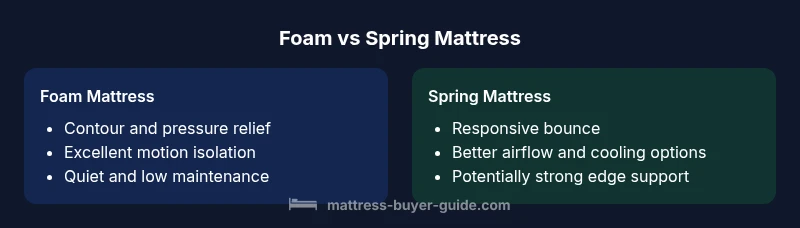
Foam mattresses excel in pressure relief and quiet motion isolation; spring mattresses excel in bounce, edge support, and cooling potential.
Choose foam if contouring and minimal partner disturbance are priorities. Choose spring if you value responsiveness and airflow. For many sleepers, a well-designed hybrid can offer the best of both worlds.
FAQ
What is the main difference between foam and spring mattresses?
Foam mattresses contour to the body and excel at motion isolation, while spring mattresses offer more bounce and potential airflow. Your choice should hinge on whether you prioritize pressure relief or responsiveness.
Foam contours for pressure relief and quiet nights; springs are bouncy and breathable. Pick based on whether you want contouring or responsiveness.
Which mattress type is better for back pain?
There isn’t a one-size-fits-all answer. Many back sleepers benefit from firmer, well-supported surfaces, which can be found in both foam and spring designs depending on construction. Look for proper spinal alignment and transitional support.
Back sleepers should seek a mattress with solid support and good spinal alignment, available in both foam and spring styles.
Do foam mattresses sleep hot?
Some foam mattresses can sleep warmer, especially older or denser foams. Modern foams often incorporate cooling gels, open-cell structures, and breathable covers to improve airflow and temperature control.
Foam can sleep warmer, but many foams now include cooling features to improve comfort.
Are hybrid mattresses a good middle-ground?
Yes. Hybrids combine foam comfort layers with a coil core, aiming to balance contouring and bounce while improving airflow. They can be a strong compromise for mixed preferences.
Hybrids blend contour and bounce, offering a practical balance for many sleepers.
How long do foam and spring mattresses last?
Lifespan varies widely by quality and usage. In general, better-made foams and coils tend to hold up longer than lower-quality materials, but gradual sag or wear is normal with time.
Durability depends on quality; with proper care, both types can last several years, but expect varying lifespans by model.
What price ranges should I expect for foam vs spring?
Prices vary by materials, density, and brand. Foam options span a broad range from mid-priced to premium, while spring mattresses range from affordable to premium depending on coil quality and padding.
Prices depend on material quality and brand; both foam and spring offer budget to premium options.
Highlights
- Assess your sleep position and preferred feel before buying
- Consider a hybrid if you want a balance of contour and bounce
- Test edge support and motion isolation in-store or at home
- Factor cooling features into the foam choice to avoid overheating
- Check warranties and return policies to protect your investment