Mattress Price in 2026: A Practical Buying Guide
Understand mattress price in 2026, including drivers, typical ranges, and how to budget. Learn how type, size, and materials affect cost with practical steps from Mattress Buyer Guide.


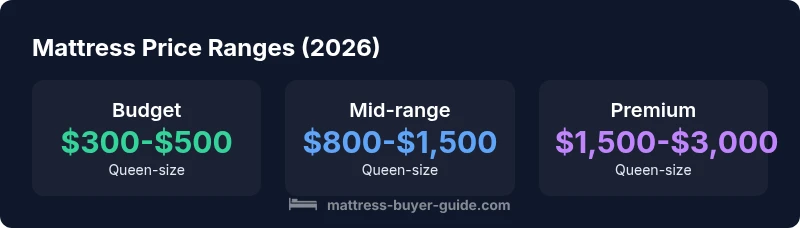
Mattress price in 2026 generally spans from about $300 for basic budget models to $3,000–$4,000 for premium hybrids and luxury latex sets. The majority of buyers pay in the mid-range, roughly $800–$1,500 for queen-sized options. Price depends on type (foam, innerspring, hybrid), size, durability, and warranty. Mattress Buyer Guide analysis shows this broad spectrum helps shoppers budget effectively.
Why Mattress Price Varies: Key Drivers
Prices shift for mattresses because of several intertwined factors that begin with the product’s core materials and end with the retailer’s business model. The Mattress Buyer Guide team notes that the most impactful drivers are: type (foam, spring, or hybrid), size (twin, queen, king), performance features (cooling layers, zoned support, edge-to-edge durability), and the warranty length. Regional supply chains and promotional calendars also push prices up or down seasonally.
When shoppers think about mattress price, they should remember that the upfront sticker price is only part of the total cost. Over the mattress’s life, durability and the cost of replacements or support accessories matter more than a single sale. The Mattress Buyer Guide Analysis, 2026, emphasizes that durable builds with solid warranties frequently yield lower lifetime costs compared with cheaper models that need early replacement. This is why the first step in any price-focused plan is to map out your priorities: are you prioritizing budget, or maximum longevity? According to Mattress Buyer Guide, most buyers end up balancing immediate affordability with long-term value.
Key takeaways from these drivers include: price reflects the total value proposition, not just the initial cost; better materials often justify higher upfront costs; and a longer warranty can improve value through reduced risk.
Price Segments: Budget, Mid-Range, and Premium
In practice, mattress prices cluster into three broad segments. Budget models, typically built with basic foam or standard coil systems, deliver reliable sleep for a low upfront cost but offer shorter lifespans and fewer comfort options. Mid-range mattresses balance cost and durability with improved comfort layers, better edge support, and longer warranties. Premium mattresses use advanced materials (natural latex, high-density foams, pocketed coil systems, or hybrid constructions) and feature enhanced cooling, targeted zoning, and longer warranties. These segments are not rigid; many products blend features across categories, especially in the hybrid and latex markets.
From a pricing perspective, shoppers should define not only the price range they’re comfortable with but also the expected value within that range. Mattress Buyer Guide Analysis, 2026, indicates that mid-range options often deliver the best cost-to-value ratio for most sleepers, with premium models offering the longest lifespan and the least likelihood of premature sagging. The key to choosing within a segment is to scrutinize materials, warranty, and sleep testing policies. When you know your priority—budget versus longevity—you can narrow your search quickly and avoid overpaying for features you do not need.
The Impact of Size: Twin to King and Everything In Between
Size dramatically influences price, because more material and larger dimensions require more resources to manufacture and ship. A typical price ladder shows smaller sizes costing less in absolute terms but not always proportionally; upgrading from a twin to a queen often adds a substantial amount due to additional layers and longer warranty coverage. King-size models can be noticeably more expensive due to larger comfort surfaces and richer cooling or support systems.
For pragmatic budgeting, map your space, sleep needs, and partner compatibility. If you share a bed or require motion isolation for restless sleepers, a higher-price point in queen or king sizes may offer better long-term value. The Mattress Buyer Guide Analysis, 2026, suggests evaluating the price delta against expected lifespan and sleep quality improvements rather than chasing the largest size at the smallest cost.
Material Matters: Foam, Innerspring, Latex, and Hybrids
The choice of core material and comfort layers is the largest determinant of price. Budget foam often keeps sticker prices down but yields shorter lifespans and less robust edge support. Innerspring models provide traditional feel and strong support at moderate prices, while hybrids blend coils with foam or latex for improved contouring and cooling. Latex tends to be among the pricier options due to material costs and durability. Hybrid and latex-heavy constructions sit at the higher end of the price spectrum but can deliver the most consistent long-term support. Across all materials, the quality of foams (density and durability), the coil system (pocketed vs. continuous), and the presence of cooling technologies materially affect price.
The Role of Warranties and Durability in Price
Warranty length and the materials’ durability are often good predictors of a mattress’s long-term value. Higher-priced models frequently come with longer warranties and more durable materials, which translate into fewer sagging issues and fewer replacements over time. When evaluating price, consider the total cost of ownership: a cheaper initial price can lead to higher long-term costs if the mattress fails prematurely and requires replacement. The Mattress Buyer Guide Analysis, 2026, reinforces that prioritizing durability and warranty coverage can improve overall value, especially for households with multiple sleepers or those who expect years of use from their purchase.
How to Budget: A Step-by-Step Approach to Mattress Pricing
- Define your budget range and identify must-have features (cooling, edge support, motion isolation).
- Narrow by size; measure your room and ensure bed height compatibility with sheets and frames.
- Compare core materials and warranty terms across 3-5 candidates per price range.
- Read independent reviews focusing on long-term performance and sag resistance.
- Schedule at-home trials where available and check return policies.
- Look for seasonal promotions but compare total costs, including shipping, returns, and milestones.
- Consider financing options if upfront price is a barrier, but avoid interest-heavy plans.
- Evaluate total ownership costs, including future replacements and accessories like mattress protectors.
Following this framework helps you avoid overpaying while ensuring the mattress price aligns with the expected lifespan and daily comfort. Mattress Buyer Guide reiterates the importance of balancing upfront price with long-term value to achieve sustainable sleep quality.
How to Read Deals Without Compromising Quality
Deals are common around holiday weekends and seasonal promotions, but not all discounts are created equal. When you see a steep price drop, verify the mattress’s construction details, warranty, and return policy. Use price history tools to confirm the deal is genuine and not a temporary promotional blip. Focus on models with durable cores, quality foams, and a fair trial window. If a deal seems too good to be true, it likely needs closer inspection for potential hidden costs (shipping, setup, or restocking fees).
Calculating the True Cost: Hidden Fees and Long-Term Value
To prevent sticker shock, estimate true cost by adding shipping, setup, returns, and potential future replacements to the upfront price. The most valuable mattresses are those that offer a combination of comfort, durability, and a warranty that covers sagging beyond a reasonable threshold. Use a simple calculator: upfront price + shipping + adjustable base or frame costs + 1- to 2-year maintenance supplies, and compare against long-term durability estimates. Mattress Buyer Guide Analysis, 2026, highlights that prioritizing lifetime value over the initial price yields greater satisfaction and savings over time.
Practical Shopping Scenarios: What to Buy on Different Budgets
If you’re buying on a tight budget, seek models with solid warranties and a good trial period, and compare similar-density foams and coil counts to estimate durability. For mid-range budgets, prefer hybrids or better latex blends with longer warranties and cooling features. For those willing to invest, choose premium latex or high-density foam hybrids with advanced zoning, edge support, and extended coverage. In every case, use a side-by-side comparison based on materials, warranty, trial period, and total ownership cost. The Mattress Buyer Guide Team suggests focusing on value over price and validating comfort through sleep tests whenever possible.
Price ranges by mattress category and material
| Category | Typical Price Range (USD) | Key Factors | Best For |
|---|---|---|---|
| Budget foam | 300-500 | Polyfoam core, short lifespan, basic warranty | First-time buyers, guest rooms |
| Mid-range foam/hybrid | 800-1500 | Quality materials, balanced durability, mid-level warranty | Everyday sleepers |
| Premium latex/hybrid | 1500-3000 | Natural materials, premium support, extended warranty | Longevity seekers |
FAQ
What drives mattress price the most?
The largest drivers are the core material (foam, springs, latex), size, and the sophistication of comfort features such as cooling and contouring. The warranty length and build quality also push prices up. Look for value-based decisions rather than chasing the lowest price.
The biggest price drivers are material type, size, and durability. Also check warranty length to gauge long-term value.
Are expensive mattresses worth it?
If longevity and consistent comfort are priorities, a more expensive mattress often pays off through fewer sagging issues and longer warranty protection. For casual sleepers, mid-range models typically deliver most value without the premium price.
They can be, if you value durability and long-term comfort.
When do mattress prices typically drop?
Prices commonly drop during seasonal sale events and holiday weekends. However, not every model will be on sale, so compare across several models and review total costs, including shipping and returns.
Sales happen around holidays, but compare total costs first.
How should I budget for a king-size mattress?
Expect higher prices for king-size options due to larger material needs. Focus on core materials, durability, and warranty, and plan for accessories like a compatible foundation and sheets. Compare at least three king-size options in your budget range.
King sizes cost more—compare materials and warranty, and budget for the foundation.
Do online brands offer lower prices than brick-and-mortar stores?
Online brands often offer lower base prices due to lower overhead, but always account for shipping, returns, and trial periods. In-store experiences can help with testing comfort, but online reviews can guide reliability.
Online can be cheaper, but check shipping and return terms.
What warranty should I expect relative to price?
Higher-priced mattresses usually come with longer warranties that cover sagging and structural issues. A solid warranty (at least 10 years or more for premium models) complements price by protecting your investment.
Longer warranties often come with higher price points and better protection.
“Price is a function of materials, durability, and design. Prioritize comfort and long-term value over the initial discount.”
Highlights
- Understand price drivers to budget effectively
- Mid-range often balances value and longevity
- Size and materials cumulatively impact total cost
- Warranties signal long-term value and durability
- Shop with a plan and compare total cost, not just sticker price