Difference Between a Double Mattress and a Queen
Explore the differences between a double (full) and a queen mattress, including dimensions, room fit, bedding needs, and practical guidance to help you choose the right size.


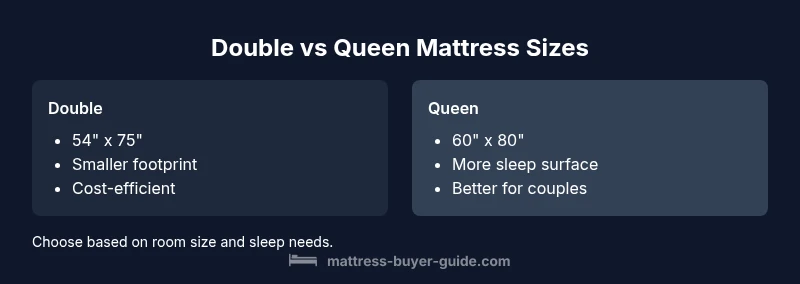
The double mattress (also called a full) measures 54 inches wide by 75 inches long, while a queen is 60 inches wide by 80 inches long. Those extra inches translate into a larger sleep surface for couples or restless sleepers, but a double can be the smarter pick in small rooms or tighter budgets. Understanding the size difference helps you avoid a cramped setup or an overly spacious bed for the room.
What the sizes mean in practice
When shoppers ask about the difference between a double mattress and a queen, they are usually weighing space, comfort, and budget rather than purely color or brand. According to Mattress Buyer Guide, the choice often comes down to how many people will sleep on the bed, how much room is available, and how much you value extra length or width. The Mattress Buyer Guide team emphasizes that the terminology varies regionally: what some markets call a double, others call a full, and a queen remains a universal standard in many countries. Understanding these semantics helps you avoid buying a size that feels cramped or oversized in your bedroom. In this article, we break down the practical implications of each size, from dimensions to daily use.
Dimensional specifics: Double vs Queen
Size matters for how you move, tuck in blankets, and complement other furniture. A double mattress, commonly called a full in the United States, measures about 54 inches wide by 75 inches long (approximately 137 cm by 191 cm). A queen mattress, by contrast, is about 60 inches wide by 80 inches long (≈ 152 cm by 203 cm). Those extra inches translate into noticeable differences in sleep surface area: the queen adds roughly 5.2 square feet of surface. Thickness varies by model, but all else equal, a queen is the roomier option.
Room layout and doorway considerations
Bedroom layout and traffic flow should influence size choice as much as sleeping habits. A queen bed requires more floor space, leaving less room for nightstands, dressers, and walking paths. If you frequently move furniture for cleaning or guests, a double may be easier to maneuver through tight doorways and hallways. Additionally, consider doorway clearance when you move the mattress into the room; the queen’s wider footprint can complicate tight entries in older homes.
Bedding compatibility: sheets, protectors, and foundations
Sheet sets and protective coverings come in standard sizes, and both double/full and queen bedding are widely available. Ensure your fitted sheet pockets are deep enough for your mattress height, and check that your duvet covers or comforters fit your chosen size. Foundations and bed frames should pair with the mattress footprint; most standard frames accommodate both sizes, but you may need a queen-specific frame for a secure fit and balanced weight distribution.
Sleep scenarios: couples, solo sleepers, pets
Solo sleepers who value extra space or taller occupants often prefer a queen for the added width and length. Couples sharing a bed gain significant benefits from the queen’s larger surface area, especially if one or both partners are restless sleepers or if pets join the bed regularly. In smaller bedrooms or guest rooms, a double can still provide comfortable two-person sleep without overpowering the space.
Space, price, and value drivers
In many markets, price per square foot tends to be lower on doubles than on queens, but total cost varies by brand, materials, and features. If you already own a compatible foundation or frame, upgrading to a queen may be a value-driven decision for better sleep quality and future resale value. In tight budgets, the double often provides better upfront cost efficiency and makes it easier to furnish a small room while leaving room for other essentials.
Durability, weight, and handling
Weight varies by materials (innerspring, memory foam, hybrid), but generally, a queen mattress is heavier than a double. This has implications for moving and setup, especially in multistory homes or apartments. A robust mattress protector and a simple lifting technique can protect both sizes during relocation. If you anticipate frequent moves, consider the logistical aspects of handling a larger mattress.
Frame compatibility and foundations
Most modern bed frames support both sizes, but a queen typically requires a frame with a width of 60 inches and a suitable foundation. If you’re using a platform bed or an adjustable base, ensure compatibility with your chosen size. Some frames offer adjustable slats or split options that can accommodate a move from double to queen without major changes.
Maintenance and longevity tips
Regular rotating and annual inspection of the foundation help lengthen mattress life, regardless of size. Vacuum the surface to remove dust and use a breathable protector to reduce moisture and stains. For both sizes, avoid excessive bending or heavy impacts that can compromise the core materials. Proper airflow in the sleep environment supports longevity and reduces odor buildup.
Common myths and misconceptions
A common myth is that bigger is always better for every sleeper. In reality, sleep quality improves when the mattress size matches your body dimensions, sleep position, and room layout. Another misconception is that bigger mattresses are universally harder to move; with the right equipment and helpers, a queen can be relocated just as easily as a double.
Decision framework: a step-by-step approach
- Measure your room and ensure a minimum clearance around the bed for nightstands and movement. 2) Consider who will sleep on the bed and how much space you want for movement. 3) Factor in existing frames, foundations, and accessories. 4) Compare bedding availability and price ranges in your region. 5) Test both sizes if possible, using a showroom or in-home trial.
Quick reference scenarios and recommendations
If you sleep alone in a small room, a double may maximize space and budget. If you share the bed with a partner or pets, or you value extra reach lengthwise, a queen is the safer long-term choice. Always pair your final decision with appropriate bedding and a compatible foundation to ensure even weight distribution and a stable sleep surface.
Comparison
| Feature | Double mattress (full) | Queen mattress |
|---|---|---|
| Dimensions (width x length) | 54 in x 75 in (137 cm x 191 cm) | 60 in x 80 in (152 cm x 203 cm) |
| Sleep surface area | About 4050 square inches (~26.4 sq ft) | About 4800 square inches (~33.3 sq ft) |
| Best for | Small rooms, solo sleepers on a budget | Couples, or solo sleepers who want more space |
| Room footprint | Easier fit in compact bedrooms | Requires more floor space and wider layout |
| Sheet and bedding availability | Widely available in standard full/double sizes | Widely available in queen size |
| Frame and foundation compatibility | Usually fits standard full/double frames | Typically requires queen-size frame or compatible base |
| Weight and handling | Lighter on average | Heavier, especially with high-density foams |
The Good
- Queen provides more sleeping space for couples and restless sleepers
- Double is more space-efficient in small bedrooms and often cheaper upfront
- Both sizes have broad bedding and foundation options
- Easier to move through tight doorways in smaller homes
Cons
- Queen requires more room space and can crowd bedroom layouts
- Double may feel cramped for couples or shared sleeping pets
- Regional availability and pricing can vary, complicating comparisons
- Weight differences can impact setup in multi-floor homes
Queen is the better all-around choice for most couples and medium-to-large bedrooms; double suits stricter space constraints and tighter budgets.
Choose queen for more sleeping space and flexible room layouts. Choose double when space and cost are the primary constraints, and you sleep alone.
FAQ
What is the main size difference between a double and a queen?
The double is 54x75 inches, while the queen is 60x80 inches. The queen offers more width and length, increasing sleeping space for two or more sleepers. This difference affects both room layout and bedding needs.
A queen is notably larger than a double—60 by 80 inches versus 54 by 75. It adds space for two people and pets, but requires more room and sometimes new sheets.
Will a queen be too big for a small room?
In very small rooms, a queen can feel imposing and leave less space for other furniture. If you routinely move around the bed or have limited walking space, a double may be more practical.
In small rooms, a queen can feel too big. If space is tight, a double might be a better fit unless you absolutely need extra sleep surface.
Are the bed frames and foundations interchangeable between sizes?
Most frames and foundations are size-specific. A queen typically requires a queen frame, while a double uses a full/double frame. Some adaptable bases exist, but verify compatibility before purchase.
Frames are usually size-specific, so check that your frame matches the mattress size you choose.
Is a double mattress comfortable for couples?
A double can be comfortable for couples who sleep apart or have a smaller sleeping area. For most couples, a queen provides more personal space and reduces partner disturbance.
A double can work for couples who sleep close, but a queen is generally more comfortable for two adults.
How do I choose between double and queen?
Start with room measurements, considering doorway clearance and furniture. Then assess sleeping arrangements, budget, and long-term needs. If space allows, a queen is often the safer long-term choice.
Measure your room, think about who will sleep on the bed, and pick the size that fits both space and comfort needs.
Do sheets differ between double and queen sizes?
Yes. Double sheets fit 54x75 inch mattresses, while queen sheets fit 60x80 inch mattresses. Ensure you have a matching fitted sheet depth and a compatible protector for the chosen size.
Double and queen sheets aren’t interchangeable; pick the size that matches your mattress.
Highlights
- Measure your room before choosing size
- Consider sleep partners and pets when deciding
- Check frame compatibility and bedding availability
- Balance cost with long-term comfort
- Test sizes if possible before buying