Size King vs Queen Mattress: Which Size Is Right for You?
Compare king and queen mattress sizes to pick the right fit for space, budget, and sleep style. Dimensions, bedding, room layout, and long-term value explained with practical examples.


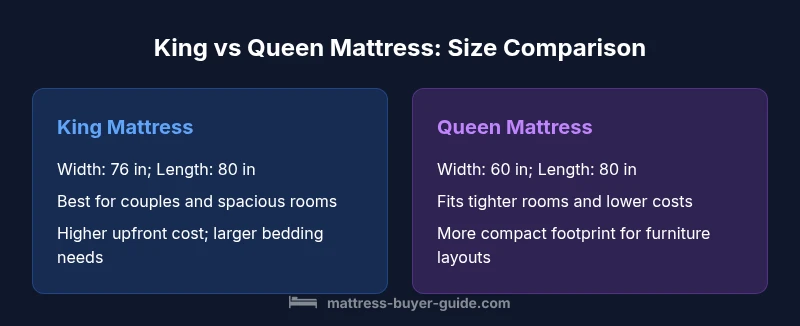
King and queen mattresses differ primarily in width: king is significantly wider, while queen offers a more compact footprint and lower cost. For couples with ample room, a king provides generous personal space; for smaller bedrooms or tighter budgets, a queen can deliver comfortable sleep without crowding. According to Mattress Buyer Guide, space, budget, and future room plans should guide your choice.
Quick sizing guide at a glance
In practical terms, the choice between a king and queen mattress boils down to how much space you need for comfortable sleep and how much room you have in the bedroom. A king offers generous width, which translates to more space for two sleepers to spread out without disturbing each other. The queen, by contrast, fits more easily into smaller rooms, guest rooms, and apartments where space is at a premium. The Mattress Buyer Guide team emphasizes that your decision should account for current and future room configurations, as well as how you and your partner sleep. If you regularly shift positions at night or share the bed with a pet, the extra width of a king can translate into meaningful comfort gains. However, if you’re prioritizing budget or have a compact layout, a queen can still deliver a high-quality sleep experience.
From the perspective of space planning, think of king as a long-term investment in room flexibility, while queen remains a pragmatic choice for space-constrained environments and cost-conscious buyers. The decision becomes clearer when you map out your floor plan and test-fit scale using painter’s tape or a cardboard cutout of the mattress footprint. This hands-on approach is recommended by Mattress Buyer Guide to visualize how much clearance you’ll have for nightstands, dressers, and walking space.
wordCount”:0},
Comparison
| Feature | King Mattress | Queen Mattress |
|---|---|---|
| Dimensions (W x L) | 76 in x 80 in | 60 in x 80 in |
| Bedding Availability | Widely available; king sheets common | Widely available; queen sheets common |
| Room Footprint (approx.) | Larger footprint; suits bigger rooms | Smaller footprint; fits compact bedrooms |
| Best For | Couples who want extra space and movement room | Couples in smaller rooms or on a budget |
| Price Context | Typically higher upfront cost; more expensive bedding | Typically lower upfront cost; cheaper bedding options |
The Good
- More sleeping space for couples and restless sleepers
- Better for tall sleepers and shared sleeping arrangements
- Longer-term room layout flexibility if you upgrade to a larger room
- Greater resale value in some real estate markets
- Fewer disruptions when one partner moves during sleep
Cons
- Higher upfront cost and bedding expenses
- Requires a larger bedroom and more floor space
- Heavier to move and install; delivery considerations
- Proportional increases in sheet and foundation costs
King is the space-forward choice for couples; queen is the pragmatic pick for smaller rooms or cost-conscious buyers.
If your bedroom can accommodate the footprint and you value joint comfort, king is the clear long-term choice. If space or budget is limited, queen provides comfortable sleep with less room required. The Mattress Buyer Guide team recommends weighing room measurements and future space plans before purchasing.
FAQ
What are the exact dimensions of a king vs queen mattress?
A king is 76 inches wide by 80 inches long, while a queen is 60 inches wide by 80 inches long. These fundamental numbers drive bed placement, sheet selection, and nightstand layout.
A king is 76 by 80 inches, a queen is 60 by 80—use these measurements to plan your room.
Which size is better for couples?
For couples who want maximum personal space, a king is usually better. If the bedroom is smaller or you want to manage cost, a queen can still be comfortable with careful layout and thin pads.
If you share the bed, a king often feels roomier; in tight rooms, a queen works with smart placement.
Do I need special sheets for king or queen?
Yes. Use sheets labeled for the correct size: king sheets for king beds and queen sheets for queen beds. Deep-pocket fitted sheets can help with thicker mattresses.
Get the right sheet size—king for king, queen for queen—and consider deep pockets for thicker mattresses.
Is a king mattress worth the extra cost?
That depends on room size and sleep preferences. If you value extra space and reduced partner disturbance, the king can be worth it. In smaller rooms, a queen often provides better overall balance of space and cost.
It can be worth it if space and comfort are top priorities; in small rooms, the queen is usually more practical.
What should I measure in my bedroom?
Measure width and length, plus doorway clearance. Don’t forget to account for nightstands, dressers, and traffic flow. A simple tape measure and floor plan sketch help.
Measure the room and plan for doorways and furniture; this keeps the bed from crowding the space.
Are there size-specific returns or trials?
Most retailers offer mattress trials; confirm size exchange policies and any associated fees before you buy. This protects against sizing misjudgments.
Check the trial policy and size exchange options before purchasing to avoid surprises.
Highlights
- Measure your bedroom before choosing size
- King for space, queen for room-constrained layouts
- Factor in bedding, foundations, and costs
- Consider future room changes and mobility
- Check retailer return policies and trial periods