Difference Between a Full Mattress and a Twin: Size, Comfort, and Fit
A comprehensive comparison of twin and full mattresses, covering dimensions, room layout, bedding, foundations, and real-world use cases to help you choose the right size for your space and sleep needs in 2026.


Here's the TL;DR: A twin mattress saves space and is ideal for kids' rooms or compact apartments, but offers less sleeping area. A full mattress gives more room for one sleeper or two lean sleepers, without going to queen. The choice hinges on room size, sleeping arrangements, and budget. Consider your space and needs before buying.
Understanding the difference between a full mattress and a twin
Choosing mattress size is more than just a matter of space—it affects comfort, sleep quality, and daily living. The difference between a full mattress and a twin is primarily in width and the available sleeping area, which in turn influences who should consider each size. According to Mattress Buyer Guide, making the right choice starts with knowing your space constraints, your typical sleep partner, and how you use the bed. The Twin size, also known as a single, is common in children's rooms, studio apartments, and guest rooms, and it’s designed to maximize floor space. The Full size, sometimes called a double, offers more width while keeping the length the same, which can be a better option for taller sleepers or couples who don’t mind a snug fit. This sets the stage for a deeper dive into dimensions, room layout, and practical decision factors. The Mattress Buyer Guide Team also notes that the right size should align with both lifestyle and space, not just budget.
Size and dimensions: how much space do they actually take?
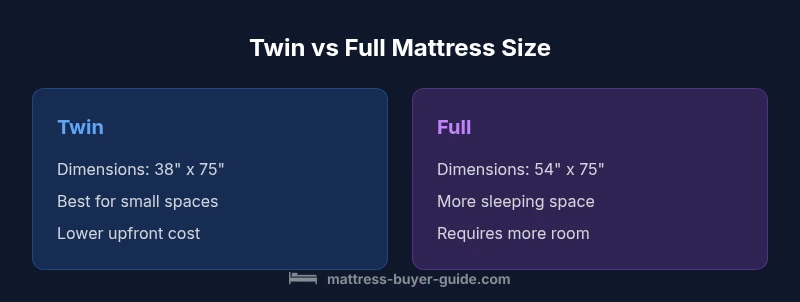
Dimensions matter because they determine how much of your room is left for movement, furniture, and storage. A standard twin mattress measures 38 inches wide by 75 inches long, while a full mattress is 54 inches wide by 75 inches long. In practical terms, the full adds about 16 inches of width compared to the twin, which translates to roughly 2.4 extra square feet of sleeping surface. For many households, that extra width can make a notable difference when sharing the bed with a partner, or simply when maneuvering around nightstands and a dresser in a smaller bedroom. Consider the bed’s orientation in your room—will a full leave you with a comfortable corridor on both sides, or will a twin allow easier access from multiple angles? Mattress Buyer Guide emphasizes visualizing the bed in real terms: lay tape on the floor, measure doorways, and map any potential obstructions before you buy.
Room fit and layout considerations
Space planning begins with a floor plan. In compact bedrooms, a twin can free floor space for a desk, dresser, or wardrobe; in guest rooms that double as a home office, a full can strike a balance between comfort and usability. If you have standard closet space, a full might push furniture slightly, but it also reduces the need to live with a skimpy layout. For bunk beds or shared rooms, twins are popular because they leave extra room for play, study, or storage in the same footprint. However, if the bed is the primary feature of the room, a full can anchor a more balanced arrangement and allow for two people to move around without squeezing past each other.
Sleeping arrangements and comfort implications
Understanding who will sleep on the bed matters as much as the space. A twin is often enough for a single sleeper who values compact living or a child transitioning toward a larger bed. For anyone who shares a bed regularly, or for a taller adult who wants full legroom, the extra width of a full becomes noticeable in practice. The difference in comfort is not only about width; it also interacts with mattress thickness and materials. A full mattress paired with a quality foundation can offer a more comfortable sleep surface for mixed sleep styles (combining side, back, and stomach sleepers) than a twin, simply because you’re not constantly fighting for space. The Mattress Buyer Guide Team emphasizes testing comfort in real-world scenarios before committing.
Bedding, foundations, and frame compatibility
Sheet sets and comforters are sized to the mattress. A twin uses twin sheets, while a full uses full-size sheets; while duvets and blankets are often sold in multiple sizes, compatibility issues arise when mismatched. Foundational support matters too: a twin may pair with lighter foundations or slats; a full often requires sturdier slats or a bigger foundation to prevent sag under heavier sleepers. If you’re renting, consider a bed frame that can adapt to different sizes or a convertible platform that can be adjusted from twin to full. Remember that mattress toppers, protectors, and fitted sheets are a practical way to extend comfort and maintain freshness across sizes.
Longevity, durability, and support differences
Durability in mattresses is driven more by materials, density, and construction than by size alone; however, there are practical implications of choosing a twin versus a full. A full mattress, especially in households with heavier sleepers or more intense daily use, may experience more noticeable wear at a given price point because the larger surface area can interact with body weight distribution. Conversely, a twin mattress can be easier to rotate and flip (where applicable) and often costs less upfront, which can influence long-term value. Material choices—whether memory foam, latex, or hybrid constructions—play a critical role in support and motion isolation. In any case, investing in a mattress with appropriate density and a quality foundation yields better longevity than chasing a minimal price. Mattress Buyer Guide Team analysis shows that value comes from balanced construction and realistic expectations about wear.
Care, maintenance, and cleaning implications
Regular care extends the life of any mattress size. Rotating or flipping (when the design allows) helps maintain even wear. Vacuuming the surface, addressing spills promptly, and using a washable cover can protect both twin and full mattresses. The twin size, due to its smaller surface, can be easier to refresh quickly in a small apartment, while a full may require more time for rotation and vacuuming if you share the bed with a partner. If you have pets or children, consider stain-resistant covers and a plan for washing them. A consistent maintenance routine translates into a longer-lasting sleep surface for either size.
Cost and value: budgeting for twin vs full
Budgeting for mattress size means weighing upfront costs against long-term comfort and sleep quality. In general, twin mattresses are less expensive than fulls, particularly when comparing entry-level materials; higher-end twin models can approach mid-range full prices, depending on features like cooling technologies and premium foams. The full size, by virtue of its greater sleeping width, often delivers a more versatile sleeping surface for single users who value space and for couples who don’t want to compromise on legroom. When evaluating value, consider not only the price of the mattress but also the cost of a compatible foundation, sheets, and the potential need for additional bedroom furniture. Mattress Buyer Guide recommends balancing initial price with durability and comfort to maximize longevity.
Real-world scenarios: who should buy which size?
This section translates theory into everyday decisions. In a studio apartment with limited floor space and a single sleeper, a twin mattress typically wins for practicality. For a growing child’s room that could eventually host a friend or a teen, a twin can adapt as a transitional bed. A guest room that occasionally hosts couples benefits from a full, offering more room without the footprint of a queen. If you’re upgrading from a crib or a twin to a larger size in a shared space, a full becomes a natural next step. Finally, in a home office suite, a full bed can double as a daytime seating area while still supporting overnight guests when needed. The choice hinges on how you live in the space and how much bed surface you want at night.
How to measure your space and decide
Measuring the room and the bed’s footprint is a practical method for avoiding mismatches. Start by measuring the length and width of the sleeping zone, leaving space for a nightstand, a dresser, and at least one clear path around the bed. Check door swings and window placements to ensure you can move the bed in and out. Create a simple floor plan, then place scaled outlines of twin and full footprints on the map to visualize how they would live in real life. Add a ruler or tape measure for alignment checks of rug edges and furniture clearance. Finally, account for your ideal sleeping posture, postural support needs, and temperature control; while room layout matters, personal comfort is the deciding factor. Mattress Buyer Guide’s approach is to combine measurements with practical living needs.
Common misconceptions debunked
Many shoppers assume that a bigger bed always equates to better sleep; size alone cannot fix poor support, pillow quality, or a matted mattress. Others think a twin is only for children; in reality, a well-chosen twin can support adults in small spaces, while a full may feel too big in extra-small rooms. Some buyers assume that all memory foam feels the same; density and layer construction influence feel and support, not size. Understanding these nuances helps you look beyond the hype and pick a bed that aligns with your daily habits and sleep goals.
Practical shopping checklist and final notes
Before you buy, use this concise checklist to avoid pitfalls: confirm the exact dimensions of the bed frame and doorway; verify bedding compatibility (sheets, duvet covers, mattress protectors); assess the warranty and return policy; compare materials across brands; and test sit-and-sleep in-store or via trial periods when possible. If you’re unsure about whether a twin or full is right, start with a floor plan and a mattress you know you’ll use daily. Remember to consider future needs, such as children growing into larger rooms or a shift in guest-use frequency. Bottom line: pick the size that best fits your space, your budget, and your sleep preferences, and don’t rush the decision.
Comparison
| Feature | Twin Mattress | Full Mattress |
|---|---|---|
| Dimensions (L x W) | 38 x 75 inches | 54 x 75 inches |
| Sleep surface area (approx.) | ~2,850 in² (~19.8 ft²) | ~4,050 in² (~28.1 ft²) |
| Best for | Small rooms, kids' rooms, and single sleepers | Singles who want extra space or couples on a budget |
| Bed-frame compatibility | Twin frames, bunk beds, standard twin foundations | Full frames, standard full foundations |
| Bedding compatibility | Twin sheets, blankets, duvet (twin size) | Full sheets, blankets, duvet (full size) |
The Good
- Twin size is space-saving and budget-friendly for smaller rooms or kids' rooms
- Full size provides more sleeping area and is better for solo sleepers who want extra comfort
- Sheets and bedding come in widely available sizes, reducing replacement costs
- More versatile with frames and day-to-day layout in rented spaces
Cons
- Twin may feel cramped for adults or in shared sleeping situations
- Full requires more room and can constrain furniture placement in tight spaces
- Value depends on brand and materials; low-end options may wear faster
Full-size is generally preferable for comfort and shared use; twin is best for compact spaces and tight budgets.
Choose full when you regularly sleep with a partner or value extra width; choose twin when space is paramount or you’re outfitting a child’s room.
FAQ
What is the main size difference between a twin and a full mattress?
The twin is 38x75 inches while the full is 54x75 inches, giving the full an extra width of 16 inches.
Twin is narrower at 38 by 75 inches, while a full is wider at 54 by 75 inches, offering more sleeping space.
Can I use a twin on a full-size frame?
Twin mattresses are sized for twin frames, so they do not fit securely on a full frame without adapters or modification.
Twin mattresses usually don’t fit properly on full frames; stick to twin frames or compatible setups.
Are twins comfortable for couples?
A twin can be uncomfortable for couples who move a lot or value space; a full or larger is typically better for shared sleep.
For couples, a bigger size is usually more comfortable.
Do full mattresses cost significantly more than twins?
Prices vary by brand and materials; generally full-size mattresses cost a bit more than twins, but deals and sales change the math.
Prices vary a lot; expect a bit more for full than twin, depending on materials.
What should I consider for a child transitioning from a crib?
A twin is common for kids transitioning to a bed, while a full may be a longer-term option if space allows.
Twin is a good transition bed that lasts years, until a larger size is needed.
What bedding sizes should I buy?
Buy sheets and covers in twin or full sizes matching the mattress; keep a few protectors handy for spills.
Get the right size sheets for your bed, twin or full.
Highlights
- Measure your space before shopping
- Twin saves space; full adds bed area
- Consider future needs like growing bedrooms or guest use
- Budget for bedding and foundations, not just the mattress