Hard Mattress vs Soft Mattress: An Analytical Guide
A rigorous, data-driven comparison of hard vs soft mattresses, covering firmness definitions, sleep position effects, body weight considerations, materials, testing methods, and buying tips to help you choose with confidence.


Hard mattress vs soft mattress represents two ends of a spectrum in feel, support, and durability. Firm surfaces typically promote spinal alignment for back and stomach sleepers, while softer surfaces prioritize contouring and pressure relief for many side sleepers. The best choice balances support, comfort, materials, and cost, tailored to your weight and preferred sleep posture.
What the terms mean in practice
In the context of consumer mattresses, hard mattress vs soft mattress describe distinct feel categories rather than a universal standard. The phrase hard mattress vs soft mattress captures a spectrum of firmness, from rigid, minimal-sinkage surfaces to plush, contouring foams. According to Mattress Buyer Guide, the choice hinges on how your body interacts with the surface, your weight, and your typical sleep posture. For most adults, the difference is not merely comfort—it is about balance between support and pressure relief, maintaining proper spinal alignment while reducing joint stress. This section will set the stage for a data-driven, practical evaluation.
Firmness and spinal alignment: the structural rationale
The spine prefers a neutral alignment: neither overly arched nor propped into a rigid curve. Firmness interacts with resting posture to influence the support under the lumbar region and the pelvis. A hard mattress tends to resist sinkage, which can keep the lumbar spine aligned for heavy people or strict back sleepers, but may push into the hips for side sleepers. Conversely, a soft mattress allows more contouring around shoulders and hips, which can support the natural S-curve for side sleepers but may permit sagging in the lower back for heavier individuals. The bottom line is that firmness is a tool for maintaining sagittal balance, not a fixed label of quality. Use your body weight and typical posture as the guiding metrics.
Pressure relief and sleeper-specific needs
Pressure relief is not a one-size-fits-all feature. For people with painful shoulders, hips, or joints, a softer surface can reduce painful pressure points by allowing the body to sink slightly into the mattress. However, too much sinkage can lead to misalignment, especially for heavier sleepers or those who sleep on their stomachs. A firmer surface reduces sinkage and distributes weight across a broader area, which can alleviate pressure on the joints that rest directly on the bed. The best approach is to consider the contact points of your body—the hips, shoulders, and sacrum—and how the mattress distributes pressure across those points without creating new hotspots or sag. In practice, many shoppers test a mid-range firmness first and adjust based on observed comfort over a few nights.
Material implications: innerspring, memory foam, latex
The actual feel is not just about the label 'hard' or 'soft'; it's shaped by the core material and its layering. Innerspring or hybrid constructions often feel firmer due to coil support, yet can combine with soft comfort foams on top for a balanced feel. Memory foam tends to cushion and contour, producing a softer feel at rest but can feel firmer to active sleepers depending on density and layering. Latex offers buoyant, responsive support that can feel firmer than memory foam but still allow contouring at pressure points. The interaction of core and comfort layers determines whether a mattress feels hard or soft in practice, and it also affects durability, temperature regulation, and motion transfer. When evaluating a mattress, examine the layer order, density, and how the surface responds to shifting weight.
Sleep position and weight: who should choose what
Sleep position and body weight are the two strongest predictors of the appropriate firmness range. Back sleepers often benefit from medium to firm levels to support the lumbar region; stomach sleepers typically prefer firmer surfaces to prevent the hips from sinking. Side sleepers usually lean toward softer surfaces to cushion the shoulders and hips. Lighter individuals can feel comfortable on slightly firmer surfaces if the top layer softens to their weight, while heavier individuals may experience adequate support on a firmer bed that resists excessive sag. This dynamic explains why many users undergo a functional trial period when buying a mattress, to verify alignment and comfort across several nights.
Durability, lifecycle costs, and long-term comfort
Hard mattresses built with dense cores or spring systems tend to resist wear and sagging longer than very soft foams, but not all firmer mattresses perform equally. Soft mattresses with high-density foams can also offer durability if designed with robust edge support and quality covers. The key is not just the surface feel but how the core responds to ongoing load, temperature, and motion. A mattress that remains comfortable for five to ten years will typically balance support and pressure relief across a wide user base. Budget-conscious shoppers should factor in the potential need for replacement buffers or toppers to preserve the intended feel without paying for premium materials upfront.
Temperature, motion isolation, and edge support considerations
Temperature control can differ markedly between hard and soft beds. Some firmer, coil-based models promote airflow and reduce heat buildup, whereas dense memory foams on a soft mattress can trap heat if not designed with cooling technologies. Motion isolation tends to be stronger on softer foams and hybrids with memory foam layers, benefiting couples who share a bed. Edge support—how well the perimeter holds up—often increases on firmer mattresses or those with reinforced edges, while soft foam edges may compress under weight. When evaluating a mattress, look for claims such as temperature regulation features, edge reinforcement, and motion isolation ratings by the manufacturer.
How to test firmness at home and a decision framework
The most practical method to determine whether a mattress feels hard or soft for you is a structured at-home test. Start with a two-week trial when possible and vary positions during testing, noting any sustained discomfort or alignment issues. Use a simple scoring rubric: support under the lower back, shoulder and hip comfort, and overall sleep calm. Transitions between positions should feel natural, not abrupt, and you should not wake with joint pain. If you collide with a mattress that seems comfortable in the first night but causes stiffness later, you may be dealing with an inappropriate firmness profile for your unique biomechanics.
Practical testing plan: four-week decision path
Step 1: Identify your main sleep position and weight class; Step 2: Narrow to two firmness categories; Step 3: Use trial periods and record daily comfort; Step 4: Decide based on cumulative score and durability expectations. This plan helps you avoid buyer's remorse and ensures you pick the firmness that aligns with spinal health, pressure relief, and overall sleep quality.
Comparison
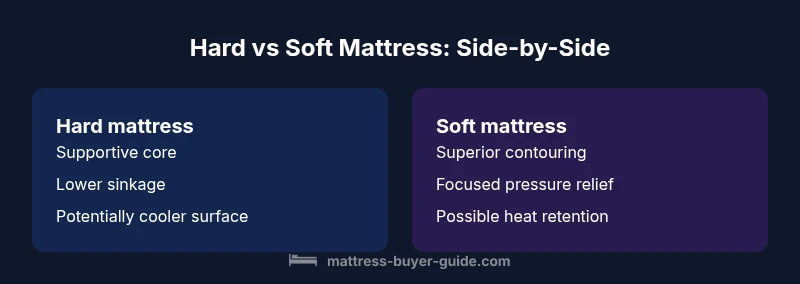
| Feature | Hard mattress | Soft mattress |
|---|---|---|
| Support and contour | Firm, minimal sinkage; promotes neutral spine for some back/stomach sleepers | Pronounced contouring; comfortable cradle for shoulders/hips |
| Pressure relief | Good general support with limited pressure point sinking | Excellent pressure relief for targeted joints, especially shoulders and hips |
| Durability / longevity | Often durable with robust cores; less risk of sag under even weight | Can wear in more visible ways over time if foam layers deform |
| Motion transfer | Depends on core; some coils transfer more motion | Typically superior motion isolation with memory foam or dense foams |
| Temperature regulation | Airflow-friendly if coil-based; tends to stay cooler in many setups | Dense foams can trap heat without cooling systems |
| Edge support | Often stronger edges with reinforced construction | Edges may compress more on soft foam designs |
| Best for sleepers | Back/stomach sleepers; heavier individuals may prefer this feel | Side sleepers; lighter individuals seeking contouring |
| Price range (qualitative) | Mid-range to high, depending on core | Mid-range to high, depending on materials and density |
The Good
- Typically supports neutral spine alignment for the right sleeper type
- Often more durable with a solid structural core
- Clear baseline feel that customers can rely on for consistency
- Good foundation for reinforced edge support and accessories
Cons
- Can feel too rigid for many side sleepers seeking cushion
- Less contouring may reduce immediate pressure relief for some users
- Potential for heat retention in dense foam configurations
Hard mattresses generally provide better spinal alignment and durability for many back/stomach sleepers, while soft mattresses excel at pressure relief for side sleepers.
Choose hard if you prioritize long-term support and edge stability. Choose soft if your priority is contouring comfort and shoulder/hip relief. Base your choice on weight and sleep position, then validate with a testing window.
FAQ
What exactly is a 'hard' mattress vs a 'soft' mattress?
A 'hard' mattress emphasizes minimal sinkage and firm support to keep the spine aligned. A 'soft' mattress contours more to the body, providing cushion and pressure relief at joints. The line between them is defined by feel, materials, and construction rather than a universal hardness scale.
Hard means less sinkage and firmer support; soft means more contouring and cushion. The right choice depends on your weight and sleep position.
Which firmness is best for back sleepers?
Back sleepers typically benefit from medium to firm options that support the lumbar region without causing excessive pressure at the hips. The goal is to maintain a neutral spine throughout the night.
Back sleepers usually do well on a medium to firm mattress that supports the lower back.
How does weight affect the ideal firmness?
Weight influences how deeply you sink into a mattress. Heavier individuals often need firmer surfaces to prevent sag, while lighter individuals may feel comfortable on slightly softer beds that still support the spine.
Weight changes how much you sink in; heavier people tend to prefer firmer interiors.
Can a mattress feel hard and soft at the same time?
Yes. Some mattresses use dual layers that feel firmer in the core while offering a soft surface. This can balance support with localized pressure relief, depending on density and materials.
Some beds balance a firm core with a soft top layer for mixed feel.
How long should firmness last before a replacement is needed?
Firmness tends to hold for several years, but comfort can shift with wear, temperature, and weight distribution. Monitor for persistent sinking, sagging, or changing sleep quality and plan replacements as needed.
If the bed starts sagging or you wake uncomfortable, it may be time to reassess.
What role does temperature play in the feel of hard vs soft mattresses?
Temperature affects how materials respond; firmer coil cores often stay cooler, while dense memory foam can trap heat if not designed with cooling features. Look for breathable layers and cooling technologies in whichever type you choose.
Cooling features matter for comfort, especially with foam.
Are there hybrid options that feel both firm and soft?
Yes. Hybrids combine a firm support core with softer comfort layers to achieve a balance between support and contouring. They can adapt to different sleeping positions with a well-engineered layer stack.
Hybrid beds mix firmness and plush layers for balance.
Highlights
- Identify your primary sleep position before choosing firmness
- Heavier sleepers often fare better on firmer surfaces
- Soft mattresses offer superior pressure relief for side sleepers
- Durability and temperature performance depend on material choice
- Use at least a short home test to confirm alignment and comfort