Memory Foam Mattress vs Spring: An In-Depth Comparison
A detailed, analytical comparison of memory foam vs spring mattresses, examining comfort, cooling, durability, motion isolation, and value to help you choose the best option for your sleep needs.


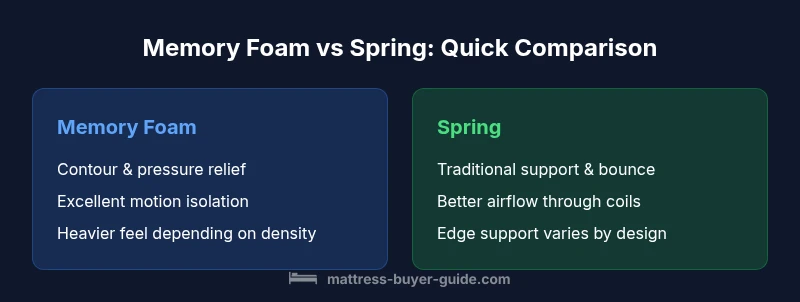
Memory foam mattresses excel in contouring, pressure relief, and motion isolation, while spring mattresses deliver traditional support, bounce, and edge stability. For couples or light sleepers, memory foam often reduces motion transfer; springs tend to sleep cooler and feel more responsive. In short, memory foam is ideal for cradling comfort and quiet sleep, whereas spring surfaces favor lift, airflow, and traditional feel.
Introduction: What memory foam mattress vs spring means for sleep
The choice between memory foam mattress and spring designs shapes how your body feels at night, how you move, and how long you stay asleep. When evaluating memory foam mattress vs spring, you’re weighing contouring comfort, edge support, temperature behavior, and long-term value. According to Mattress Buyer Guide, the most successful selections balance personal comfort with sleep goals and budget. In this guide, we unpack the differences between these two primary mattress technologies, explain how each type works, and translate that into practical buying criteria. By the end, you’ll know which path aligns with your sleep needs—whether you crave under-pressure sink-in comfort or classic, buoyant support. This analysis uses neutral criteria and real-world testing considerations, so you can compare models without marketing fluff. Remember that every sleeper is unique, and a carefully chosen mattress is more important than a brand name.
The core materials and how memory foam works
Memory foam mattresses are built from viscoelastic foam that softens under heat and pressure, allowing the upper comfort layer to contour to your body. The density and layering determine feel: a softer top yields hugging pressure relief, while firmer layers resist sinking too deeply. Because memory foam relies on body heat to soften, it tends to cradle hips and shoulders, align the spine in many sleeping positions, and reduce motion transfer. The material’s slow response delivers a cushioned, sink-in sensation that many people associate with comfort. However, density also affects durability and temperature behavior; foams with higher density typically last longer and resist indentation, while lower-density foams may feel temporary or allow quicker body impressions. When shopping memory foam, look for lines such as open-cell structures for breathability and cooling technologies, which can help mitigate heat retention for sleepers who sleep warm.
The core materials and how spring mattresses work
Spring mattresses rely on coil systems to provide support, often supplemented by comfort layers such as foam or fiber. Coil type and arrangement influence bounce, edge support, and responsiveness. Traditional Bonnell or offset coils offer a sturdy baseline, while pocketed coils provide independent movement and reduced motion transfer in some designs. The spring core determines how supportive the surface feels across the sleep surface and along the edges. In many models, the coils are paired with multiple foam or latex layers to balance contouring with lift. The durability of a spring mattress often hinges on coil quality, gauge, and the perimeter support system. Because air can circulate more readily through the coil structure, springs can feel cooler than full foam surfaces—though some modern foams include cooling features to address this advantage. When selecting a spring mattress, consider the coil count or density in combination with the top layers to gauge overall feel.
Comfort and contouring: memory foam vs spring
Contouring is the hallmark of memory foam: you sink gently into the top layers and your curves are supported by a conforming surface. For people who carry more weight in hips and shoulders or who want to minimize pressure points, memory foam often excels. Springs, by contrast, offer more lift and a responsive feel. They can translate small adjustments into noticeable changes in position, which some sleepers prefer for alignment. Note that many modern hybrids blend both technologies to try to capture the benefits of contouring plus bounce. The firmness rating is not universal across brands; a medium-firm memory foam can feel different from a medium-firm spring due to how the top layers interact with the support core. In practice, you should test both types with your typical sleeping position and weight to judge whether sinking sensation or buoyant lift better supports your spine.
Motion isolation and partner sleep
Memory foam is renowned for minimizing motion transfer; the dense foam often absorbs movement so a partner’s turning is less noticeable. This makes memory foam a popular choice for couples with different sleep schedules or sensitive sleepers. Springs tend to transmit more motion unless they are high-quality pocketed coil designs with substantial edge support. Hybrids or multi-layer builds can mitigate this by isolating motion in the comfort layers. The practical takeaway: if your bed is shared and you want undisturbed sleep, memory foam (or a high-quality hybrid) is usually preferable; if you want a more immediate reaction to movement and easier edge-to-edge access, a spring-based surface may be better.
Temperature regulation and cooling considerations
Foam can trap heat because of its dense structure; however modern memory foams often integrate gel, graphite, or open-cell technology to improve airflow. Temperature regulation varies by density, cell structure, and additional cooling layers, so some memory foam mattresses sleep cooler than older designs. Springs naturally allow better air circulation through the coil system, which can contribute to a cooler night for many sleepers. Yet the overall temperature also depends on the cover, padding, and any cooling tech used in the top layers. A key practical step is to choose a breathable cover and a configuration that incorporates cooling elements, such as phase-change materials or ventilated foams. If you sleep hot, look for explicit cooling claims and real-world reviews focusing on temperature performance.
Durability and long-term value
Durability in memory foam depends on density, compression resistance, and the quality of the cover and support layers. In many cases, higher-density memory foam offers better longevity, though early impressions of firmness can change with time. Spring mattresses longevity hinges on coil durability, edge support, and the construction of the comfort layers. Pocketed coils can maintain shape longer than traditional Bonnell designs, especially when paired with high-quality foams. Overall, the long-term value comes from balancing upfront cost, comfort preferences, and how well the mattress maintains support and feel after years of use. While memory foam often shows less sag in the early years with proper care, springs require perimeter reinforcement to prevent rolling off the edge.
Edge support and easy movement on the surface
Edge support matters for couples sharing the bed, sitting on the side, or sleeping near the edge. Memory foam surfaces can feel more compliant near the edges, which might reduce the effective sleeping area. Some buyers compensate with higher-density top layers or reinforced edge supports, but this adds cost. Spring mattresses with perimeter coils or reinforced edges typically deliver firmer edge support, making it easier to sit or lie near the edge without compressing the surface. The trade-off is that certain hybrid designs may compromise edge feel if they prioritize comfort layers over rigid perimeter support. In practice, test edge-to-edge comfort and consider whether you primarily sit at the edge or sleep near it. Your choice can influence your waking experience, especially if you share the bed with a partner who often sits or sleeps toward the border.
Maintenance, care, and lifespan extension
Maintenance habits affect both foam and spring mattresses; following manufacturer instructions for foundations and covers prolongs life. Regular cleaning and rotation are simple steps that reduce uneven wear. For memory foam, keep the top surface clean and allow air to circulate through breathable covers; for springs, rotate the mattress and ensure the foundation remains stable to prevent sag. If the mattress has a removable cover, wash it according to care labels to preserve the surface. Spills should be absorbed promptly and cleaned with appropriate cleaners to avoid stains; avoid harsh chemicals. Finally, investing in a high-quality foundation or base can reduce wear and maintain alignment. With good care, memory foam and spring mattresses can serve several years of comfortable sleep.
How to test memory foam vs spring: a practical approach
If you can, test both mattress types in-store using a neutral setup—lie on your back, side, and stomach in a few positions for several minutes each. Take notes on contouring, support, and temperature sensations. If you’re buying online, look for models with robust trial periods and clear return policies, so you can sleep on the mattress at home and assess long-term comfort. Focus on how the surface feels under your hips and shoulders, how easily you move, and whether you wake with any stiffness. A methodical hands-on test combined with real-world trial periods typically yields the most reliable decision.
Shopping framework: how to decide with confidence
Create a decision matrix based on your priorities: pressure relief, cooling, motion isolation, edge support, durability, and price. Rate a few candidate models for memory foam and spring options against those criteria, then narrow to a couple of finalists. Read independent reviews that discuss long-term performance, not just initial feel. Finally, use trial periods to validate your choice in your bedroom environment and foundations. A thoughtful, data-backed approach reduces uncertainty and helps you select a mattress that supports your sleep quality over time.
Comparison
| Feature | Memory foam mattress | Spring mattress |
|---|---|---|
| Construction | Viscoelastic foam layers; density matters | Coil-based core (varies by design); sometimes pocketed coils |
| Comfort & contour | High contouring; hugs shapes and joints | More lift and buoyancy; varies by coil quality |
| Motion isolation | Excellent motion isolation; sleepers stay undisturbed | Moderate to good; better with high-quality pocketed coils |
| Temperature/cooling | Can trap heat without cooling layers; needs cooling tech | Typically cooler due to airflow through coils |
| Edge support | Edge performance depends on top layers; some soft edges | Often strong edge support with reinforced perimeters |
| Durability | Durability hinges on foam density and wear resistance | Durability hinges on coil quality and perimeter design |
| Maintenance & lifespan | Regular cleaning; density-driven longevity | Regular rotation; coil and layer quality dictate lifespan |
| Best for | Side sleepers seeking contouring and pressure relief; quiet sleep | Couples wanting bounce, edge strength, and airflow |
The Good
- Excellent pressure relief and contouring
- Strong motion isolation for peaceful sleep
- Wide range of firmness and layering options
- Can be combined in hybrids for balanced feel
Cons
- Foam can trap heat without cooling features
- Some foams may off-gas briefly and feel heavy
- Edge feel can be softer on some memory foam designs
- Spring options vary; cheaper coils may sag sooner
Memory foam excels in comfort and motion isolation; springs excel in airflow and edge support
Choose memory foam if you value cradling contour and minimal motion transfer. Opt for springs if you prefer a cooler surface, energetic feel, and strong edge support. For many buyers, a balanced hybrid offers the best of both worlds.
FAQ
Which mattress type offers better pressure relief?
Memory foam generally provides superior contouring and pressure relief, especially for side sleepers and those with joint discomfort. However, the level of relief varies by density and layering, so testing is essential. Springs can offer relief when paired with soft comfort layers, but the sensation tends to be more buoyant than enveloping.
Memory foam often delivers the best pressure relief due to its contouring. Test densities to find your ideal balance of hug and support.
Do memory foam mattresses sleep hot?
Some memory foam designs sleep warmer because foam spaces air poorly. Modern memory foams incorporate gel, graphite, or open-cell structures to improve cooling. If temperature is a concern, look for explicitly stated cooling features and user reviews focused on cooling performance.
Yes, memory foam can sleep hot unless cooling features are built in. Look for explicit cooling claims and reviews.
Is memory foam durable for long-term use?
Durability depends on foam density and construction quality. Higher-density memory foam tends to resist sagging longer, but overall longevity also depends on the foundation and care. For reliable long-term performance, verify density specs and warranty terms.
Density matters for longevity. Check density and warranty to gauge long-term durability.
Are memory foam and spring mattresses good for stomach sleepers?
Stomach sleepers often benefit from firmer surfaces that promote spinal alignment. Memory foam can feel overly soft if not paired with a firm top layer, whereas some spring mattresses provide a stable, supportive feel. Testing remains essential to ensure proper neck and back alignment.
Stomach sleepers typically need firmer support; test for alignment and comfort to avoid neck strain.
How should I test memory foam vs spring in-store?
Test both types by lying on your back, side, and stomach for several minutes in each position. Pay attention to contouring, bounce, and feel near the edges. If you’re shopping online, rely on trial periods and straightforward return policies to replicate this in your home.
Test in-person with your three sleeping positions; ensure you have a good trial period if buying online.
Can I combine memory foam with springs in a hybrid?
Yes. Hybrids blend memory foam or other foams on top of a spring core to balance contouring with lift and airflow. The exact feel depends on the ratio and quality of the top layers, so try multiple hybrids to find the right mix.
Hybrids try to mix contouring with bounce. Test several to find the best balance for you.
Highlights
- Prioritize motion isolation for couples and light sleepers
- Consider cooling features if you sleep hot
- Check edge support and foundation compatibility
- Test both types in real sleeping positions
- Factor in warranty and trial periods when budgeting