Twin Mattress Size vs Full: A Practical Side-by-Side Guide
A rigorous, objective comparison of twin mattress size vs full, covering dimensions, space implications, sleep scenarios, costs, and practical buying guidance for homeowners, renters, and shoppers planning their next mattress upgrade.


Short answer: Twin mattresses maximize usable floor space and are ideal for single sleepers in compact bedrooms, while fulls offer more surface area for restless sleepers or occasional couple use. According to Mattress Buyer Guide, the twin mattress size vs full decision centers on room dimensions, nightly movement, and future needs such as a potential upgrade. Read on for specifics and a side-by-side comparison.
Twin vs Full: What they are and who they’re for
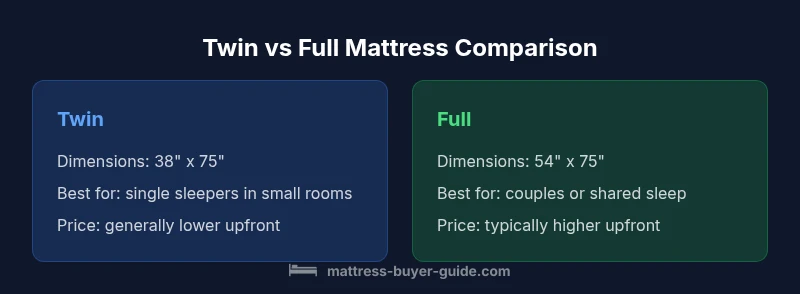
A twin mattress measures 38 inches wide by 75 inches long, while a full mattress measures 54 inches wide by 75 inches long. The twin is the most space-efficient option, commonly chosen for children’s rooms, dormitories, and small bedrooms where a second occupant isn’t expected. The full, by contrast, provides significantly more sleeping surface while remaining manageable in medium-sized rooms. The decision between the twin mattress size vs full hinges on two core realities: the amount of floor space you can dedicate to a bed and how you sleep in practice. For someone who moves a lot at night or shares the bed occasionally, the extra width can make a meaningful difference in comfort. According to Mattress Buyer Guide, when space is at a premium, twins win on footprint; when you anticipate sharing or growing comfort needs, the full earns ground. This section sets the stage for a deeper dive into dimensions, room layouts, and practical buying considerations.
Dimensional differences and space implications
The 38" x 75" footprint of a twin is well-suited to narrow bedrooms, bunk setups, and guest rooms where a single sleeper uses the space efficiently. A full at 54" x 75" consumes more real estate but delivers roughly 40% more surface area, a meaningful increase for people who shift positions or sleep with a partner on occasion. If you’re measuring a bedroom for a bed, the width difference translates into valuable space for a nightstand, dresser, or walking room. From a layout perspective, twins leave longer wall space for desks or closets, whereas fulls can constrain traffic flow but improve sleeping comfort for two. When evaluating the twin mattress size vs full, think about whether the room can accommodate the wider footprint without feeling cramped, and whether you want to preserve floor space for other furniture or activities. Mattress Buyer Guide notes that the space trade-off is often the deciding factor between these sizes, especially in urban apartments or compact guest rooms.
Comfort, support, and sleep surface considerations
The sleep surface is the most immediate comfort factor in choosing between twin and full. A twin’s narrower surface can be adequate for petite individuals or those who prefer to sleep in a single position, but it offers less side-to-side motion room for restless sleepers. The full provides more shoulder-to-hip space, which can reduce contact with a partner and minimize rolling into the other person at night. For back and stomach sleepers, both sizes can perform well with appropriate mattress type (innerspring, memory foam, or latex), but the larger width of the full can better accommodate alignment for side sleepers who requiremore lateral space. When evaluating the twin mattress size vs full, prioritize your typical sleeping position, body size, and whether you share the bed. The goal is to match the surface area to your preferred sleep quality and movement patterns.
Room layouts and real-world setups
Layout practicality becomes critical when you’re constrained by doorways, windows, or closet space. A twin can fit more easily into narrow rooms and fits well with a compact nightstand or under-window placement. In a child’s room, twin often enables a longer desk or play area beside the bed. A full, while larger, often pairs better with a standard dresser and a slightly wider nightstand, creating a more balanced sleeping zone in a medium-sized bedroom. If you’re decorating a shared guest room, consider how frequently you’ll host two adults and what furniture arrangements you’ll allow. The twin’s compact footprint may simplify rearrangements, while the full may demand a thoughtful floor plan to preserve walkways and access. Twin mattress size vs full is ultimately a question of space, usage, and future flexibility.
Cost considerations and total value
Price is a practical factor in the twin vs full decision. In most markets, twins tend to be less expensive upfront than fulls, making them attractive for students, first apartments, or budget-conscious buyers. However, the long-term value should consider durability, bedding needs, and potential resale value. A full may carry a higher initial cost but offer more utility in a shared bedroom or growing household, potentially reducing the need to upgrade soon. When evaluating the twin mattress size vs full, model pricing across different brands and materials matters just as much as the size itself. Look for sales, bundles, and warranty terms to assess total ownership cost over several years.
Upgrade paths and future-proofing
If you anticipate a future shift—such as a growing family, a move to a shared room, or a preference for more flexible guest accommodations—a full bed is more “future-proof.” It survives longer as a primary bed in a variety of living spaces and tends to retain resale value better than a twin in many markets. Conversely, a twin can be easily relocated to other rooms or converted for use as a daybed, making it a flexible tool for sparse floor plans. In the twin vs full decision matrix, consider where you expect to be in 3–5 years and how your sleeping needs may evolve; your longer-term needs can tilt the balance toward the full.
Buying considerations: foundations, sheets, and accessories
Both sizes share common foundational needs—box springs or foundations, bed frames, and compatible sheets. The twin size uses twin sheets and a twin foundation, while the full uses full-sheet sets and a corresponding foundation. If you already own a bed frame or plan to move furniture between rooms, ensure the frame and foundation are compatible with your chosen size. Bedding accessories tend to be widely available for both sizes, but it’s wise to verify depth specifications for fitted sheets and mattress protectors. As you weigh the twin mattress size vs full, factor in the cost and availability of these accessories, as they influence overall ownership experience.
Practical measurement checklist and layout planning
Before finalizing your choice, measure the intended room space and doorways to confirm the bed will fit with at least 2 feet of clearance on either side for nightstands and movement. Create a simple layout sketch to visualize how a twin or full will sit within the room, noting the position of windows, outlets, and radiators. Use painter’s tape to mark the footprint on the floor for a real-world sense of scale. If possible, test sleep comfort by lying on models of each size in-store or at a showroom, focusing on mobility and space around the bed. By stepping through these measurements and comfort tests, you’ll reduce the risk of purchasing a bed that feels cramped or restricts daily living.
Quick decision framework: who should choose which size
If you live alone, have a compact room, and want to maximize living space, the twin is usually the better choice. If you regularly share a bed or expect to upgrade your living situation within a few years, the full provides more room to maneuver and a calmer night’s sleep. For children transitioning into adolescence, a twin bed can be a logical step before upgrading to a full later on. Use a simple scorecard that weighs space, budget, and future needs to determine the most reasonable option. This framework aligns with Mattress Buyer Guide’s evidence-based approach to mattress sizing.
Conclusion and how to proceed (buying steps)
Armed with a clear understanding of space, cost, and future needs, you’re ready to choose between twin and full. Start by measuring your room, check furniture layouts, and compare local price ranges and warranty terms. Use the decision criteria outlined above to guide your selection, then verify that your frame, foundation, and bedding are compatible with the chosen size. If you still feel uncertain, consider starting with a twin in one room and reserving a future upgrade path to full as needs evolve.
Comparison
| Feature | Twin mattress | Full mattress |
|---|---|---|
| Dimensions (inches) | 38 x 75 | 54 x 75 |
| Best for | Single sleepers in small rooms | Couples or shared sleep occasionally |
| Space footprint | More floor space available | Less floor space available due to wider width |
| Estimated price range | Lower upfront cost | Higher upfront cost (varies by brand and material) |
| Accessory compatibility | Widely available with twin sheets and foundations | Widely available with full sheets and foundations |
| Upgrade potential | Easier to move between rooms or repurpose | Better long-term versatility for two sleepers |
The Good
- Space-saving design ideal for small rooms
- Lower upfront cost and easier to budget
- Easier to move or relocate between rooms
- Widely available with accessories and foundations
Cons
- Less surface area for two sleepers on a regular basis
- Less future-proof for growing households or shared use
- Can feel cramped for taller individuals sharing a bed
Twin for space-conscious singles; full for couples or future-proof versatility
If you prioritize maximizing floor space and sleeping alone, choose a twin. If you anticipate sharing sleep or upgrading rooms later, opt for a full for longer-term comfort and flexibility.
FAQ
What are the exact dimensions of a twin mattress?
A twin mattress measures 38 inches wide by 75 inches long. This size is designed for single sleepers and compact rooms. If space is tight, a twin can help maximize floor area for other furniture and movement.
A twin mattress is 38 by 75 inches, best for one person in a small room.
What are the exact dimensions of a full mattress?
A full mattress measures 54 inches wide by 75 inches long. It provides a broader sleeping surface and can accommodate two sleepers more comfortably than a twin, though it takes more room overall.
A full mattress is 54 by 75 inches, offering more width for two people when needed.
Is a twin mattress big enough for two people?
Generally not ideal for two adults on a regular basis. A twin can work for occasional guests or a very petite couple, but most couples prefer a full or larger.
A twin isn’t usually suitable for two adults most nights.
Are twin and full sheets interchangeable?
No. Twin sheets and full sheets have different dimensions and fitted depths. If you select a twin, buy twin-sized sheets and a twin foundation; for a full, use full-sized sheets and a compatible foundation.
Twin and full sheets are not interchangeable; match sheets to the mattress size.
What factors other than space should influence my choice?
Sleep position, height, and whether you expect to share the bed at times matter. Your room layout, existing furniture, and budget also influence the decision.
Think about sleeping style, room layout, and budget alongside space.
What size is better for a child’s room versus an adult guest room?
A twin is often ideal for a child’s room due to space efficiency, while a full is better for a guest room where two adults may sleep when needed.
Twin suits kids; full is a better guest-room choice.
Highlights
- Measure room dimensions before choosing size
- Consider current and future sleep needs
- Twin saves space; full offers more surface area
- Account for bedding and foundation compatibility
- Plan upgrade path if you expect changes in living arrangements