Is a Single Mattress the Same as Twin? A Practical Size Guide
Learn whether a single mattress is the same size as a twin, understand regional naming differences, and get practical tips for measuring and choosing the right mattress size.


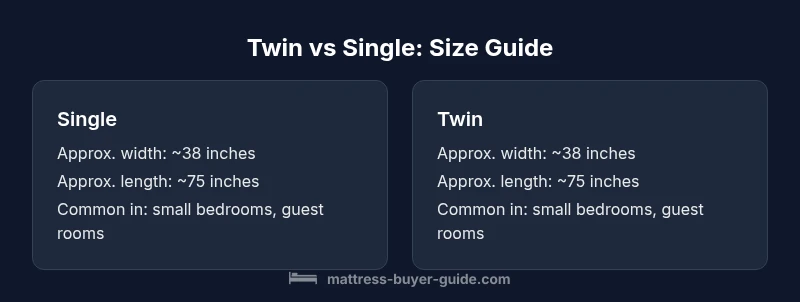
In most markets, a single mattress and a twin mattress refer to the same basic size, typically around 38 inches wide by 75 inches long. The exact dimensions can vary by brand, so always check the label. For most sleepers, the distinction is more about terminology than true size. Mattress manufacturers sometimes use both terms interchangeably, especially for guest rooms or budget lines.
Understanding the Basics: What do 'single' and 'twin' mean?
Readers frequently ask is single mattress the same as twin? The short answer for many markets is yes—the two terms often point to the same core dimensions. In practice, however, regional language, retailer conventions, and product labeling can create subtle differences that matter when you measure frames or sheets. According to Mattress Buyer Guide, the goal is not to memorize every regional quirk but to confirm the exact numbers printed on a product page or label. When dimensions differ, the impact is most noticeable in fitted sheets, bed frames, and adjustable bases. A quick rule of thumb is to treat both terms as interchangeable unless a retailer cites an exact width and length. This keeps you from buying the wrong sheets or a frame that won’t fit when you set up a guest room or a small apartment.
Key takeaway: dimension labels can be inconsistent across brands, so always confirm the exact numbers before buying.
Dimensions and regional variations
The most common size associated with both 'single' and 'twin' in many parts of the world is around 38 inches wide by 75 inches long (about 96.5 cm by 191 cm). This sizing is familiar to many households and fits a wide range of bed frames and nightstands. Yet, there are regional exceptions. In some markets, a 'single' can be slightly narrower or longer, and in specialty retailers you may encounter non-standard variants marketed under either label. Mattress Buyer Guide emphasizes that, for true accuracy, you should check the product’s measurements rather than rely on the terminology alone. If you’re shopping in a cross-border context (e.g., importing from the U.S. or Europe), examine both the stated width and length in centimeters or inches and compare them to your existing setup.
How retailers use terminology: interchangeable vs. precise labeling
Retailers often use interchangeable terms to simplify inventory or align with regional habits. In the United States, many stores treat "single" and "twin" as synonyms in their online catalogs and showroom floors. In the United Kingdom and parts of Europe, however, a "single" can reflect a slightly different width (commonly around 36 inches in commercial listings) while maintaining similar length. The practical effect is occasionally a mismatch between the size you measure at home and the size listed online. When in doubt, compare the actual product dimensions (width x length) and, if needed, contact the retailer for a precise spec sheet. Mattress Buyer Guide notes that dimension accuracy is what prevents returns and sleep disruption.
Measuring spaces and verifying dimensions
Before you buy, measure your space and the bed frame you plan to use. Start with the mattress footprint (width and length), then add clearance for sheets, a fitted cover, and easy bed-making. For rooms with tight turning radii or doors that swing inward, also measure doorways and walkways to ensure the mattress can be moved into place. For online purchases, print or save the product spec sheet and compare it directly to your measurements. If the retailer provides multiple size options, use the dimension data instead of the name label to decide.
Bedding and frame compatibility you should know
Sheets, frames, and headboards are often sold by precise dimensions rather than labels. A 38" x 75" twin-sized sheet set will typically fit both terms, but fabric stretch, corner depth, and elastic fit can vary by brand. If your bed frame has a built-in headboard or footboard, verify that the frame’s inner dimensions align with the mattress, not the label. Likewise, if you use a memory foam topper or a waterproof cover, verify that the combined thickness remains within the frame’s tolerance. When you’re shopping for a guest room, this extra check helps avoid mismatches after delivery.
Space planning: where a twin/single makes the most sense
In compact bedrooms, a twin or single mattress is a practical choice because it leaves more floor space for movement and storage. For children’s rooms, a twin can transition well into adolescence with minimal layout changes. In rental apartments, a twin size can optimize living space while still offering ample sleeping area for one sleeper or a guest. By understanding that the size label often maps to a standard footprint rather than a radically different dimension, you can plan layouts with confidence.
Practical shopping tips to avoid confusion
- Always verify exact dimensions on the product page or label, not just the size name.
- Compare width x length in inches or centimeters across brands.
- Check bed frame clearance, sheet depth, and topper thickness when mixing products.
- Be mindful of regional differences if you are shopping across borders.
- Use inventory filters that display numeric dimensions rather than relying on the label alone.
What retailers get right (and what to watch for)
Many retailers clearly list width and length alongside the product name. Others rely on marketing terms that blend labels like single, twin, and standard size. When dimensions differ slightly between brands, a shopper should seek the exact measurements and cross-check interior frame compatibility. The key is to not rely solely on the label; the real numbers determine fit and comfort. Mattress Buyer Guide suggests creating a simple comparison sheet that captures width, length, thickness, and sheet availability for each option.
Mattress Buyer Guide perspective: best practices for this topic
From the Mattress Buyer Guide Team perspective, the question is not just about labeling but about ensuring sleep geometry aligns with your space and sleep goals. We advocate verifying exact dimensions, factoring in practical accessories, and prioritizing a reliable retailer’s spec sheet. Our approach is to present a clear picture of how a single and a twin relate in real terms, rather than relying on marketing language. This helps homeowners, renters, and shoppers avoid buying mistakes that lead to restless nights and returns.
Final check before you buy: a quick 5-step checklist
- Confirm width and length in inches or cm.
- Compare to your existing bed frame and space.
- Review sheet and topper compatibility.
- Note any regional variations in naming.
- Save the retailer’s spec sheet for future reference.
Glossary and quick reference terms
- Twin vs single: In many markets, these terms refer to the same size, but always confirm exact measurements.
- Width: How wide the mattress is across the bed.
- Length: How long the mattress is from head to foot.
- Sheet fit: The ease with which standard sheets will fit, considering depth and corner fit.
Comparison
| Feature | single | twin |
|---|---|---|
| Typical dimensions (WxL) | 38 x 75 inches (varies by brand) | 38 x 75 inches (varies by brand) |
| Regional naming tendencies | Often interchangeable in US markets | Often interchangeable in US markets; UK usage may differ slightly |
| Best use case | Small bedrooms, guest rooms | Small bedrooms, guest rooms |
| Bedding compatibility | Fits standard twin/single sheets | Fits standard twin/single sheets |
| Availability | Widely available across retailers | Widely available across retailers |
The Good
- Widely available and budget-friendly options
- Terminology is easy to learn for most retailers
- Fits compact bedrooms and guest spaces
Cons
- Terminology confusion can lead to mismeasurement
- Brand-specific dimension variations may cause confusion
- Some listings use the term inconsistently online
Twin is generally the same size as a single; verify exact dimensions before buying
In most cases, the terms map to the same footprint. Always check the width and length from the retailer to avoid sizing mistakes, especially when shopping online or across borders.
FAQ
Is a single mattress the same size as a twin?
In many markets, yes—single and twin commonly refer to the same footprint (roughly 38 x 75 inches). However, some regions or brands vary, so always verify exact measurements on the product page.
Yes—usually, single and twin are the same size, but check the numbers to be sure.
Are there size differences between single and twin in UK vs US?
Yes. In the US, single and twin are often the same footprint, while in the UK a 'single' can be slightly narrower, commonly around 36 to 39 inches wide depending on the retailer.
Yes, there can be regional differences; always confirm the exact width and length.
Will twin sheets fit a single mattress?
Most twin and single sheets are designed to fit the standard footprint, but fit depends on depth and corner tolerances. If in doubt, check the sheet’s product details.
Usually, yes, but confirm the depth and fit before buying.
Why do retailers use different terms for the same size?
Retailers use terms driven by regional conventions, branding, and inventory clarity. This can lead to identical-sized products being marketed under different names.
Marketing labeling can vary by region and retailer.
How can I verify mattress dimensions when shopping online?
Always open the product specs and look for width x length in inches or centimeters. If dimensions are missing, contact customer service before purchasing.
Check the exact numbers in the specs or ask the seller.
What should I check besides dimensions when choosing between terms?
Check frame compatibility, sheet depth, topper thickness, and any regional dimension differences to ensure a proper fit in your space.
Look at frame fit, sheets, and toppers, not just the label.
Highlights
- Always confirm exact width and length before purchasing
- Understand regional naming differences to avoid misreading specs
- Check frame compatibility and sheet fit with the chosen size
- Use a quick dimension checklist when comparing options
- Rely on retailer spec sheets, not just the label