Pocket Spring Mattress vs Foam: A Comprehensive Comparison
Compare pocket spring and foam mattresses to decide which sleeps best for you. Explore core construction, comfort, temperature, durability, and price to guide your buying decision.


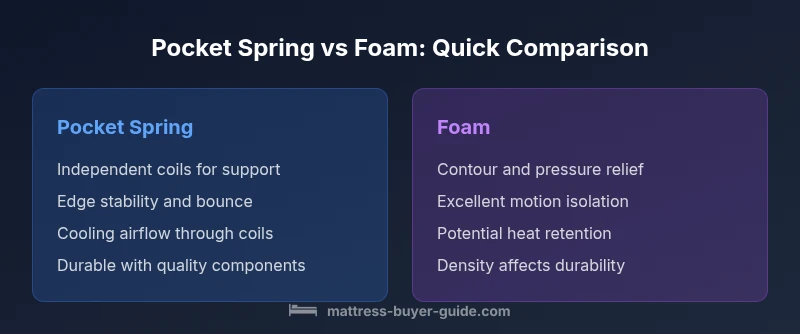
Pocket spring mattress vs foam: pocket-spring models combine independent coils for solid support and edge stability, often with cooler sleep, while foam mattresses excel at contouring, pressure relief, and quiet motion isolation. If you share a bed or want rebound with durable edges, pocket springs are a solid pick; if you value deep contouring and minimal partner disturbance, foam is a strong alternative. Mattress Buyer Guide notes the trade-offs clearly.
What is a pocket spring mattress?
A pocket spring mattress uses individually wrapped coils (pocketed coils) that respond to each area of the body. Because the coils are enclosed in their own fabric pockets, each spring can move independently, which reduces motion transfer and allows targeted support for the hips, shoulders, and lower back. The edge of the mattress is typically reinforced by a strong perimeter, giving you a usable sleep surface all the way to the edge. Air can circulate between the coils, which can contribute to cooler sleeping conditions compared with some solid foam designs. The overall feel is often buoyant and responsive, with a noticeable lift that makes it easier to move and reposition. For heavier sleepers or couples, pocket springs tend to distribute weight more evenly and resist sag over time, provided the coil count and quality are adequate. According to Mattress Buyer Guide, well-constructed pocket spring systems offer durability and reliable support when paired with quality comfort layers.
What is a foam mattress?
Foam mattresses rely on foam layers—typically polyurethane foam, memory foam, or latex—to provide contouring and pressure relief. The surface shape follows your body, which can reduce pressure on shoulders, hips, and knees. Memory foam adds a slow-responding feel that minimizes motion transfer, making it popular among partners and light sleepers. Latex foams offer a middle path with bounce and resilience, while polyfoams can be more budget-friendly. The density and thickness of the foam determine durability and support: higher density foams tend to hold shape longer but may be heavier and more insulating. Foam mattresses can sleep warmer unless designed with cooling gels, open-cell structures, or breathable covers. Foam’s uniform surface can feel very plush or very firm depending on the layer arrangement and density, and some sleepers experience less “sleep surface bounce” than with springs.
Core construction: pocket spring vs foam
Pocket spring systems center around a coil layer; each coil is wrapped, allowing independent movement. A comfort layer—foam, latex, or wool—sits on top to provide contour, pressure relief, and a preferred feel. By contrast, foam mattresses suspend support in one or more foam layers, sometimes with a transition layer before a denser support core. The foam core can be zoned to provide targeted support for different body areas. With the right configuration, a foam mattress can deliver excellent contouring and motion isolation, but it can also trap heat if cooling features aren’t included. The choice of foam density and coil count (in hybrids) largely determines how the bed performs over time.
Comfort profiles: feel, bounce, and contour
Pocket springs tend to deliver a buoyant, responsive feel with noticeable bounce and consistent support across the surface. The feel can vary from plush to firm, but most people perceive a more lighter, springy sensation and a robust sitting edge. Foam mattresses, especially memory foam, emphasize contouring and pressure relief, creating a cradling sensation that molds to curves. This can enhance spinal alignment for some sleepers but may feel slower to rebound after movement. Latex foams blend bounce with contouring and often offer a middle ground between springy and sink-in sensations. Your preferred feel—bouncy versus contouring—will strongly influence which type suits you best.
Edge support and motion isolation
Edge support is typically stronger on pocket spring models due to the perimeter coil reinforcement, which helps prevent sag along the edges of the bed. This makes the full surface usable for sitting or sleeping near the boundary. Foam beds vary in edge support, depending on foam density and construction; less dense foams can feel less stable at the very edge, though high-density foams and reinforced edge structures improve performance. When it comes to motion isolation, memory foam and high-density foams excel at dampening movement, making it easier to sleep through a partner’s motions. Pocket springs can also offer good motion isolation, especially when paired with dense comfort layers, but not to the same extent as closed-cell memory foams in some setups.
Temperature regulation and climate considerations
A key differentiator is how heat is managed. Pocket springs promote airflow between coils, which can help sleepers stay cooler in many setups. The top comfort layers still matter, but the open structure generally promotes breathability. Foam beds can sleep warmer, particularly if the foam layer is high in body-conforming memory foam; however, many brands now incorporate cooling gels, phase-change materials, and breathable covers to mitigate heat retention. If you tend to overheat at night, a pocket spring foundation with a breathable top layer or a latex option may be more comfortable, whereas foam with cooling technologies can also work well for hot sleepers.
Durability, wear patterns, and longevity
Durability hinges on materials and build quality. Pocket spring mattresses with a high coil count and robust edge support tend to maintain shape for many years, though sag can occur if coils degrade or if comfort layers compress. Foam beds rely on foam density and the integrity of the cover and stitching; high-density foam generally lasts longer and resists indentations, though some foams may experience slow recovery or foam breakdown with heavy use. In both cases, the longevity is influenced by factors like frame stability, nightly load, bedding temperatures, and how well the mattress is rotated (where applicable). For a clearer estimate, consult the warranty terms and manufacturer guidelines for your chosen model.
Price, value, and warranty considerations
Price typically scales with materials, density, and build quality. Pocket spring mattresses span a wide price range—from affordable entry-level options to high-end hybrids—reflecting coil count, pocket quality, and comfort-layer materials. Foam mattresses also vary, with budget polyfoam often cheaper than high-density memory foam or latex constructions. In many markets, long-term value is boosted by reliability, support, and warranty coverage. When evaluating price, consider long-term cost per year, durability, and the potential need for a compatible foundation. A robust warranty can also provide peace of mind, especially if you anticipate heavy use or motion from a partner.
Sleep position and body weight guidance
Back and stomach sleepers often benefit from stable support and a surface that resists excessive sag; pocket springs can deliver durable support across the surface, particularly with firmer configurations. Side sleepers may prefer foam’s contouring to relieve shoulder and hip pressure, though a well-designed pocket spring with a soft or medium comfort layer can also work well. Heavier sleepers may notice less sink and better edge support on pocket spring beds; lighter sleepers may enjoy the cradling feel of memory foam or latex foams. When choosing, align firmness with your weight and preferred sleeping position for the best results.
In-store testing tips and online trials
The best way to compare pocket spring vs foam is to test both in person, ideally on a bed frame similar to your own. Lie down for at least 10-15 minutes in your typical sleep position, paying attention to support, contour, and edge feel. Compare the boundary during edge testing, and consider how the bed responds to shifting positions. If shopping online, request a trial period to evaluate comfort at home; use the trial to simulate your nightly routine and note how you sleep with temperature changes, partner movement, and varying room temperatures.
Practical buyer tips: what to look for in specs
Look for coil count and coil type in pocket springs—more coils and smaller windings generally indicate better weight distribution and durability, provided the rest of the construction is solid. For foam beds, density (pounds per cubic foot) and the density of transition and support layers matter for durability and support. Check the cover material, edge reinforcement, and whether cooling features are included. Consider your room climate, bedtime routine, and whether you prefer a springy or contouring feel. Don’t forget to verify compatibility with your bed frame or foundation and read warranty terms for coverage details.
Comparison
| Feature | Pocket Spring Mattress | Foam Mattress |
|---|---|---|
| Core construction | Pocketed coil system with independent springs | Foam core (polyfoam/memory foam) |
| Feel and bounce | Responsive, with more lift and bounce | Contour-focused, varies with density |
| Edge support | Typically strong due to coil frame | Edge support varies; can be weaker in lower-density foams |
| Motion isolation | Good, but coils can transmit some vibration; enhanced with dense comfort layers | Excellent, especially with memory foam |
| Temperature regulation | Airflow through coils improves cooling | Heat retention possible; cooling features help |
| Durability | Durable with quality coils and layers | Durability depends on foam density; high-density foams last longer |
| Maintenance and lifespan | Rotate and rotate if dual-sided; longevity depends on build | Density and cover quality influence lifespan; may require less rotation |
| Estimated price range | Mid-to-high; varies by coil count and materials | Low to mid; high-end foams can be expensive |
| Best for | Sleepers who want edge support, bounce, and cooler sleep | Sleepers who want contouring and motion isolation, especially couples or light sleepers |
The Good
- Excellent edge support improves usable surface
- Good durability with proper components
- Wide firmness options and longevity potential
Cons
- Foam can trap heat without cooling features
- Memory foam may feel slow to recover
- Pocket springs can be heavier and pricier; edge sag risk with low-quality builds
Pocket spring mattresses are the go-to for durability and edge support; foam excels at contouring and motion isolation.
Choose pocket springs if you want a buoyant feel and reliable edge support. Choose foam if you prioritize pressure relief and minimizing partner movement, then test firmness and validate density and cooling features before buying.
FAQ
What is the main difference between pocket spring and foam mattresses?
Pocket spring mattresses use a system of individually wrapped coils that provide support and bounce, while foam mattresses rely on foam layers to contour to your body. The primary difference is in weight distribution and surface response.
Pocket springs use coils for support and bounce, while foam uses contouring layers. Your choice depends on edge support and bounce versus deep contouring.
Which sleeps cooler, pocket springs or foam?
Pocket spring systems generally promote airflow through the coil cavity, aiding cooling. Foam can sleep warmer unless designed with cooling features.
Pocket springs tend to sleep cooler due to airflow; foam can be warmer without cooling tech.
Is foam better for pressure relief?
Memory foam and other high-density foams offer strong pressure relief by contouring to curves. Some sleepers prefer springs for a more buoyant feel with adequate support.
Foam is great for pressure relief; springs distribute pressure differently but can still be supportive.
How long do pocket spring and foam mattresses last?
Durability depends on materials and build quality. High-quality pocket springs and high-density foams both offer long lifespans if the components stay intact and the bed is well-supported.
Durability varies by quality; both can last many years with good components and proper support.
What should I test when trying mattresses in-store?
Lie in your typical sleep position for 10-15 minutes, compare edge feel, and note how the surface responds to movement. Bring a partner to compare options.
Spend 10-15 minutes lying in your usual position and check edge feel and motion.
Do I need a specific foundation for pocket springs or foam?
Most mattresses require a sturdy, compatible foundation. Check manufacturer guidance and ensure your base supports the chosen mattress type.
A solid foundation is important for both, follow manufacturer guidance.
Highlights
- Define your priority: edge support vs contouring
- Test bounce and motion transfer in-store
- Check coil count and foam density for durability
- Consider cooling features for hot sleepers
- Compare warranties and long-term value